

Ferda Mestek was one of the strangest characters in Prague’s history, an impresario who became famous for creating a flea circus, promoting hundreds of tiny performers, and turning an extraordinary business idea into a story remembered by Prague writers long after his death.
He called himself Ferda Mestek de Podskal, connecting his name to Podskalí, the historic Prague district where he was born. He was not a hereditary nobleman, but rather a self-invented showman who understood something remarkably well: people will pay to see something they believe might be extraordinary.
His story includes approximately 300 fleas, miniature bicycles and carriages, angry customers, a formidable wife, the writers Jaroslav Hašek and Egon Erwin Kisch, and even a theatre production created years after his death.
And, of course, there was the flea circus.
Watch the story of Ferda Mestek on Instagram, from his unusual flea circus and theatrical tricks to his connections with Prague writers and the strange spectacles that made him memorable.
For more weird stories like this, check our article 16 Strange & Dark Stories in Prague Locals Don’t Tell Tourists.
Who Was Ferda Mestek?
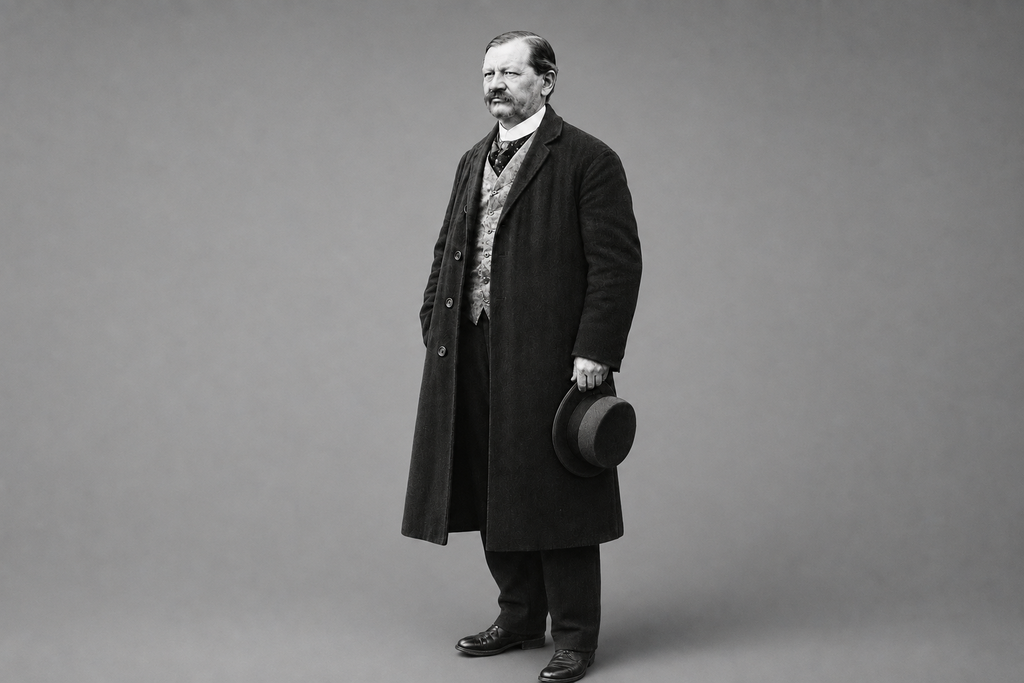
Ferda Mestek, whose full name was Ferdinand Mestek, was born on 17 March 1858 in Podskalí, Prague.
His father, Václav Mestek, was a tailor’s journeyman. Ferda’s own working life was much less predictable. Historical records connect him with several occupations, including gold working, entertainment and public-house businesses. Research into his life also identifies the Podskalí showman as an impresario, a profession that fits the colorful career for which he later became known.
He married Anna Huf in 1899.
Rather than following one ordinary profession throughout his life, Mestek moved between different ventures and forms of entertainment. This entrepreneurial, theatrical personality eventually led him toward the business that made his name unforgettable:
a circus for fleas.
Ferda Mestek and His Unusual Businesses
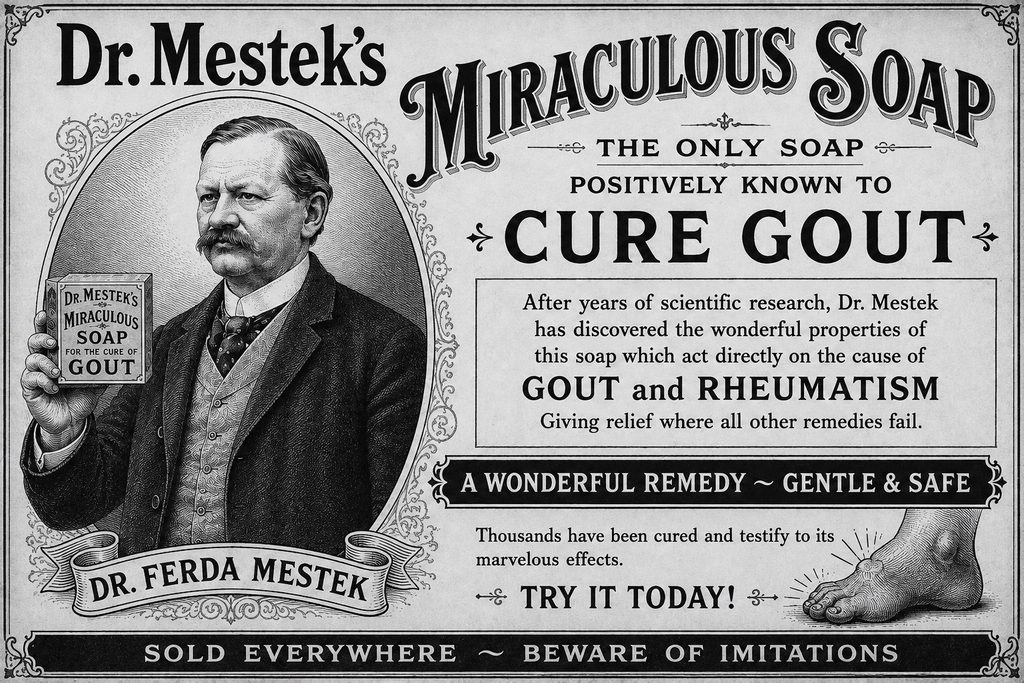
Before his flea circus became famous, Ferda Mestek was involved in other unusual commercial ventures.
According to Egon Erwin Kisch‘s account, Mestek travelled around selling supposedly miraculous products, including lemonade advertised as protection against cholera and soap claimed to cure gout.
The business eventually failed because customers bought the products on credit and did not pay.
Kisch also preserves a humorous story involving Anna. She supposedly remarked that Mestek had such bad luck that if he opened a funeral business, nobody would die.
This is one of the many entertaining episodes in Kisch’s account of the flea circus king. It is best understood as part of the literary portrait Kisch created around a man he knew and wrote about, rather than as an independently verified event.
But it captures something important about Ferda’s reputation. He was always looking for the next unusual idea. And eventually, he found one that was almost impossible to beat.
Ferda Mestek’s Flea Circus
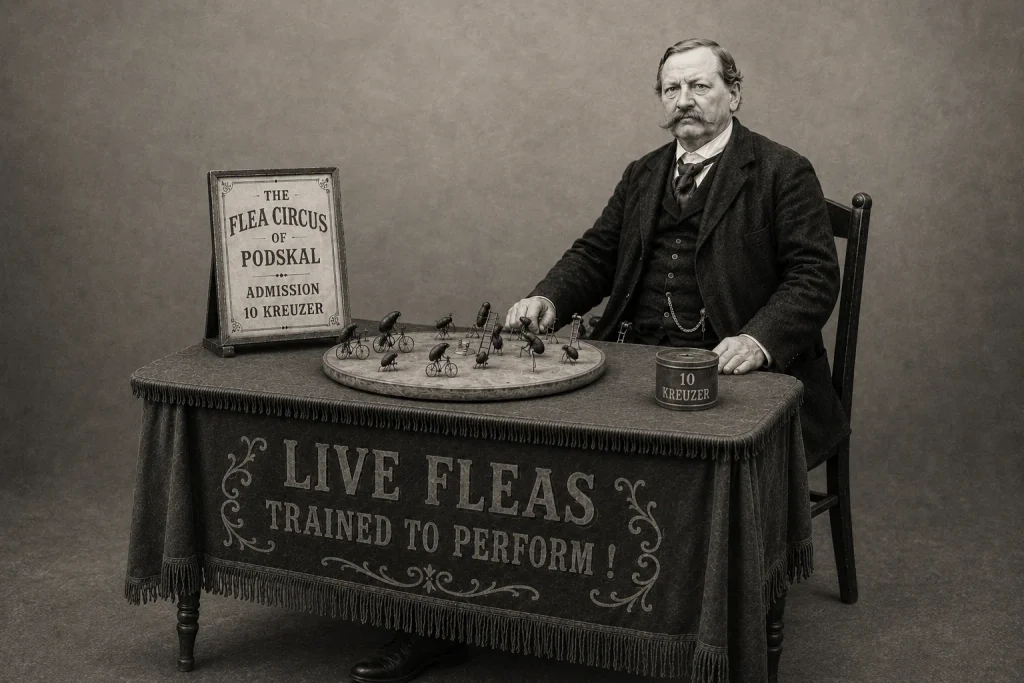
At some point, the impresario began creating his famous flea theatre.
He advertised for fleas and began collecting them from people who brought them to him.
According to Kisch, Ferda Mestek de Podskal eventually had around 300 fleas.
Three hundred tiny performers might sound like an absurd number, but Ferda treated them as a genuine theatrical company.
He divided them into different groups and created individual performers and acts.
Among the fleas mentioned by Kisch were Lo and Hedda, described as conjoined flea twins, and Miss Nudlička, presented as a kind of star performer.
The fleas were not simply displayed. Ferda created an entire miniature world around them.
What Did Ferda Mestek’s Fleas Do?
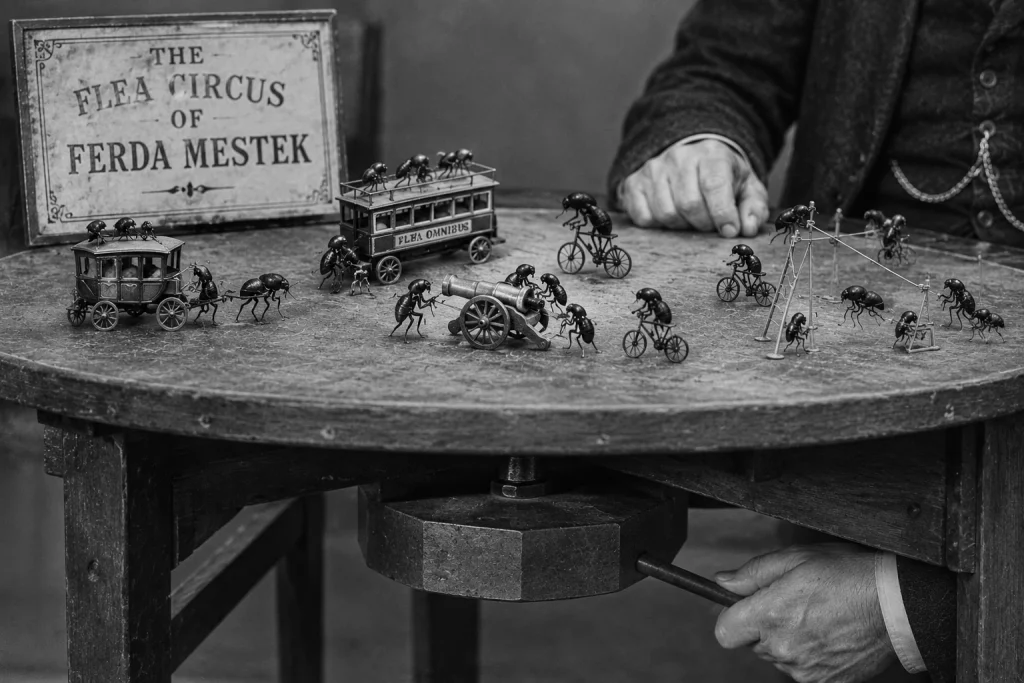
The Ferda Mestek flea circus included miniature equipment designed to create the impression of spectacular performances.
There were:
Tiny carriages
Omnibuses
Bicycles
Cannons
Other miniature props
Kisch also describes various flea performances and theatrical tricks. One particularly important detail is that some of the apparent movement could be produced using a magnet hidden beneath the table.
The result was exactly what a good showman wanted. The audience saw tiny vehicles moving and could believe that the fleas were responsible.
Ferda was not simply exhibiting insects. He was creating an illusion. And he knew how to advertise it.
The Flea Circus Becomes a Spectacle
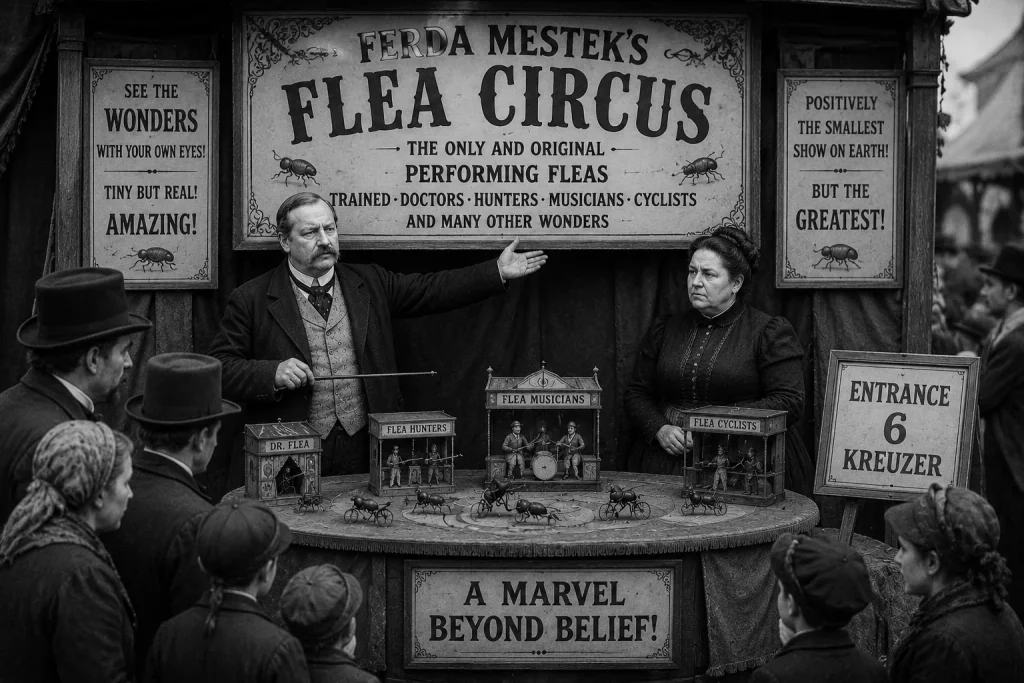
Mestek’s advertising was part of the performance.
According to Kisch, the flea theatre was surrounded by elaborate claims about its performers and organization. There were supposed flea doctors, hunters, musical performers and other elements designed to make the tiny circus appear much more sophisticated than its size suggested.
The entrance fee was reportedly six kreuzer. For the audience, the attraction was not simply the fleas themselves.
It was the promise that they were about to witness something extraordinary.
That promise was one of the Prague showman’s greatest talents.
The Ferda Mestek Customer Who Had Seen Nothing
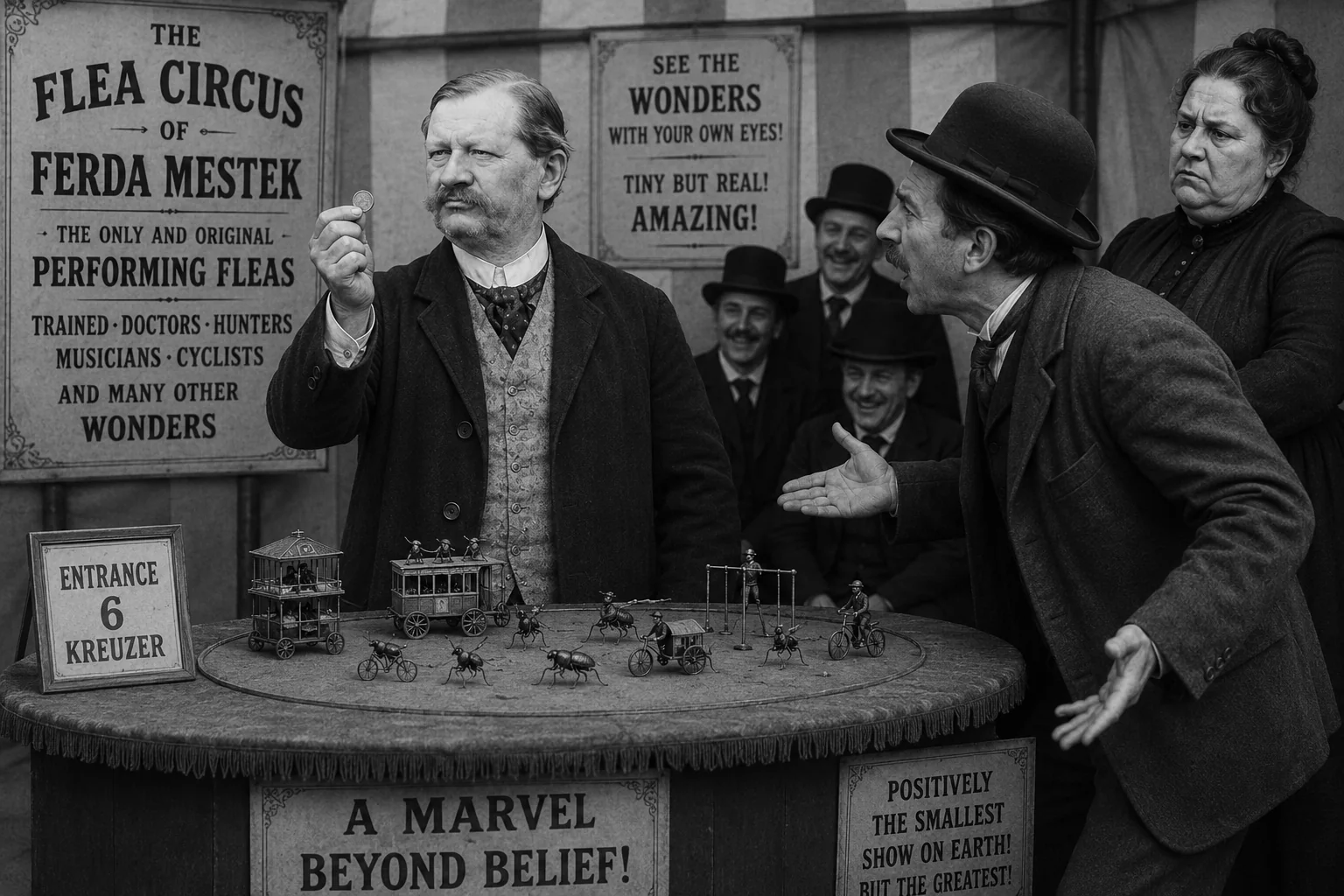
One of the funniest stories about Ferda Mestek concerns a dissatisfied customer.
It is said that a man complained that he had gone around the flea theatre twice but had not seen the spectacular performances he expected. He wanted his money back.
Ferda’s response was anything but a refund. He asked whether the man had gone around twice. When the man confirmed that he had, Ferda reportedly told him: “Then you owe me another ten kreuzer.”
The angry customer continued protesting, and Anna eventually threw him out.
Ferda then reportedly explained the situation to the remaining audience. The man had apparently wanted to see the attractions again without paying.
Whether you call it deception, entertainment or extraordinary salesmanship, Ferda clearly understood one thing:
confidence can be a powerful business tool.
Anna: The Woman Behind Ferda Mestek
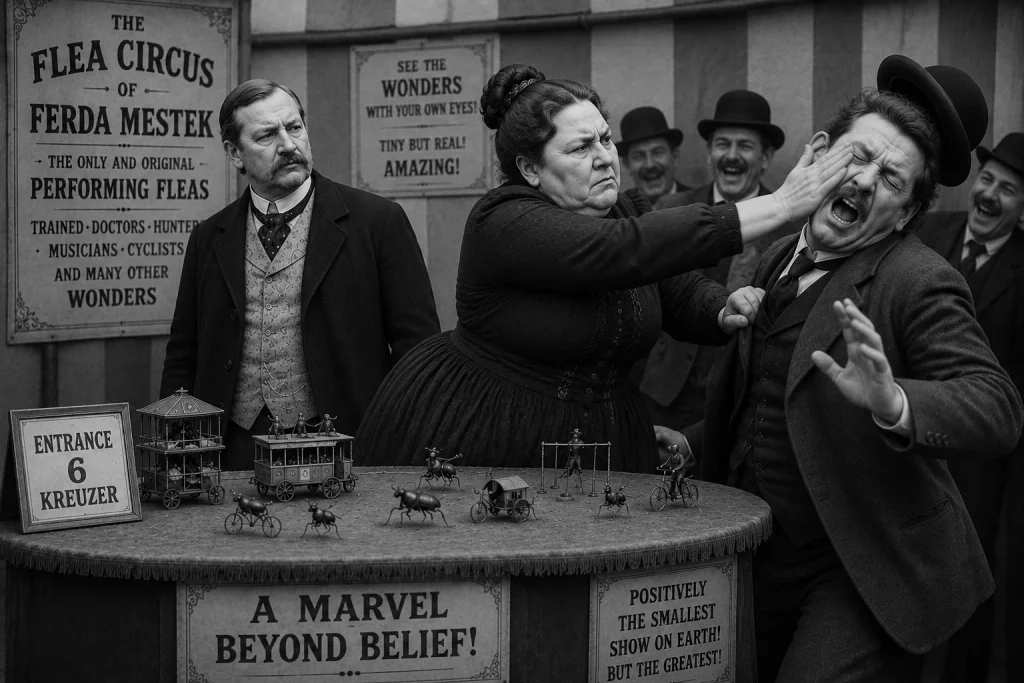
The story of Ferda Mestek cannot really be told without mentioning his wife, Anna.
Kisch presents Anna as a formidable personality who played an important role in dealing with problems surrounding Ferda’s flea theatre.
When other residents became concerned about the presence of hundreds of fleas in the building, disputes developed over the attraction and its operation.
Kisch describes Anna’s confrontations with officials and says that her interventions earned her the nickname “Behördengeißel,” roughly meaning a scourge of the authorities.
She also appears in some of the stories about angry customers. When one dissatisfied visitor became particularly troublesome, Anna was the person who dealt with him.
So while Ferda was busy selling the show… Anna was apparently handling customer complaints.
The Aristocratic Fleas
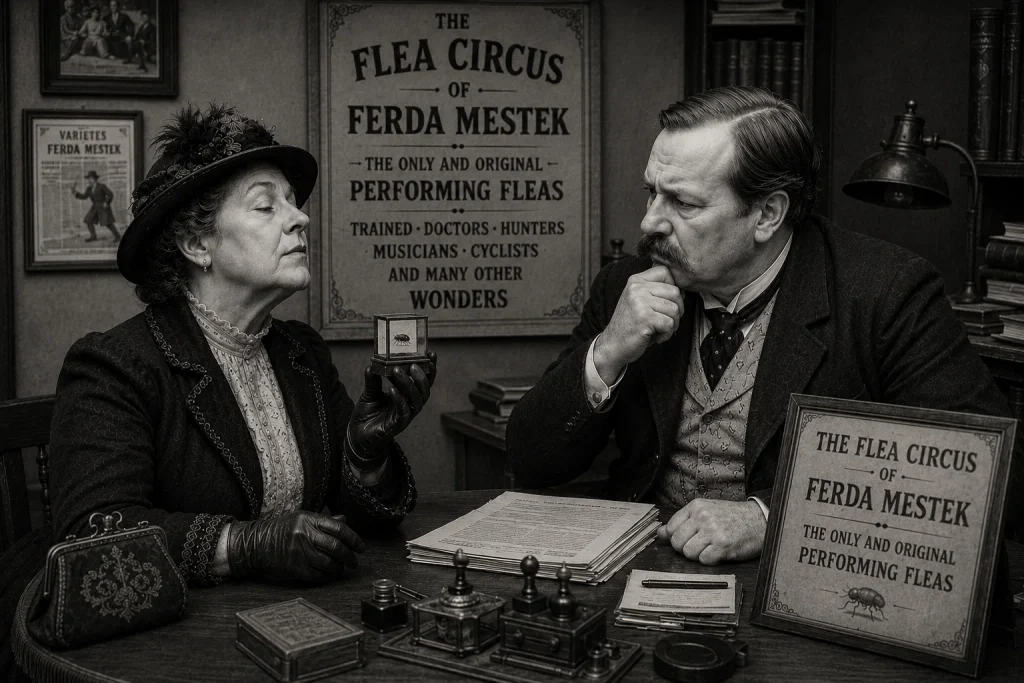
One of the stranger stories in Kisch’s account involves a woman who brought Ferda fleas that she claimed belonged to an aristocratic lady.
The woman presented them as unusually distinguished animals. According to her story, the fleas were accustomed to refined surroundings and even drank “blue blood.”
Ferda was fascinated. He joked about the fleas and offered to catch more himself, comparing his supposed flea-hunting abilities favorably with those of Buffalo Bill.
Then Anna appeared. Kisch describes Ferda’s transformation humorously, saying that the fearless flea hunter suddenly became smaller than a flea.
It is a perfect example of the kind of comic portrait Kisch created around Ferda and Anna.
Barnum & Bailey
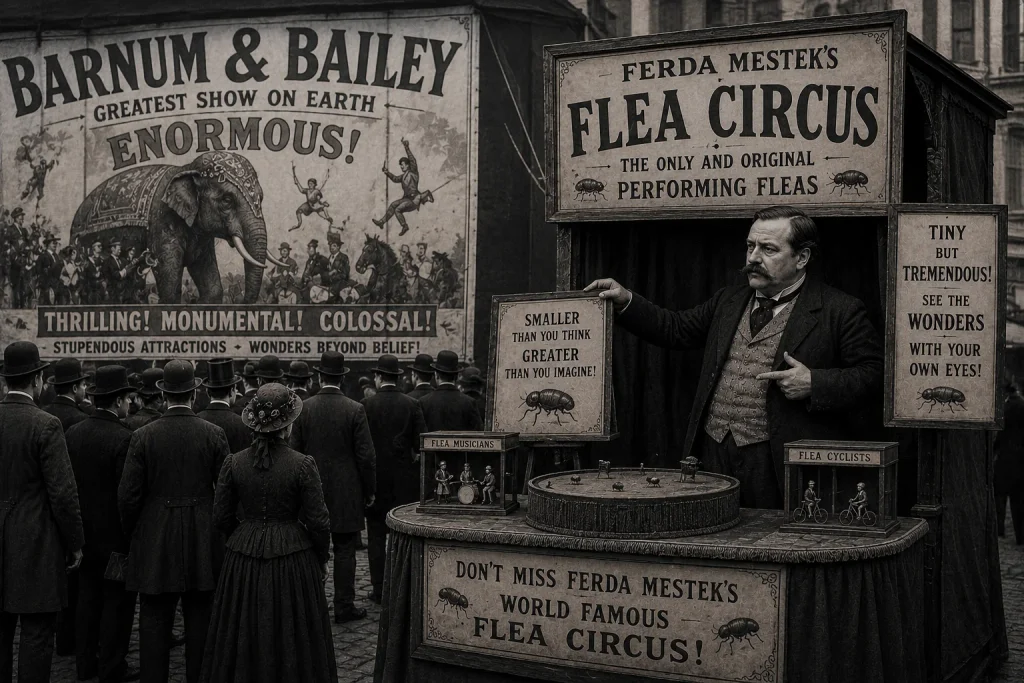
Ferda’s flea circus existed during an era when spectacular circus entertainment was becoming increasingly popular.
Then Barnum & Bailey arrived in Prague. Compared with Mestek’s tiny flea theatre, the famous American circus was enormous, with the kind of spectacular attractions that made a flea circus look almost microscopic.
But the flea circus king did not simply disappear. he promoted his own attraction using the kind of grand advertising associated with his much larger competitor.
It was an extraordinary contrast:
Barnum & Bailey had enormous circus attractions. Ferda Mestek had fleas. And yet Ferda continued promoting his tiny theatre.
That contrast is one of the reasons his story became so memorable.
Jaroslav Hašek
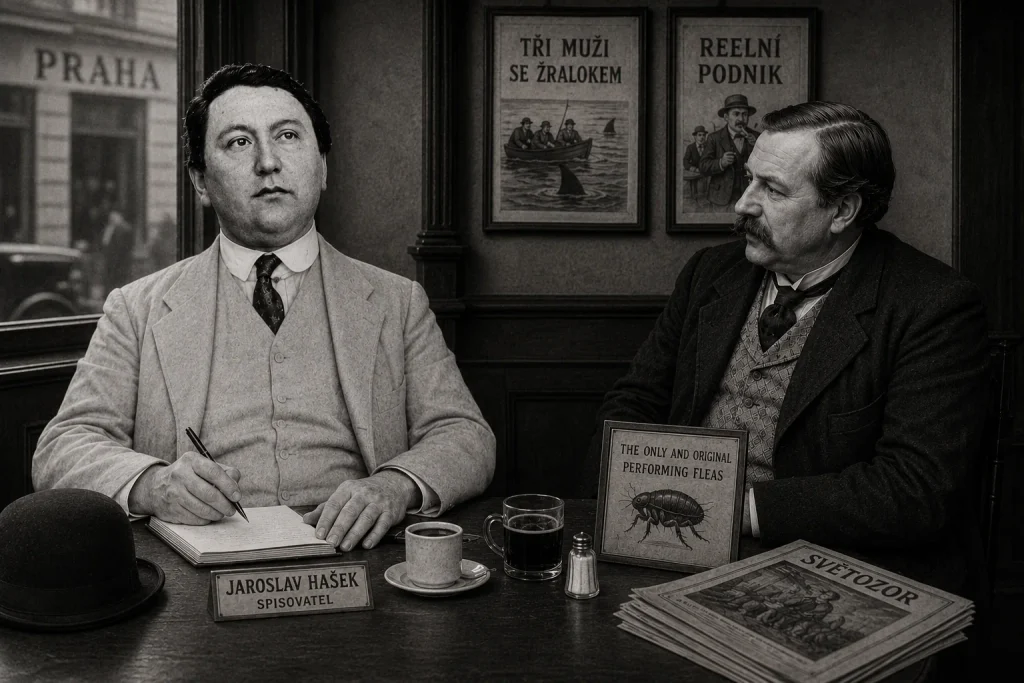
One of the most important connections in the story of Ferda Mestek is his relationship with the Czech writer Jaroslav Hašek.
Hašek knew Mestek personally and later incorporated him into his writing. Mestek appears in Hašek’s works Tři muži se žralokem and Reelní podnik, both associated with the writer’s humorous style.
The connection between the two men is particularly interesting because Hašek himself was fascinated by eccentric characters and unusual Prague personalities.
Ferda was almost tailor-made for Hašek’s world. A self-invented impresario. A businessman with bizarre ventures. A flea-circus operator. And a man who could apparently turn even an angry customer into part of the entertainment.
Ferda Mestek and the Shark
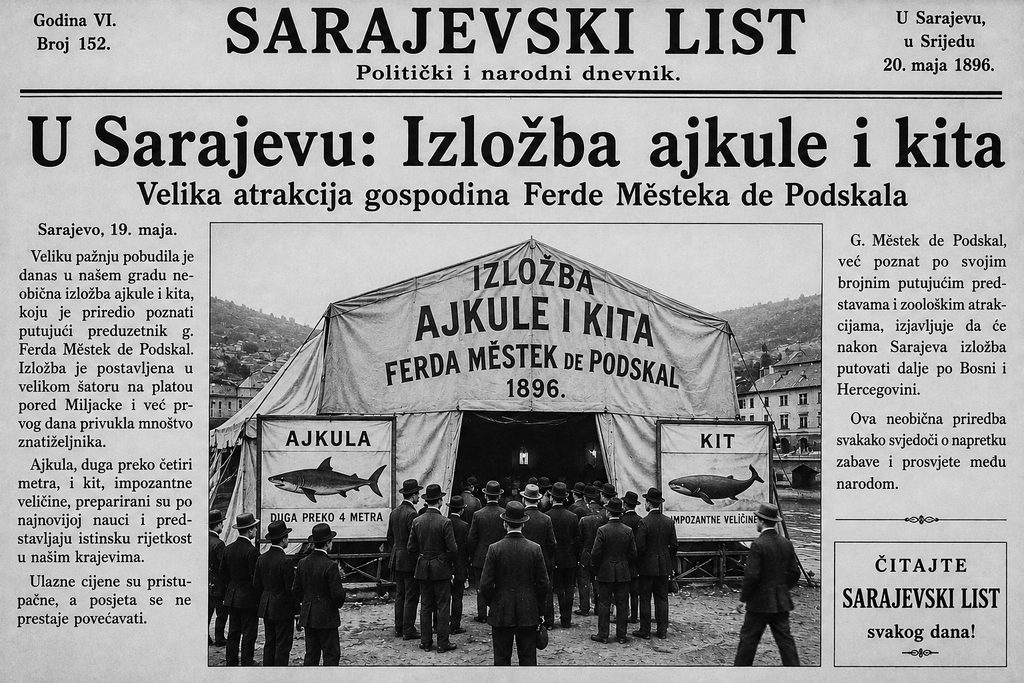
The flea circus was not even Ferda’s only unusual attraction. Historical research connects Mestek with an exhibition involving a shark, and Hašek later wrote Tři muži se žralokem “Three Men with a Shark“.
Contemporary newspaper references and later research also connect Mestek with a shark-and-whale exhibition in Bosnia in 1896.
This shows that Ferda’s career was considerably broader than the flea circus alone.
He was an impresario who repeatedly looked for unusual spectacles that could attract an audience.
Egon Erwin Kisch and Ferda Mestek
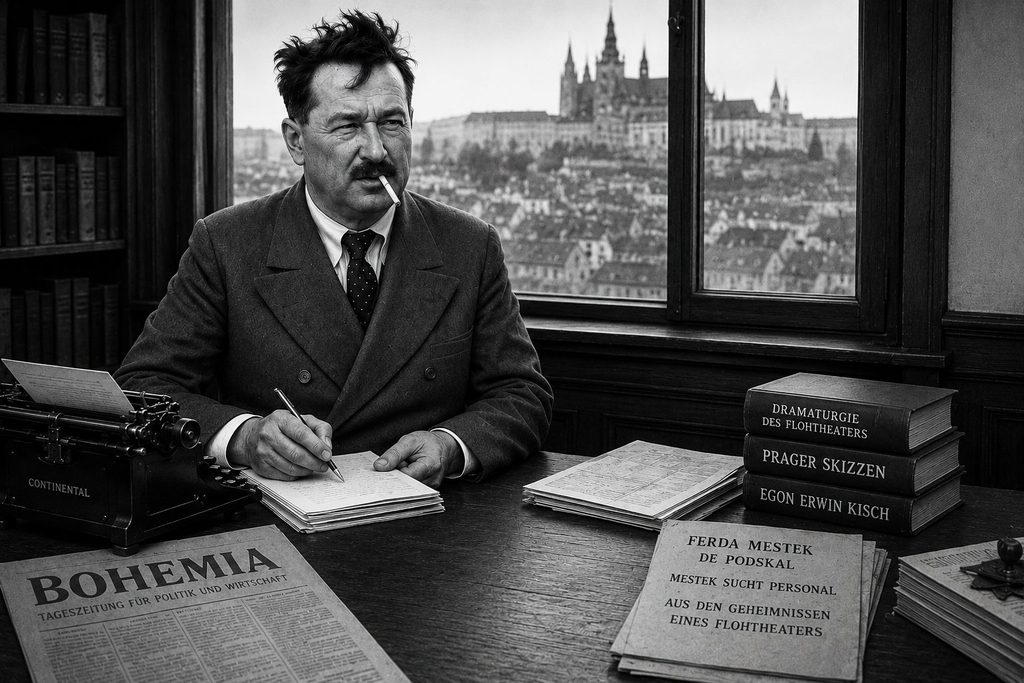
Another major Prague writer who preserved the story of Ferda Mestek was Egon Erwin Kisch. Kisch published several pieces about Mestek in the German-language newspaper Bohemia in 1914.
The pieces included:
Ferda Mestek de Podskal
Mestek sucht Personal
Aus den Geheimnissen eines Flohtheaters
Kisch later developed the material into Dramaturgie des Flohtheaters, which became part of his Prague writings.
This is particularly important because many of the most entertaining details we know about the Prague flea circus come from Kisch’s account.
His writing preserves stories about:
The approximately 300 fleas
The named flea performers
The miniature circus equipment
The aristocratic fleas
The angry customers
The extra ten-kreuzer demand
Anna’s interventions
The tricks used in the flea theatre
However, these should be understood as Kisch’s accounts and literary recollections, not automatically as independently verified facts.
When Did Ferda Mestek Die?

Ferda Mestek died on 16 June 1916 in Prague. Archival research records his death and indicates that he did not leave significant property.
His death record and other registration documents preserve details about his later life and occupations.
He was buried at Olšany Cemetery. And this is where the timeline becomes particularly interesting. Because Ferda’s story did not end with his death.
Ferda Mestek Becomes a Theatre Character
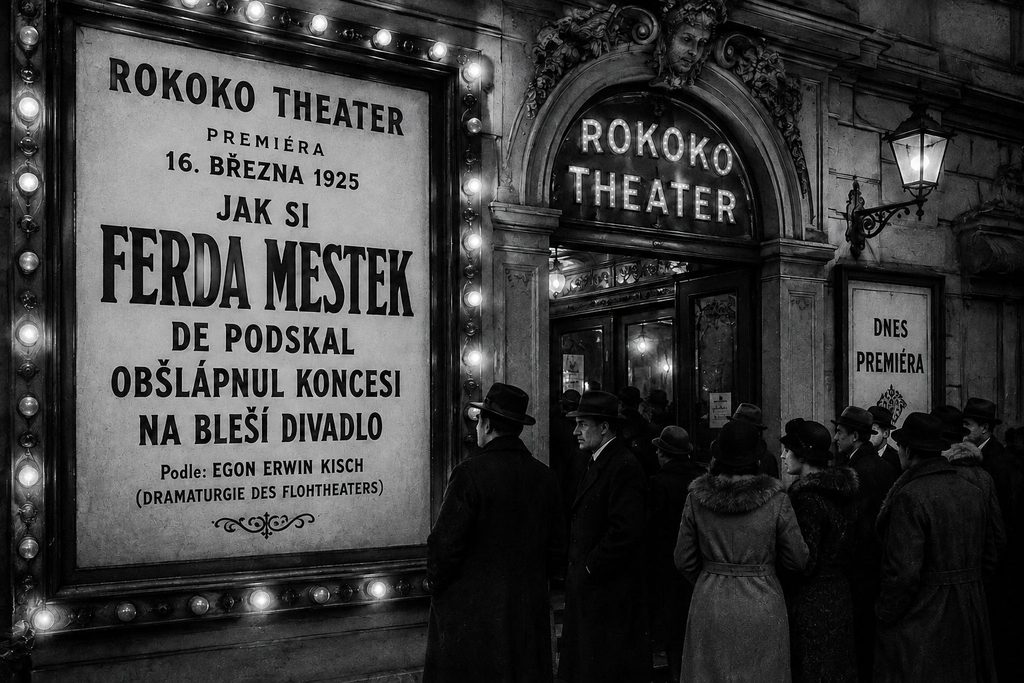
Ferda died in 1916. Nine years later, in 1925, his story appeared on the Prague stage.
The theatre production Jak si Ferda Mestek de Podskal obšlápnul koncesi na bleší divadlo premiered at Prague’s Rokoko Theatre on 16 March 1925.
The play was based on Kisch’s Dramaturgie des Flohtheaters. So 1925 was not the year Ferda became a legend. Rather, the production is evidence that the stories surrounding him had continued to circulate after his death.
His flea theatre had become part of Prague’s cultural memory.
Was Ferda Mestek Really a Scammer?
It is tempting to call Ferda Mestek a scammer. Some of his marketing certainly involved exaggeration, tricks and theatrical illusion.
But the historical record gives us a more interesting character than simply “a man who tricked people.”
He was an impresario, entertainer and self-promoter who understood how to turn an unusual idea into a spectacle.
His fleas were real, and so was the circus.
He built miniature equipment for them to perform on.
The people who came to watch were real too.
Some details have since become part of Prague folklore, while others can be traced directly to Kisch, Hašek or archival records.
That mixture of fact, storytelling and legend is precisely what makes Ferda’s story so fascinating.
The Legacy of Ferda Mestek
Ferda Mestek died in 1916, but his story survived for generations.
Hašek wrote about him. Kisch preserved his flea theatre in literature. His life inspired a theatre production in 1925. And later Prague writers continued to revisit the eccentric impresario from Podskalí.
He may never have been a real king. But he certainly became the king of one of Prague’s strangest little kingdoms:
the flea circus.
And perhaps Ferda understood something that modern marketers still know today:
Give people an irresistible story, and they may pay just to find out whether it’s true.
Even if the performers are fleas.