

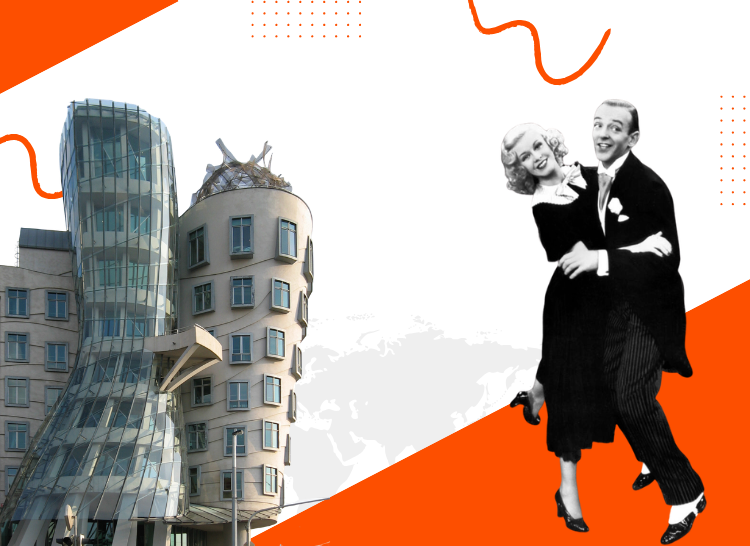
Prague Dancing House: The Stunning Tribute to Fred and Ginger
On the right bank of the Vltava River, where historic facades line Rašínovo nábřeží and trams hum past elegant nineteenth century buildings, something unexpected appears. The Prague Dancing House rises among them with a confidence that is impossible to ignore.
The Prague Dancing House does not simply stand on the embankment. It performs.
Since its completion in 1996, this striking building has become one of the most photographed landmarks in the Czech capital. Officially known as the Nationale Nederlanden building and locally called Tančící dům, it is far better known by its poetic nickname: Fred and Ginger. The comparison is not accidental. The structure was inspired by the legendary dance partnership of Fred Astaire and Ginger Rogers, whose effortless elegance defined Hollywood’s golden age.
But the story of the Prague Dancing House is not just about architecture. It is about rhythm and contrast. It is about tension between tradition and modernity. And above all, it is about a city rediscovering its own movement after decades of political stillness.
Table of contents
- The History of the Prague Dancing House
- Why the Prague Dancing House Is Called Fred and Ginger
- The Legacy of Fred and Ginger
- Deconstructivism in a City of Baroque Dreams
- How the Prague Dancing House Became an Icon
- Architecture as Political Expression
- A Dialogue Between Past and Present
- The Experience of Movement
- Why the Dancing House Endures
- Visiting the Prague Dancing House
- Final Thoughts
Estimated reading time: 9 minutes
The History of the Prague Dancing House
To understand the Dancing House, you first need to understand Prague in the late twentieth century.
The site where the building now stands once held a traditional apartment house. That house was destroyed during the American bombing of Prague on February 14, 1945, near the end of the Second World War. The empty lot remained for decades, a quiet scar in a city famous for its architectural continuity.
In 1986, during the final years of the Communist era, architect Vlado Milunić began imagining a bold new structure for the vacant plot. His neighbor happened to be playwright and dissident Václav Havel, who would later become president after the Velvet Revolution. The two discussed the possibility of building something meaningful on the site, something that could serve a cultural purpose.
At the time, it felt like a dream. But history intervened.
After 1989, when Czechoslovakia transitioned from communist rule to parliamentary democracy, the atmosphere in Prague changed. There was energy in the air. Optimism. A sense that the city could finally move forward again. Milunić revived his concept, envisioning a building composed of two parts: one static and one dynamic. Together they would symbolize a society stepping out of rigidity and into freedom.
In 1992, the Dutch insurance company Nationale Nederlanden purchased the land and agreed to finance the project. To give the design international weight, Milunić invited Canadian American architect Frank O. Gehry to collaborate. Construction began the same year and was completed in 1996.
The result was unlike anything Prague had seen before.
Why the Prague Dancing House Is Called Fred and Ginger
At first glance, the resemblance is unmistakable.
One tower is solid and composed, built of stone and concrete. The other is slender, curved, and almost transparent, wrapped in glass and supported by curved pillars. The two forms lean toward each other as if caught mid step in an elegant ballroom routine.
The stone tower represents Fred Astaire. The glass tower represents Ginger Rogers.
The metaphor works beautifully. Fred Astaire was known for precision, control, and graceful authority. His posture was upright, confident, seemingly effortless. Ginger Rogers matched him step for step, yet brought fluidity, sparkle, and expressive movement to their routines. She famously did everything Astaire did, but backwards and in high heels.
Similarly, the Dancing House balances strength with lightness. The stone tower feels grounded and steady, while the glass tower appears to swirl and bend in motion. At the top of the stone tower sits a twisted metal structure nicknamed Medusa, resembling windswept hair, adding a playful flourish to the composition.
Together, the two towers capture the illusion of movement in a city built from still stone.
The Legacy of Fred and Ginger
To appreciate the symbolism fully, it helps to revisit the cultural weight of the dancers who inspired the nickname.
Fred Astaire and Ginger Rogers starred together in a series of musical films during the 1930s, including classics such as Top Hat and Swing Time. Their on screen chemistry became legendary. They embodied elegance during the Great Depression, offering audiences glamour and escape when the world felt uncertain.
Astaire’s choreography emphasized smoothness and clarity. There were no distracting cuts or camera tricks. The dance was presented honestly, with the full body in view. Rogers matched his technique while adding emotional depth and warmth. Their partnership was a dialogue, not a competition.
In many ways, the Dancing House mirrors this dynamic. The building does not dominate its surroundings aggressively. Instead, it engages in a visual conversation with neighboring facades. It bends and curves, yet it respects the height and scale of adjacent nineteenth century structures. The windows align with surrounding buildings, maintaining continuity even as the form itself challenges convention.
Like a well rehearsed dance, it balances individuality with harmony.
Deconstructivism in a City of Baroque Dreams
Prague is renowned for its Gothic spires, Baroque domes, and Art Nouveau ornamentation. Landmarks such as the Charles Bridge and Prague Castle define the skyline and draw millions of visitors each year.
Against this historic backdrop, the Dancing House stands out dramatically.
Its architectural style is commonly described as deconstructivist, though the designers themselves sometimes referred to it as new baroque. The building is supported by ninety nine unique concrete panels, each individually shaped. The glass tower is supported by curved columns that narrow toward the base, enhancing the illusion of movement. The façade includes undulating moldings that create depth and complexity, preventing the structure from appearing flat.
Notably, the project was the first building in the world constructed using CATIA 3D software, a tool originally developed for aerospace design. This technology allowed architects to model the complex curves with precision.
When it was unveiled, the reaction was intense. Critics argued that it clashed with Prague’s historic character. Supporters praised it as a bold symbol of renewal. The debate reflected a deeper question: Could a city so defined by its past embrace something radically modern?
Over time, resistance softened. The Dancing House is now widely regarded as an icon of Czech contemporary architecture. It represents new Prague, just as Charles Bridge represents old Prague.
How the Prague Dancing House Became an Icon
Shortly after its completion, the building received international recognition. It won the Design of the Year award from Time magazine in 1996 and later appeared on a gold two thousand Czech koruna coin issued by the Czech National Bank as part of the Ten Centuries of Architecture series.
Today, it is difficult to imagine the embankment without it.
Visitors gather along the riverbank to photograph the unusual silhouette. Couples pose in front of the leaning towers. Architecture students sketch its curves. What was once controversial has become beloved.
The building has also evolved beyond its symbolic meaning. It houses offices, a hotel, a gallery, and a restaurant. The top floor is home to Ginger and Fred Restaurant, where guests enjoy international cuisine while taking in panoramic views of the Vltava River. From the terrace, you can see Charles Bridge stretching across the water and Prague Castle rising above the city.
Dining there feels almost cinematic, as if stepping into a ballroom suspended above the rooftops.
Architecture as Political Expression
The Dancing House is not merely playful. It carries political resonance.
Milunić originally envisioned the structure as leaning toward the crossroads, symbolizing a society regaining balance after years of totalitarian rigidity. The pairing of static and dynamic elements reflected the transition from communism to democracy. The building’s very motion suggested change.
Václav Havel supported the project enthusiastically, hoping it would become a center of cultural life. Although it ultimately developed into a mixed use building rather than a dedicated cultural center, it nonetheless embodies the spirit of the post revolution era.
Like a dancer stepping confidently onto the floor after a long pause, Prague was ready to move again.
A Dialogue Between Past and Present
What makes the Dancing House so compelling is not just its form, but its context.
Unlike many modern landmarks built in newly developed districts, this building sits directly within the historic core. It does not hide. It does not retreat to the outskirts. Instead, it enters into dialogue with centuries of architecture.
Look closely and you will notice that the height of the structure aligns with neighboring buildings. The window spacing acknowledges surrounding façades. The designers deliberately avoided overwhelming the street.
This sensitivity recalls the dance partnership of Astaire and Rogers. Though both were stars, neither eclipsed the other. They complemented and elevated each other through balance and mutual awareness.
Similarly, the Dancing House complements Prague’s skyline by contrast rather than imitation.
The Experience of Movement
Stand across the river at sunset and watch the glass tower catch the light. As clouds drift overhead, reflections ripple across its surface. The stone tower appears steady, while the glass one seems to shift subtly with the changing sky.
Walk along Rašínovo nábřeží and the perspective changes again. From one angle, the towers appear almost separate. From another, they merge into a single composition. The building reveals itself gradually, like choreography unfolding across a stage.
Inside, the airy interior design by architect Eva Jiřičná enhances this sense of flow. Light filters through curved surfaces, softening the geometry. Visitors experience not just a structure, but a sequence of spatial movements.
Architecture here becomes performance.
Why the Dancing House Endures
Three decades after its completion, the Prague Dancing House remains fresh. It has not become dated or diminished by trends. Perhaps this is because it was never about fashion. It was about transformation.
Fred Astaire and Ginger Rogers represented optimism during difficult times. Their dances suggested that elegance and harmony were still possible. The Dancing House, built after decades of political constraint, similarly suggested that creativity and boldness could flourish again.
Both the dancers and the building embody partnership. Stone and glass. Static and dynamic. Past and future. Tradition and innovation.
In a city celebrated for its history, the Dancing House reminds us that heritage does not mean stagnation. It means continuity enriched by new chapters.
Visiting the Prague Dancing House
If you are exploring Prague, the Dancing House deserves a stop on your itinerary.
Located along the Vltava River at Rašínovo nábřeží, it is within walking distance of many major attractions. The top floor restaurant offers sweeping views, especially beautiful at sunset. The gallery space occasionally hosts exhibitions, and the hotel allows guests to stay inside one of Europe’s most distinctive buildings.
Even if you do not enter, take time to observe it from different angles. Walk past slowly. Notice how the curves interact with surrounding facades. Consider how bold the design must have felt in 1996.
And perhaps, as you stand there, imagine Fred and Ginger gliding across a polished floor. Picture the rhythm, the balance, the effortless coordination.
That is the essence of the Dancing House.
Final Thoughts
The Prague Dancing House is more than a modern landmark.
In honoring Fred Astaire and Ginger Rogers, the building captures something timeless: the beauty of movement shared between two forms.
On the banks of the Vltava, Prague continues to dance.