
Prague’s Art Nouveau is everywhere in the center – most visitors walk right past it without looking up. It happens all the time in the historic center. People wander around surrounded by these massive, ornate façades but totally miss the carved stonework flowers, the stylized female faces, the stained glass, and the twisted iron railings that actually give the style away.
Seeing it requires a simple change in habit: look up. A weird stone face on a doorway or a high mosaic changes a street’s vibe. Also, the best design work is often hidden inside. Look behind the heavy doors of local hotels, quiet cafés, and old public halls. If you only look at the outside, you are basically getting half an experience.
Forget massive lectures. This guide simply helps you spot weird details in the wild. It lists 20 specific places to look at and shows which rooms you can enter. It also highlights a few good spots for coffee. With the walking route at the bottom, you will know exactly where to find Art Nouveau in Prague.
How to See Art Nouveau Prague at a Glance
If you just want the fast version of this experience, you basically need to watch for a few specific things:
- Nature stuff on the walls. Pay attention to messy-looking stone branches, leaf designs, or basic floral patterns stuck to the front of the buildings.
- The faces. Look straight above the main entrance doors or windows to catch those weird decorative stone women staring right back at you.
- Small details. Pay close attention to custom stained glass windows, mosaic wall panels, and weirdly stylized lettering.
- Go inside. Seriously, step into at least one big interior. The Municipal House or the Fanta Café are the simplest to access.
- Map your walk out ahead of time. Use a set route since the heaviest concentration sits packed tight inside the New Town and the central core streets.
Back around the turn of the 20th century, architects had a pretty straightforward goal. They basically wanted to merge standard building design with decorative fine arts until a structure felt like a single, massive piece of art. Prague went all in on this style super fast. Early on, it was all about curvy, looping patterns, but a few local guys eventually got tired of that and switched to harsh geometric blocks.
Naturally, this whole movement is just one era of the city’s timeline. You can check out how all these wildly different historical building phases collide over in our comprehensive guide to Prague Architecture.
20 Best Art Nouveau Buildings in Prague
This is where most visitors should spend their time. The buildings below range from major landmarks to less obvious examples, and not all have the same level of public access.
1. Municipal House: The Icon of Art Nouveau Prague
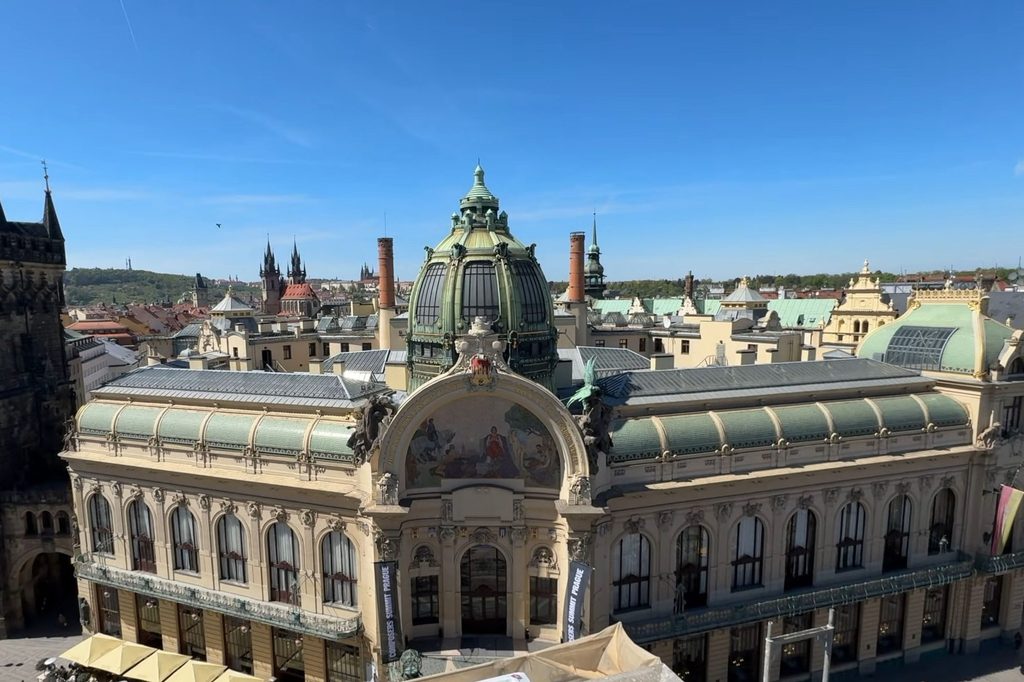
If you only have time to check out one major site to understand Municipal House, make sure it is the Municipal House.
Construction took place between 1905 and 1911. The creators spent years merging standard architecture with painting, sculpture, glass, and handmade furniture. Their goal was a single, giant artistic composition. Antonín Balšánek and Osvald Polívka were the main architects. Meanwhile, famous local creatives like Alfons Mucha helped with the decor.
The outside catches your eye immediately with its massive entry mosaic and all the statues. Honestly, though, the real payoff is stepping past the doors.
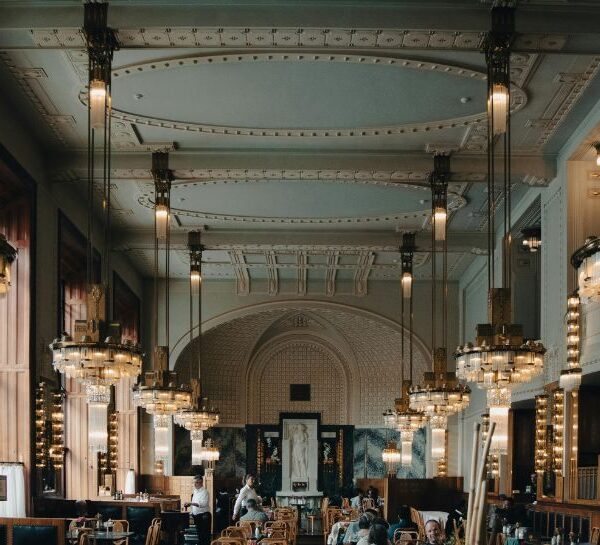
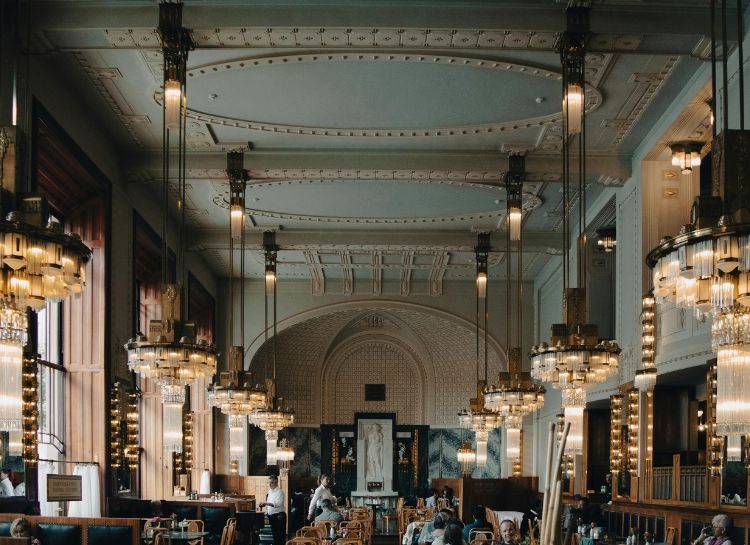
You’ll find incredible interior design elements packed into the café, the restaurants, the American Bar, Smetana Hall, and the ceremonial rooms. The Mayor’s Hall is especially crucial. Mucha handled the layout himself, making everything match perfectly from the wall paintings down to the small decorative accents.
- What to look out for: the entry mosaic, custom stained glass, heavy chandeliers, detailed metal grills, and Mucha’s work inside the Mayor’s Hall.
Can you go inside? Yes. You can walk straight into the café and the ground-floor restaurants without any special tickets. To see the big ceremonial halls upstairs, though, you have to jump on a guided tour. The local tourism board, Prague City Tourism, usually runs these for about an hour.
The building is also a really handy spot to kick off a wider walk around the historic core. If you want to expand your trip past this specific architectural era, look through our guide to Old Town Square Prague and the city’s historic squares.
2. Fanta Building at Prague Main Railway Station
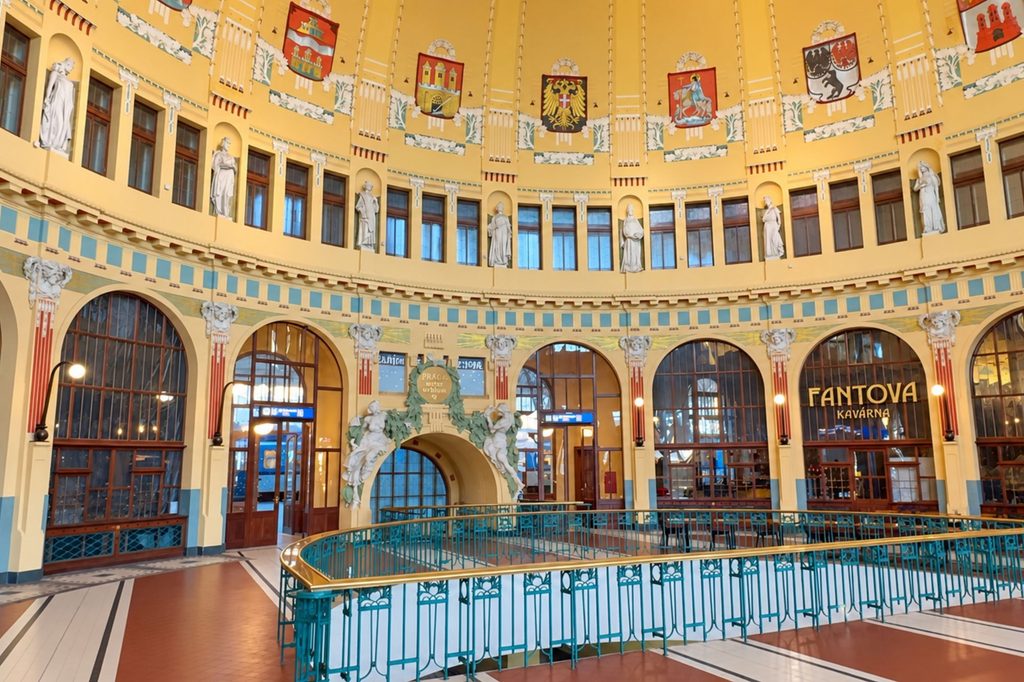
You don’t need a museum ticket to see this gorgeous architecture. Honestly, you can just catch it while waiting for a train.
Josef Fanta designed the old historic section of the Prague Main Railway Station, which went up between 1901 and 1909. Today, the Fanta Building along with the historic hall hanging over the train platforms make up one of the most prominent monuments from this design era.
The absolute simplest route for checking out the interior space is dropping into the Fanta Café inside the old station structure. If you happen to be arriving or leaving the city on the tracks, our comprehensive Prague Main Station guide breaks down everything you need to know before dealing with the station layout.
Make sure to look right up at the massive dome to spot all the decorative motifs and stone statues. The whole place was initially designed specifically around the mood and motion of old-school train travel, which gives the styling a completely different edge than a standard apartment block.
- What to look out for: the massive overhead dome, stone statue decorations, patterned wall surfaces, and classic old railway architecture.
Can you go inside? Yes. The whole station functions as an active transit hub, and the Fanta Café is fully open to anyone walking through.
3. Grand Hotel Evropa, Now W Prague
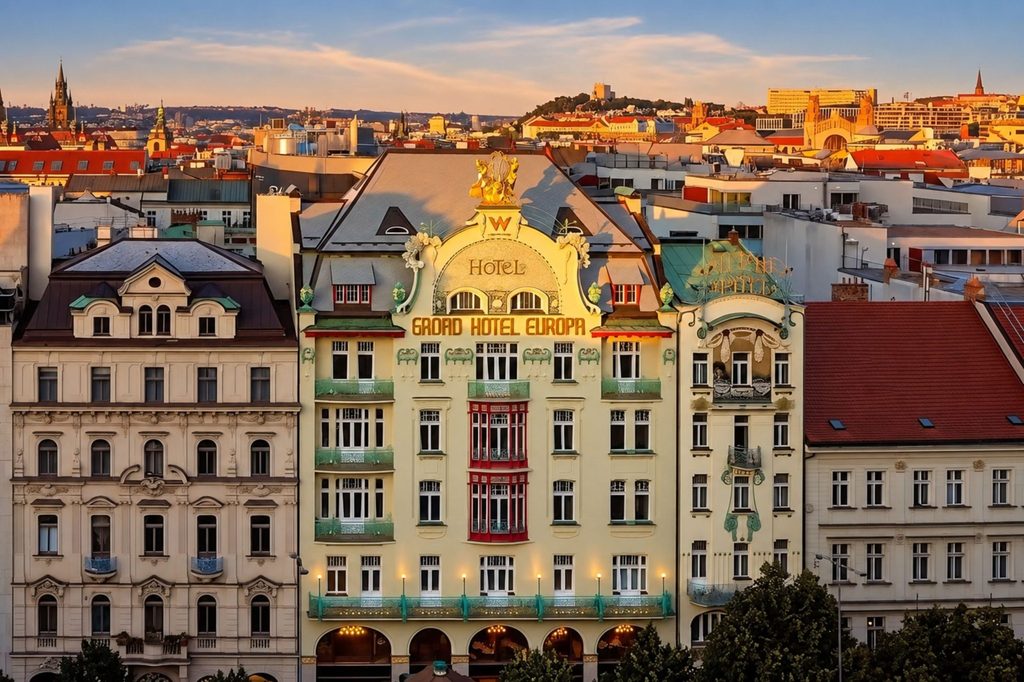
The front of the old Grand Hotel Evropa is easily one of the most famous designs you’ll spot right on Wenceslas Square.
Opening in 1905, this property originally featured classic old styling. It has now been transformed into the modern W Prague. The major renovation preserved its historic core. However, it also introduced contemporary rooms and a new back extension.
This setup makes it a pretty cool stop for travelers because it shows you firsthand how an old design landmark gets updated for modern luxury use.
The renovation workers left the intricate front stonework completely alone, though they still spent time rescuing the old mosaic signage and a few other early 1900s interior accents.
- What to look out for: the brightly colored frontage, stone carving details, vintage lettering styles, and the contrast between the old heritage structure and the modern back extension.
Can you go inside? Yes. You can freely explore the hotel’s public bar and lobby areas. Just note that private guest corridors require a room key for entry.
4. Hotel Meran, the Shining Gem of Art Nouveau Prague
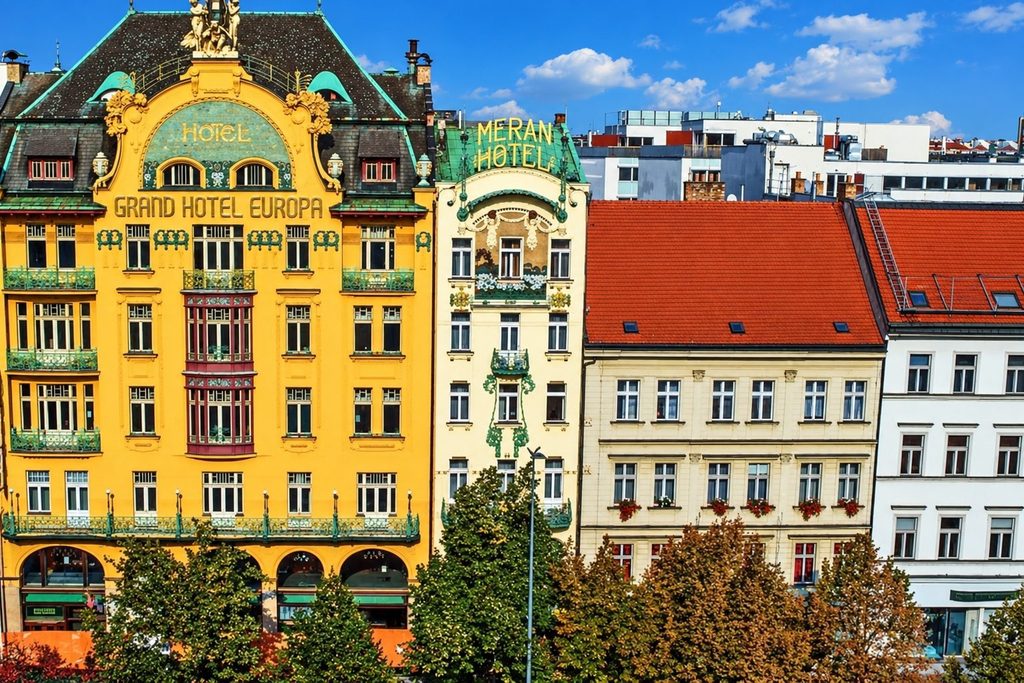
Right next to the old Evropa building sits Hotel Meran. It is another incredible spot you need to look for while walking through Wenceslas Square.
They originally built the hotel between 1895 and 1906. Later on, a restoration crew brought back its original styling. Because the plot of land it sits on is incredibly narrow, the front façade looks totally unique compared to everything around it.
It is super easy to just walk right past this place because its famous neighbor steals the spotlight.
Honestly, that is the exact reason you should squeeze it into your walking plans.
- What to look out for: the skinny vertical shape of the property, the decorative front wall, and how it squeezes in right next to the other classic Wenceslas Square structures.
Can you go inside? The place still functions as a working hotel. Because of this, viewing it from the sidewalk is your best bet. The only exceptions are if you stay overnight or use their hospitality services.
5. Hotel Paris
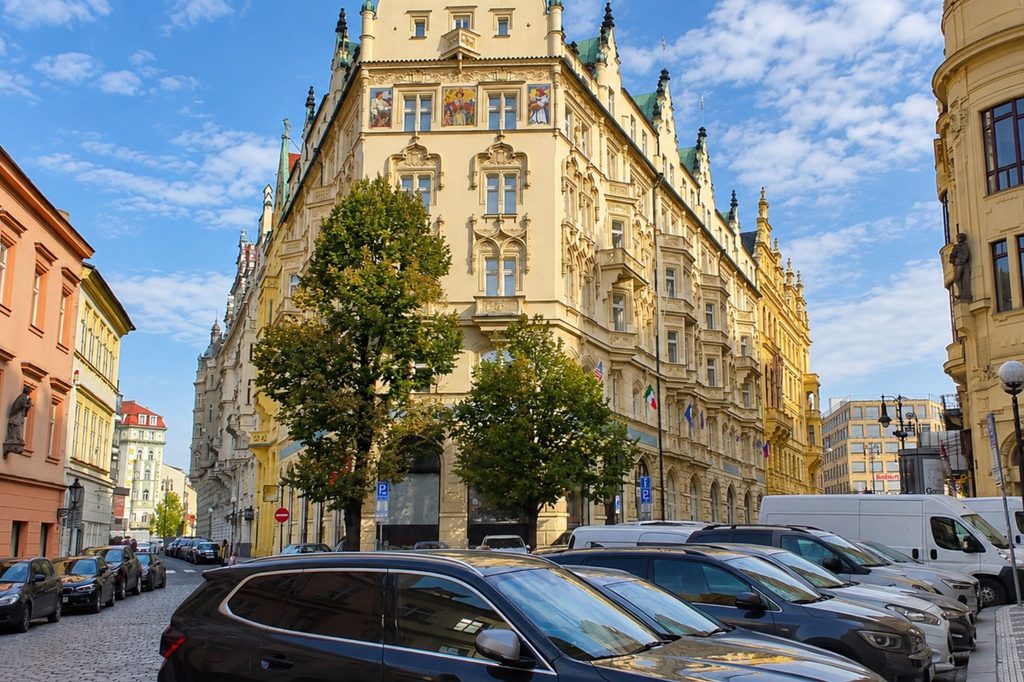
You will find Hotel Paris sitting right across the street from the Municipal House, showcasing a pretty unusual mix of older Neo-Gothic shapes and early decorative styling.
The whole place goes back to 1904. This is a fantastic spot to visit. It shows how different historic styles clash and blend inside a single luxury building. In fact, Prague City Tourism classifies the structure as a hybrid. They consider it a mix of Neo-Gothic and early Art Nouveau.
Grabbing a table over at Tony’s Café & Bar lets you hang out in that old-school space without going through the whole process of booking an overnight stay. Also, if you are looking to pivot from a day of staring at old buildings into finding a great place to eat dinner, our comprehensive Prague Restaurant directory points out exactly what to look for and where to find it.
- What to look out for: the patterns on the outside walls, the sharp corner tower, small accent carvings, and the overall vintage vibe as soon as you step into the lobby.
Can you go inside? Yes. You can easily walk right into the main public restaurant and bar areas, though keep in mind that day-to-day access to other parts of the property depends entirely on regular hotel operations.
6. Hotel Central (K+K Hotel Central Prague)
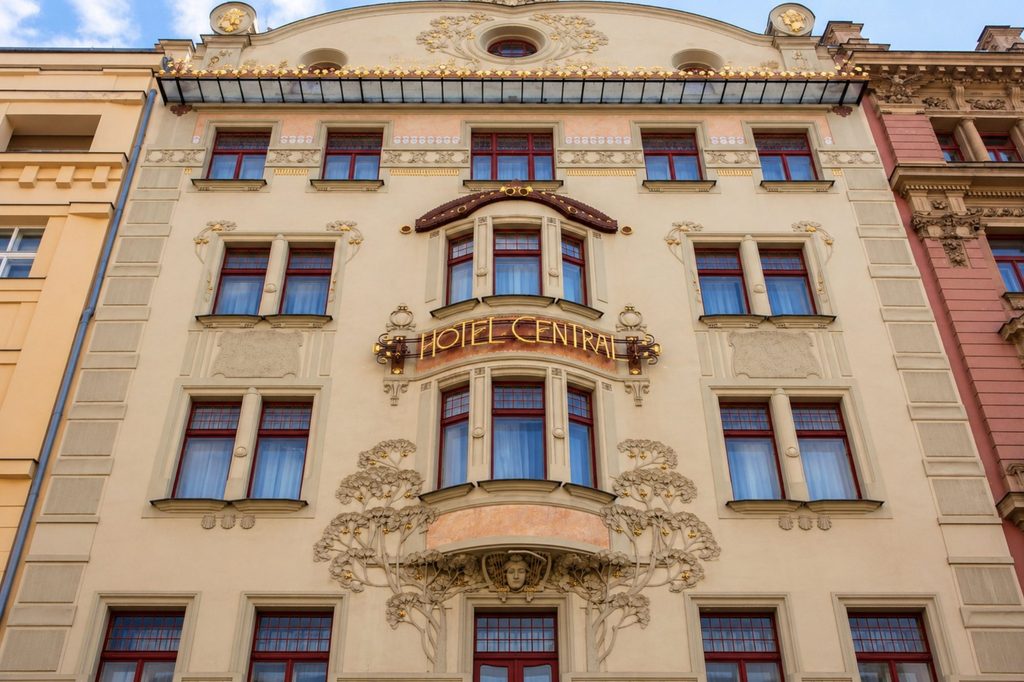
You will find the old Hotel Central sitting over on Hybernská Street. It counts as one of the very first major hotel properties built in this specific historic style.
Friedrich Ohmann, Alois Dryák, and Bedřich Bendelmayer drew up the blueprints for this project. They broke ground in 1898 and finished it by 1900.
Why this place actually matters stretches way past just having an interesting street-facing wall. The property captures a raw, early phase of Prague welcoming the movement, long before the look exploded in popularity across the rest of the neighborhoods.
If you study the front of the structure closely, you can see how they paired organic, flowing decorations with a pretty strict, balanced architectural layout.
- What to look out for: plant and flower patterns, detailed wall carvings, and the overall proportions of early-era design work.
Can you go inside? The structure still runs as a working hotel, so you can easily step into the main reception area to look around, though guest-only zones are blocked off unless you have a room key.
7. Art Nouveau Palace Hotel
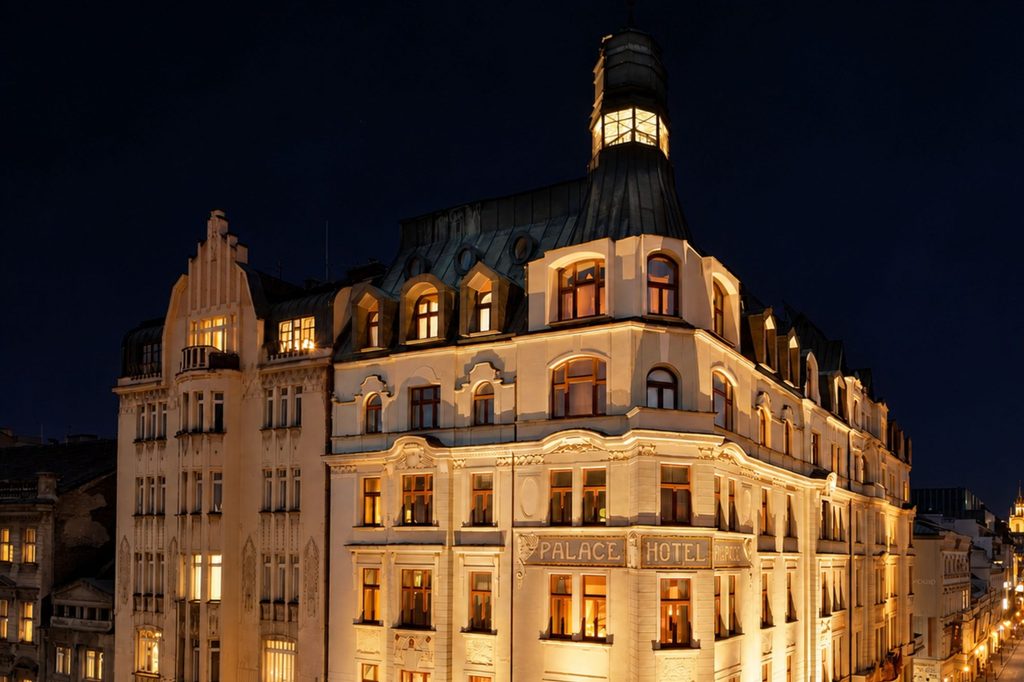
You can spot the historic Palace Hotel sitting right near the edge where the Old Town and New Town neighborhoods meet.
Workers finished putting the place together in 1909. They went with a toned-down Viennese style for the design work. The management highlights that the building preserved its early looks completely through its historical restoration updates.
This spot is a classic proof that art nouveau Prague isn’t always about massive, over-the-top façades. Some properties across the city took a much quieter, subtle approach to their look.
- What to look out for: the way the structure shapes around the street corner, the dialed-back wall carvings, and the accent details around the doorways.
Can you go inside? Yes. You can freely enter the hotel’s public dining spaces. Just note that private residential floors require a room card for entry.
8. Koruna Palace
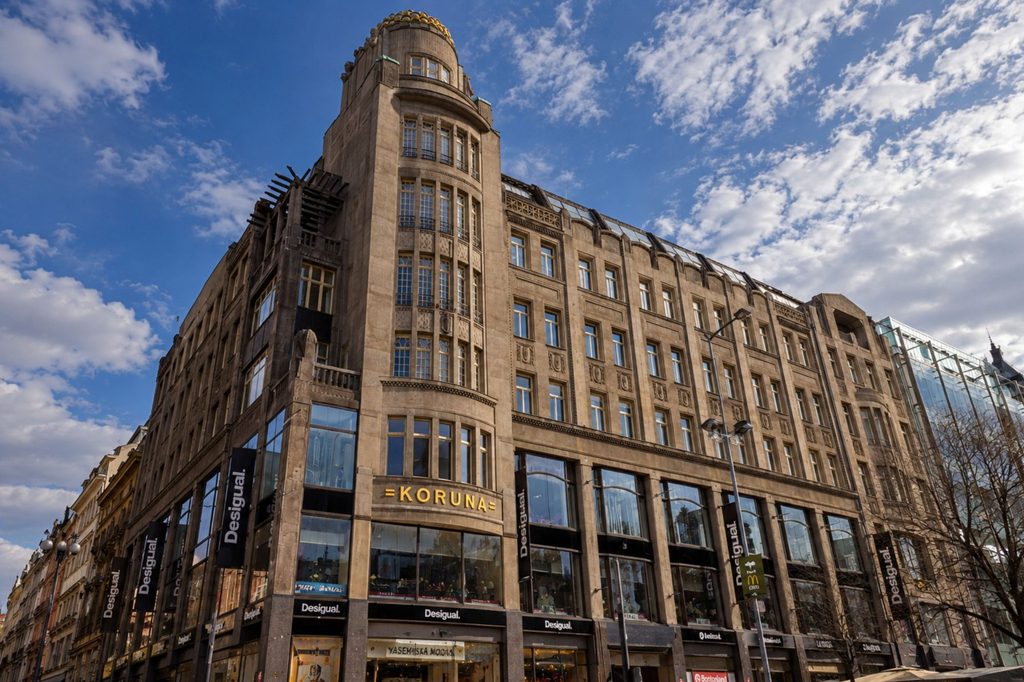
Sitting right at the bottom of Wenceslas Square, Koruna Palace stands out. It is one of the most distinctive late-era architectural examples you can find.
That big corner tower topped with a stylized crown is the main thing you’ll notice. Antonín Pfeiffer did the drawings and Matěj Blecha took care of the actual building work, wrapping it all up in the early 1900s. The name Koruna actually means crown, so the whole building design clicks the second you look at the roofline.
If you step inside, the old commercial passage and the glass dome are filled with design elements tied directly to this later stage of the movement.
- What to look out for: the crown-shaped tower, symbolic stone carvings, and vintage glass decorations.
Can you go inside? Yes. You can walk through the central shopping arcade and the various open stores without any issues, though access to specific storefronts changes depending on their individual business hours.
9. Peterka House
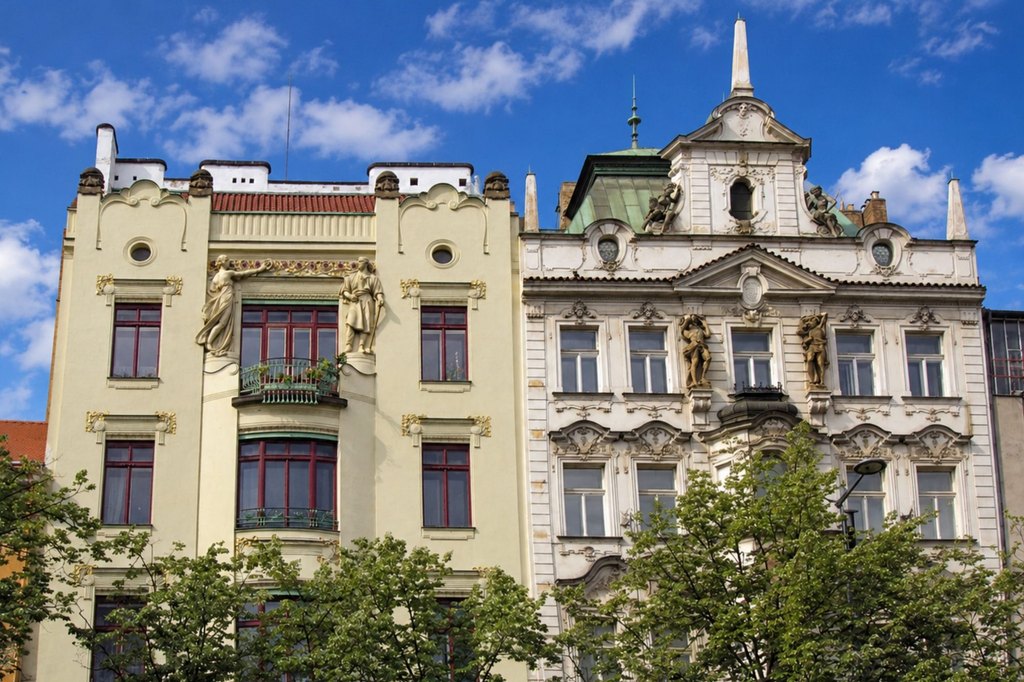
You can find Peterka House standing at Wenceslas Square 12, and it represents a really key early project by the architect Jan Kotěra.
The property dates all the way back to 1899. It features an early façade decorated with floral details and stone carvings. Even the local tourism experts over at Prague City Tourism call this building one of Kotěra’s most important early milestones.
Stopping here is smart. It shows how Prague’s Art Nouveau style fits onto a skinny city plot. The style was not just for giant palaces or luxury hotels.
- What to look out for: the plaster flower details, the wall statues, and the surprisingly modern design choices used for the ground-floor storefronts.
Can you go inside? No, you can’t really head inside this one. It’s used for regular offices and private flats today, so just view it from across the street.
10. Golden Goose Hotel
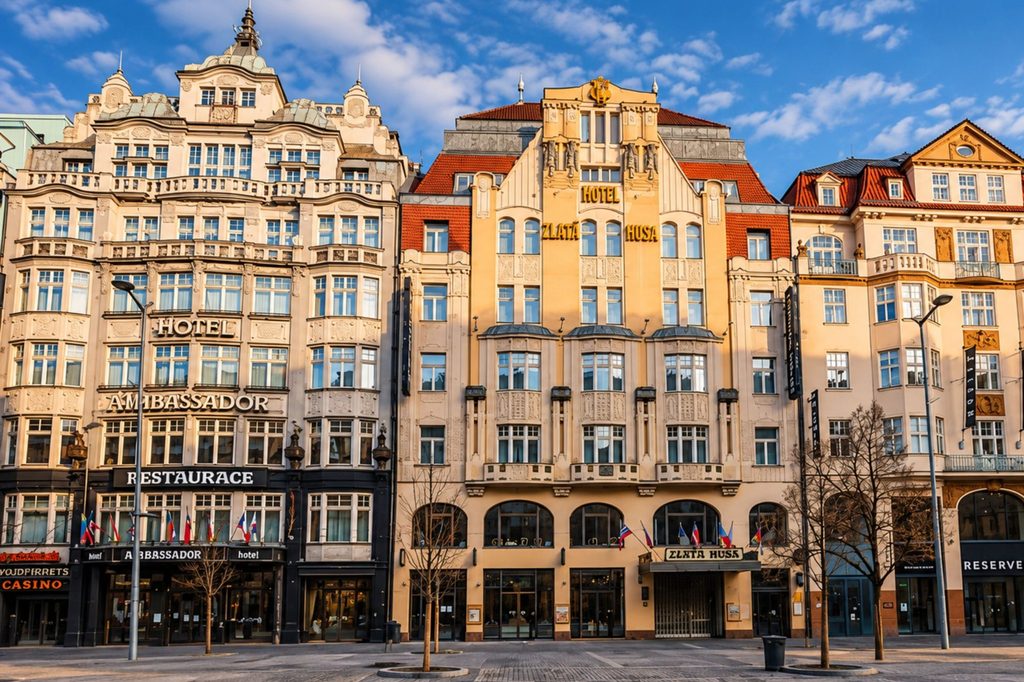
You can spot The Golden Goose Hotel right at Wenceslas Square 7. It is another late-era building that fits easily into a central walking route around the city.
The local tourism office at Prague City Tourism dates the construction back to 1910. They log the place as a late-era build built with rear courtyard wings and a walk-through arcade inside.
This Wenceslas Square stop is highly practical. It lets you see a bunch of different historical building styles side-by-side. You can take it all in within just a couple of minutes.
- What to look out for: the details carved into the front wall, the walk-through passage, and the tall vertical shape of the structure facing the square.
Can you go inside? Yes. You can walk through the ground-floor passage and step into the public areas, but the upper hotel rooms are locked off for regular guests.
11. U Nováků House and Arcade
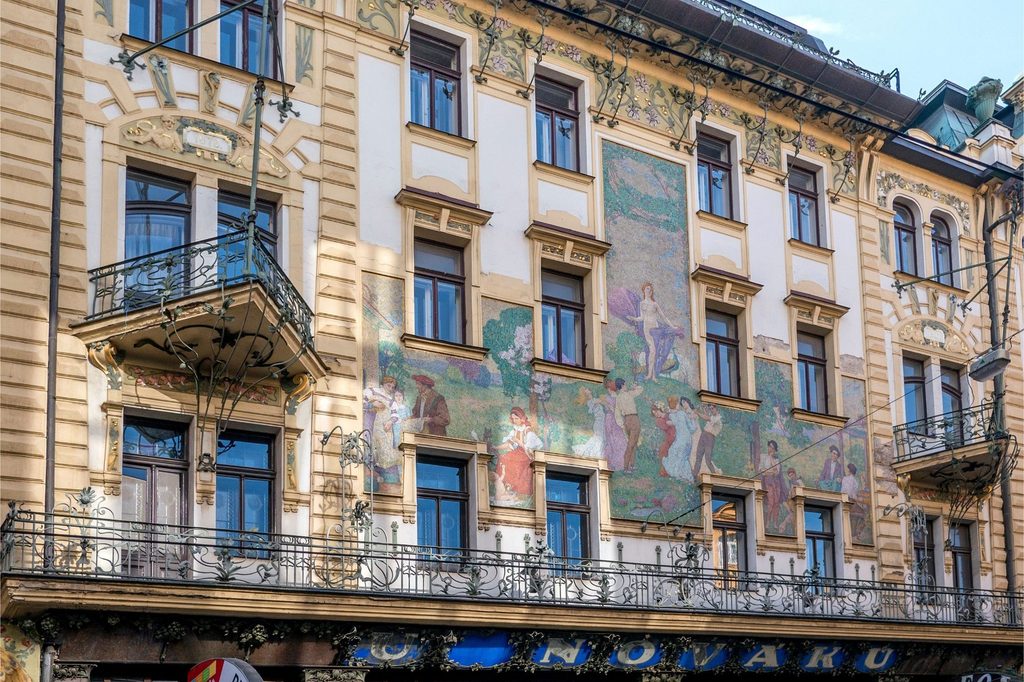
You will find U Nováků standing out clearly. It is one of the most interesting shopping and business structures from this entire historic design period.
The building went up between 1901 and 1904 following blueprints drawn up by Osvald Polívka. The original idea was to build a multi-use commercial hub that packed a shopping arcade, regular stores, office floors, a casino, and an active theater all under one roof.
Check out the inside arcade. It gives travelers a great look at how these artistic building styles mixed directly with everyday shopping. It also shows how they blended with daily work life.
- What to look out for: the colorful wall murals, the main entrance setup, and the covered shopping arcade inside.
Can you go inside? Yes. Since this walk-through is part of the network of old pedestrian corridors slicing through the city, you are free to stroll right on in, though the stores inside open and close on their own time.
12. Prague Insurance Company Building
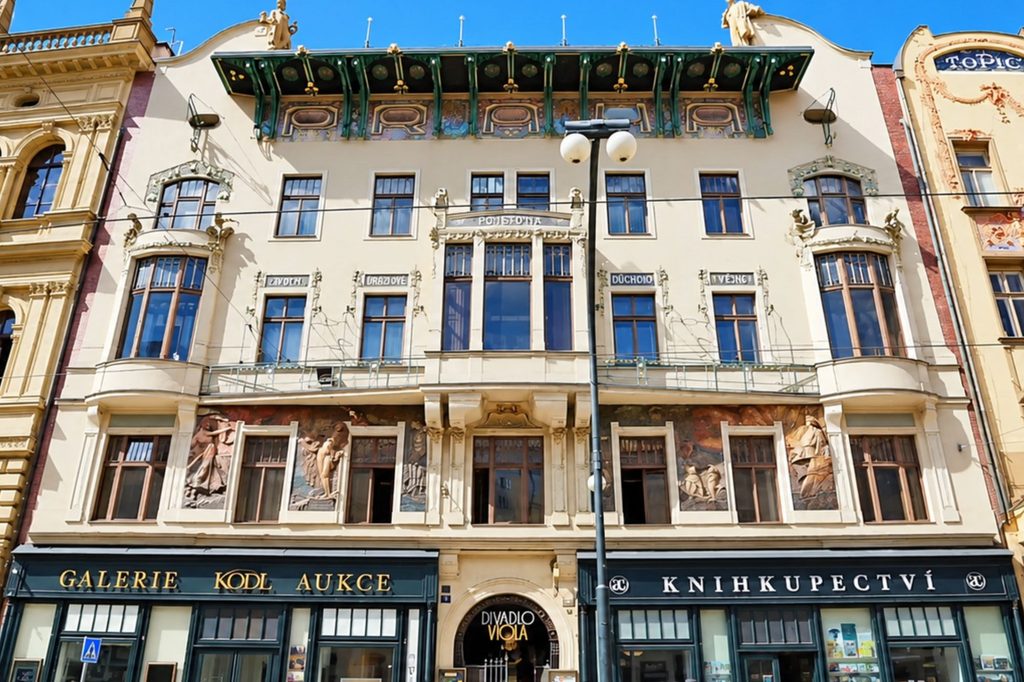
You can spot the old Prague Insurance Company building over on Národní třída. It is locally known as Pojišťovna Praha. It stands as a highly significant example of early modern architecture. The structure was masterminded by architect Osvald Polívka
The crew did a massive overhaul on the structure between 1906 and 1907. This remodel dressed it up in a brand new look. Prague City Tourism experts point out how closely tied this building is to the neighboring Topič Salon. The salon played a big role in the early exhibition history of the city’s art scene.
Make sure to slow down and study the front wall instead of just walking past it.
The custom lettering, carved stone statues, and weird insurance-themed symbols on the front make this office block stand out from other standard buildings on the street.
- What to look out for: the stone figures, the insurance-themed words and carvings, the window layouts, and how it connects visually to the Topič building right next door.
Can you go inside? The ground-floor spaces are running active commercial shops like an art auction gallery and a bookstore, so you can easily step inside to browse those areas.
13. Topič House and Topič Salon
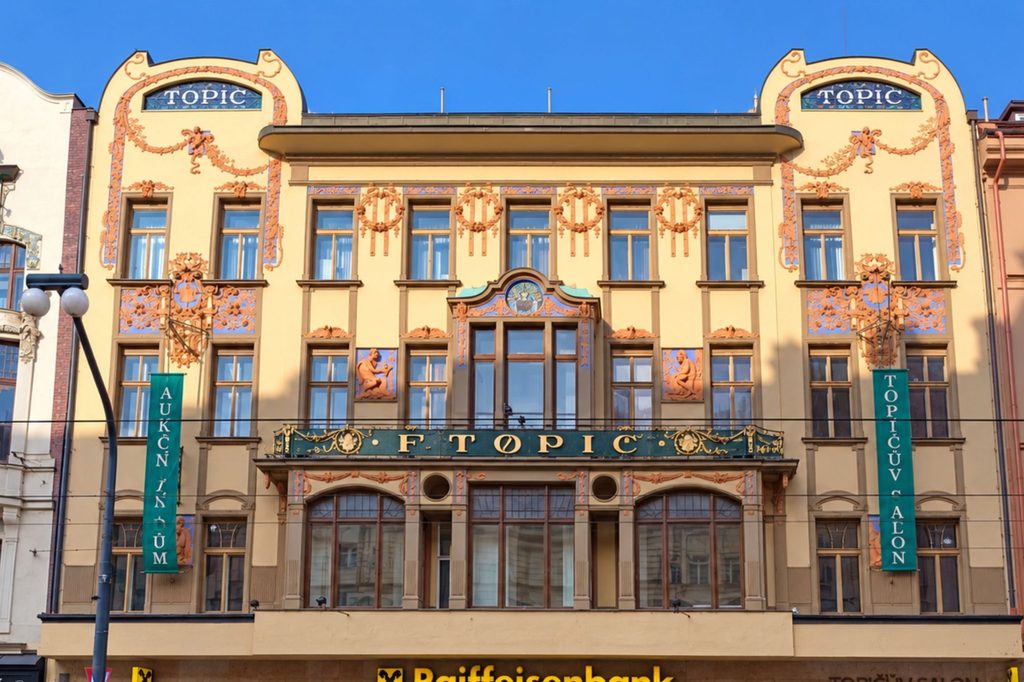
Sitting right next door to the old insurance building is Topič House, which happens to be another signature property designed by Osvald Polívka.
The property’s history relates back to František Topič. He was a well-known local publisher and cultural figure. His salon became a major hotspot for contemporary artists. Prague City Tourism notes that the outside walls truly stand out. They feature bright stained glass, mosaic panels, and flower-themed plaster carvings.
This specific address also shares a big historical milestone with Alfons Mucha. Back in 1897, a touring display of his graphic pieces went up right inside the Topič Salon. Prague City Tourism logs that event as Mucha’s very first solo show in the city, which also doubled as the first formal exhibition of this design style anywhere in Prague.
- What to look out for: the colorful stained glass panels, wall mosaics, plaster flower decorations, and the bold “Topič” lettering across the front.
Can you go inside? The building has a mix of private functions and gallery spaces, so while you can’t freely wander the entire property, you can step in if an active art exhibition or event is happening open to the public.
14. Prague Hlahol
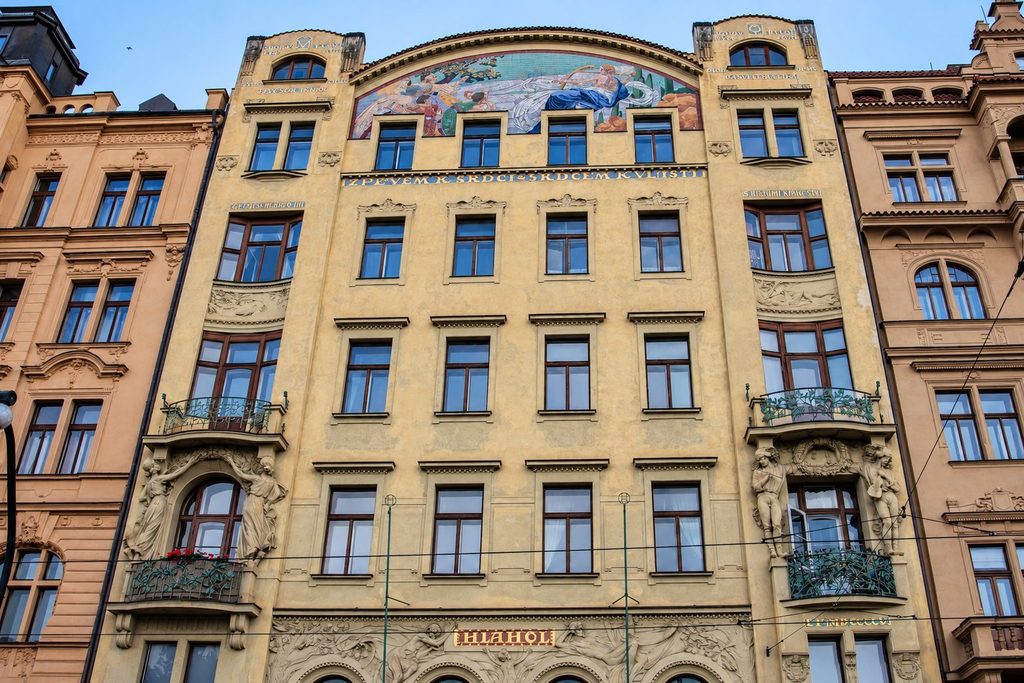
You will find Prague Hlahol sitting right along Masarykovo nábřeží, and it is a prime example of art nouveau Prague with a really intense musical history.
They built the property in the early 20th century. It served specifically as the headquarters for the Hlahol singing association. Inside, the primary performance room features a huge glass roof. Decorators mixed in tons of music-related imagery. This sits next to a big arched wall mural that Alfons Mucha painted himself.
Walking over to look at the outside of this building is completely worth a detour from the standard tourist paths.
- What to look out for: the detailed Phoenix mosaic, the musical text lines on the masonry, and the stylized stone figures.
Can you go inside? Getting past the front doors depends entirely on what concerts or special events are happening on the official schedule.
15. Prague City Hall, New Building
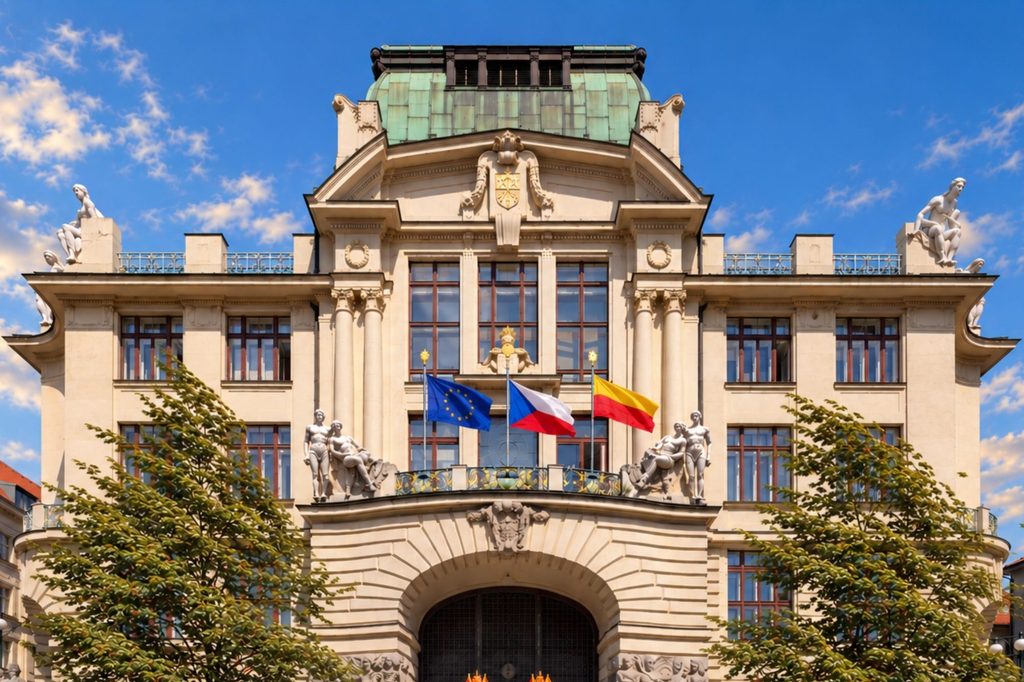
You can find the New Prague City Hall located over on Mariánské náměstí, serving as another solid example of art nouveau Prague style sitting right in the center of the city.
The construction of this office complex happened between 1908 and 1911. Since 1945, local politicians have used it as the main administrative seat for the city’s municipal government. They host council sessions, business conferences, and big public events inside the spacious Grand Hall.
Stopping by here makes a lot of sense for travelers who want to check out this architectural style on an official civic property, rather than just looking at the usual hotels or café blocks.
- What to look out for: the main wall design, the specific carvings around the entrance doors, and how the building integrates with the wider Mariánské náměstí square.
Can you go inside? Because the building acts as a functioning government headquarters, casual access to the main administrative rooms is usually restricted unless you are attending an official public meeting or a scheduled event.
16. Bílek Villa
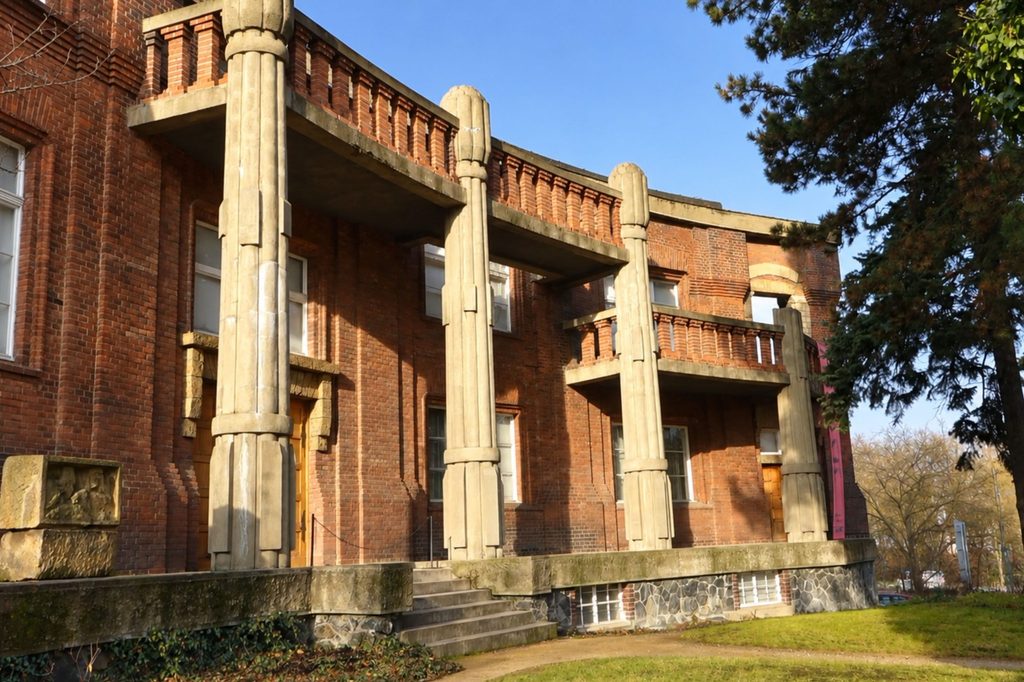
You can escape the crowded historic center and head up toward the castle area. There, you will find one of the most unusual examples of this design style.
The sculptor František Bílek designed and built the Bílek Villa between 1910 and 1911. He drew inspiration directly from a wheat field for the layout, and the odd shape of the property shows off his highly personal, symbolic style.
This place looks nothing like your typical, grand city palace.
The architecture is way more intimate, looking more like a custom brick and stone artwork than a standard residential block.
- What to look out for: the brick wall curves, columns shaped like bundles of grain, and original carvings integrated into the yard.
Can you go inside? Yes. The Prague City Gallery takes care of the property, running it as a public museum and gallery space. The official site over at Prague City Tourism lists up-to-date entry fees and hours.
17. Trmal Villa
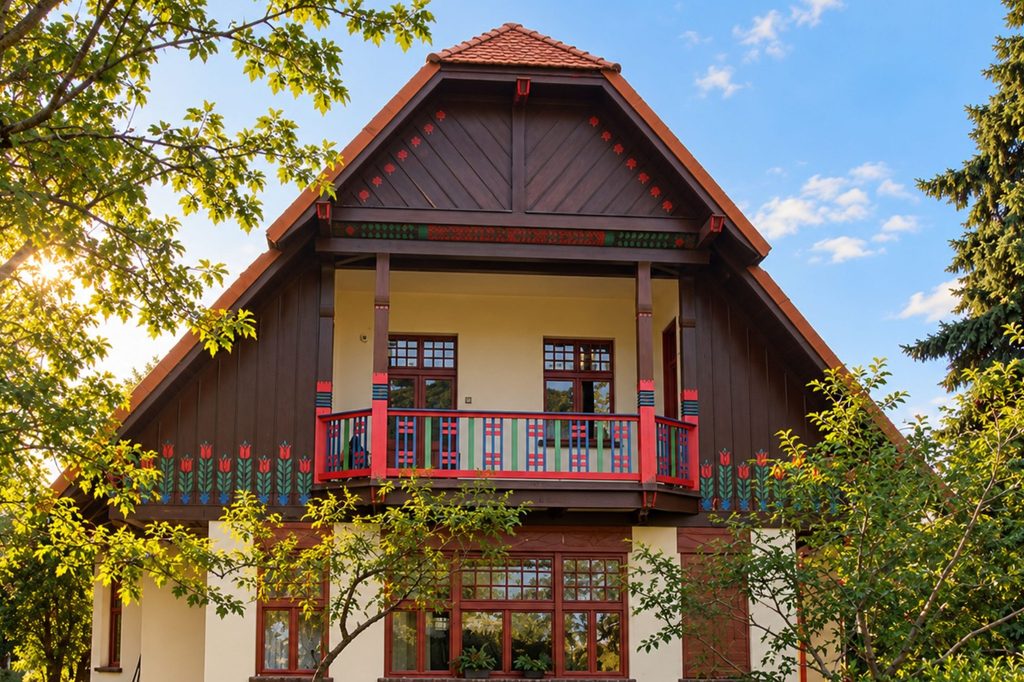
You can head out to Prague 10 to find Trmal Villa. It stands out as an excellent stop. It shows how this early historic style evolved away from the crowded city center.
Jan Kotěra designed the residential property for František Trmal back in 1902 and 1903. He ended up blending clean geometric details with English country cottage vibes and rustic Slavic folk features. Standing in front of this house makes it obvious that Czech builders weren’t just copying a famous global blueprint. They completely customized the trend to make it look local.
- What to look out for: the wooden porch structures, painted geometric accents, old-style folk shapes, and that massive, deep roof overhang.
Can you go inside? Yes. You can get a look inside by booking a guided tour or checking out their rotating event schedule. You can look up the current opening slots and ticket pricing over on the Prague City Tourism webpage.
18. Karel Mašek Villa (Villa Maška)
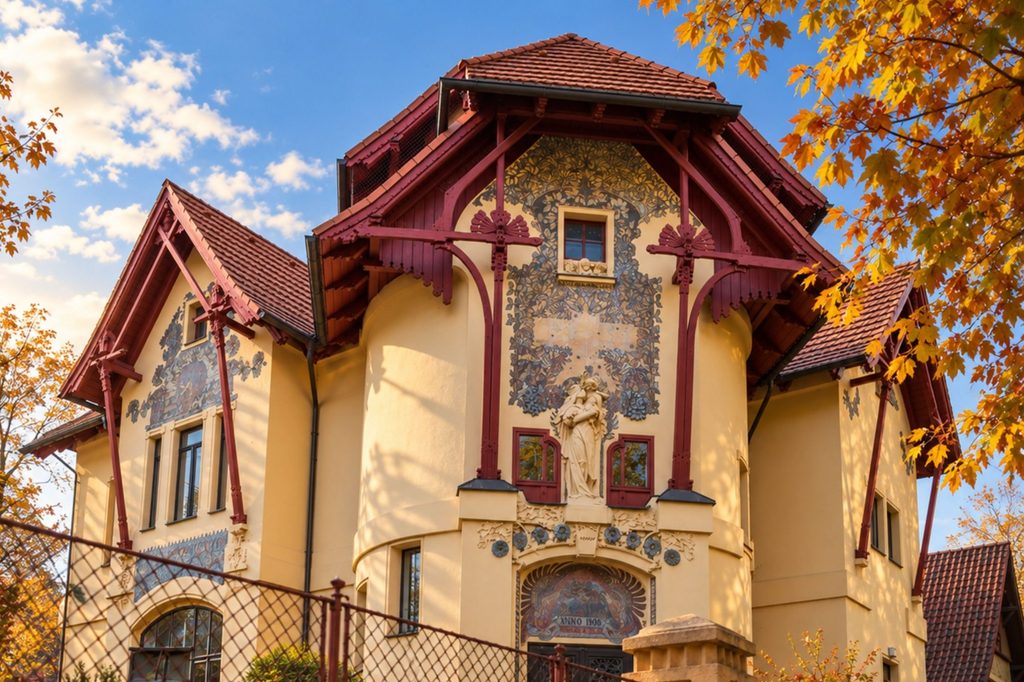
Heading out to the Bubeneč neighborhood gets you to the Karel Mašek Villa, which gives you a much quieter path to explore these older building styles away from the packed central tourist hubs.
The property served as the personal residence for the famous painter and architect Karel Mašek. The tourist board over at Prague City Tourism notes that the home stands out because of its heavily decorated, ornate styling. The design work on the front pillars is easily one of the most prominent features you will notice.
Since this place doesn’t run like a typical museum, you will be focusing entirely on checking out the exterior details from the sidewalk.
- What to look out for: the highly decorated pillars, the painted murals on the front walls, and the elaborate trim work around the upper levels.
Can you go inside? No. Google Maps lists the property as permanently closed, so you’ll have to stick to checking out the front yard and outer walls from behind the fence line.
19. Svatopluk Čech Bridge
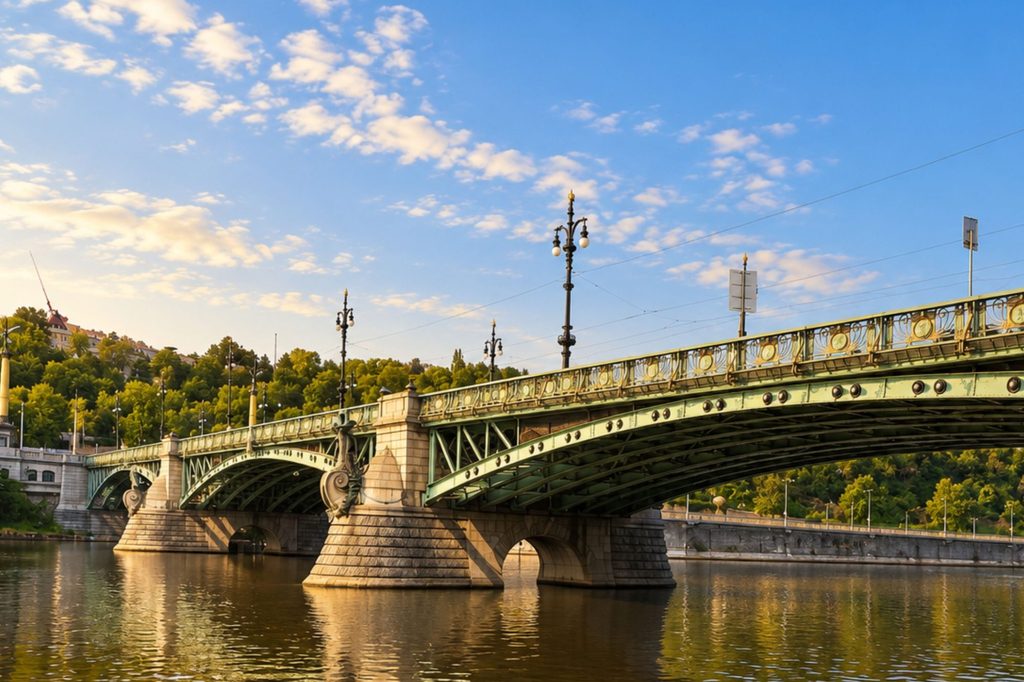
You don’t have to look at standard houses to see this historic style. It actually shows up right on the local river crossings too.
Workers put together the Svatopluk Čech Bridge between 1905 and 1908, and it counts as the only major bridge built in this specific style anywhere in Czechia. The structure links the Old Town bank directly over to the Letná side of the river, decorated with massive bronze statues, wall carvings, ornate light poles, and detailed metal accents.
Stopping here is a great way to see how city planners used these organic design styles on heavy public infrastructure, instead of just using it on private villas or luxury hotels.
- What to look out for: the winged figures of Victory on the pillars, the carvings along the light posts, hidden hydra statues, torchbearer figures, and the painted iron arches.
Can you visit? Yes. The crossing functions as a regular public road and pedestrian sidewalk, so you can walk across it for free at any hour of the day.
If you feel like checking out the rest of the historic and modern river structures around the city, head over to look through our comprehensive guide to Prague Bridges.
20. City Orphanage (Městský sirotčinec)
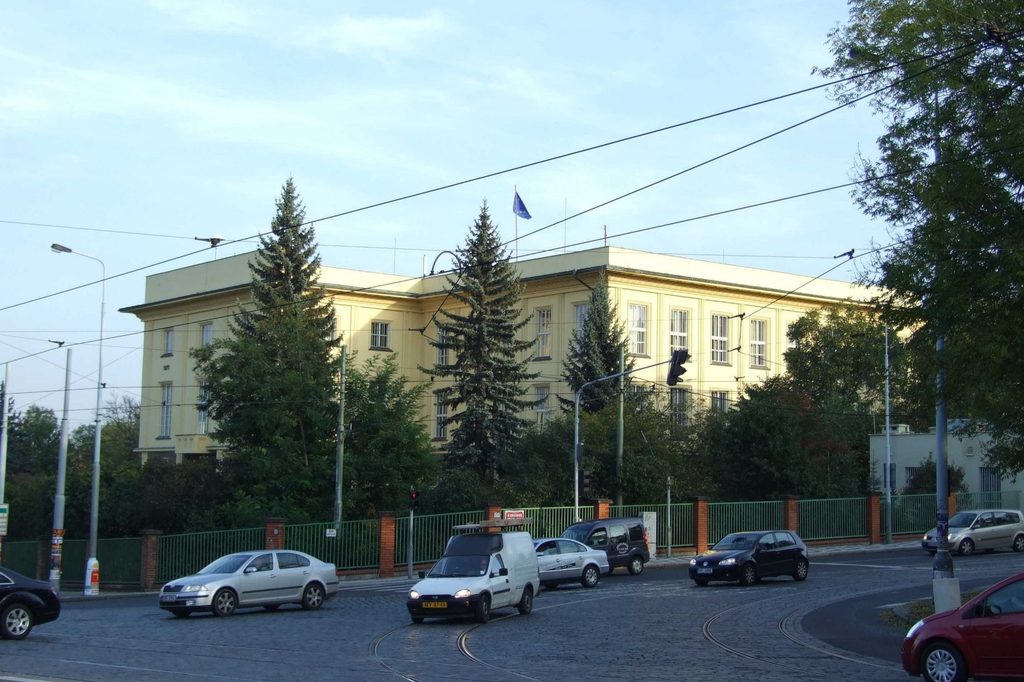
If you want to track down a highly unusual landmark, head up toward the hills near Prague Castle.
Josef Rosipal designed the old City Orphanage, which dates back to 1913. The architectural team over at Prague City Tourism classifies the property as a geometric Art Nouveau structure built with a completely flat roofline, which was a pretty radical design solution back then. Today, the Czech Ministry of Culture uses the building as its main office headquarters.
Checking out this specific spot is smart. It shows why you shouldn’t think this historic style only means looking at carved flowers and looping curves.
The geometric side of the movement looks way more controlled and modern.
- What to look out for: the completely flat roof layout, the balanced geometric block placement, and the highly simplified decorative details on the walls.
Can you go inside? No. Do not expect any regular tourist access inside the building. Since it functions as an active government ministry office, you should just treat it as an exterior stop to view from the street sidewalk.
Art Nouveau Prague by Neighborhood
If you don’t want to spend the entire day crossing Prague, organize your sightseeing geographically.
| Area | Best examples | Time to allow |
|---|---|---|
| Republic Square | Municipal House, Hotel Paris | 1.5 to 2 hours |
| Wenceslas Square | Evropa, Meran, Peterka, Golden Goose, Koruna | 1.5 to 2 hours |
| New Town | U Nováků, Topič, Prague Insurance Company, Hotel Central | 1.5 to 2 hours |
| Riverfront | Hlahol, Svatopluk Čech Bridge | 45 to 75 min |
| Castle District | Bílek Villa, City Orphanage | 1 to 1.5 hours |
| Prague 10 | Trmal Villa | 1 to 2 hours including travel |
| Bubeneč | Karel Mašek Villa and surrounding villas | 1 to 2 hours |
The central clusters are by far the simplest option for first-time visitors. The residential villas make way more sense for travelers who already know central Prague or just want to explore beyond the usual sightseeing route.
What Art Nouveau Prague Buildings Are Free to See?
This specific topic causes a massive amount of confusion for most people visiting.
Staring at the outside walls is obviously the cheapest and simplest way to experience the city. You can wander public streets and squares to study the façades without ever opening your wallet to buy a ticket.
Step past the front doors, though, and the rules change completely:
- Municipal House: The main café and restaurants are totally open to the public, but the big historical rooms upstairs require a paid tour or an event ticket.
- Fanta Café: Anyone walking through the central train station can just stroll right into this coffee shop area.
- Bílek Villa: This house runs as a museum, so you will need a standard entry ticket to get past the lobby.
- Trmal Villa: The indoor spaces stay off-limits to drop-ins, meaning you have to book onto a tour or show up for a specific event time.
- Svatopluk Čech Bridge: It is a public river crossing, meaning it is 100% free to walk across whenever you want.
- Private villas and offices: Stick to looking from the sidewalk since these active spaces are closed to tourists unless they announce special open days.
Just be prepared for the fact that entry tickets and access rules are a bit of a moving target, mostly because opening hours shift with the seasons, private events lock things down, or random renovation work changes plans out of nowhere. It is always smart to verify current conditions on the official webpage of the venue before you head out.
Common Mistakes Tourists Make in Art Nouveau Prague
Wandering around looking at buildings sounds easy enough. However, most visitors end up making the exact same mistakes. This happens when trying to track down these historic architectural gems:
Mistake 1: Thinking Art Nouveau means only floral decoration
The style isn’t just about stone flowers and leafy carvings. Prague actually has a ton of variety, ranging from highly organic, decorative buildings to later, super-clean geometric designs that look much sharper.
Mistake 2: Visiting only Municipal House
Don’t get me wrong, the Municipal House absolutely earns its massive reputation. But treating it like the only destination means you are missing out on a huge portion of the city’s architectural timeline.
Mistake 3: Ignoring Wenceslas Square
You can easily check out completely different building styles side-by-side if you spend an hour walking here. The plaza squeezes major spots like the Hotel Meran, the old Evropa façade, Peterka House, and the Golden Goose Hotel into one short stretch of sidewalk.
Mistake 4: Forgetting to look inside
An outside wall simply can’t tell you the whole story. The philosophy behind this movement was all about total environments, meaning the lobbies, light fixtures, and dining rooms inside are just as important as the street views.
Mistake 5: Assuming every building is accessible
You are going to run into doors you can’t open. Plenty of these locations serve as active commercial offices, private residential flats, hidden villas, or secure government headquarters that will turn tourists away at the entrance.
Mistake 6: Trying to see all 20 in one afternoon
You can knock out the central highlights pretty quickly if you plan right. That said, trying to sprint to the outer residential villas and properly tour the historic interiors in a single half-day is a recipe for burning out.
If you want a much broader look at the bad habits and missteps that can drain your time and money all over the city, take a look at our comprehensive guide to Things to Avoid in Prague.
Art Nouveau Prague vs Other Architectural Styles
This comparison can save you a lot of confusion when walking through the city.
| Style | What to look for | Prague example |
|---|---|---|
| Gothic | Sharp arches, tall vertical lines, intricate stone window ribs | St. Vitus Cathedral |
| Baroque | Massive curves, heavy domes, lots of theatrical movement | St. Nicholas Church |
| Art Nouveau | Flowing lines, stone flowers, human figures, matching details | Municipal House |
| Cubism | Harsh angles, weird diamond shapes, crystalline geometry | House of the Black Madonna |
| Functionalism | Super clean lines, totally practical blocks, almost zero decoration | Later 20th-century buildings |
How Long Do You Need to See Art Nouveau Prague?
1 to 2 hours
Stick strictly to the core highlights here. You’ll want to focus your time around the Municipal House, Hotel Paris, Hotel Central, and the main drag of Wenceslas Square.
3 to 4 hours
Expanding your itinerary a bit lets you add places like U Nováků, Topič House, the Prague Insurance Company block, and the old Fanta Building. This window also gives you enough breathing room to squeeze in one solid café stop.
Half a day or more
With a longer block of time, you can easily venture out toward the riverfront to see the Prague Hlahol building and the Svatopluk Čech Bridge, before heading up the hill into the Castle District.
Full day
This is where you combine the entire central walking loop with the out-of-the-way residential spots, specifically the Bílek Villa, Trmal Villa, or the collection of homes out in the Bubeneč neighborhood.
Don’t push yourself to check off every single address just because the list hits 20 properties. Select the specific route segments that actually match what you want to see.
If you are interested in exploring the city through entirely different historical angles, take a look at our guide to Prague Themed Walks, which covers specialized routes for Art Nouveau, Cubist buildings, medieval history, Jewish heritage, and hidden local spaces.
Alfons Mucha and Art Nouveau Prague
You simply cannot talk about this city’s design history without bringing up Alfons Mucha.
Mucha basically got famous worldwide because of his fancy posters. Still, his real impact on the local streets goes way past basic canvas art. He was heavily involved in designing the inside of the Municipal House, where he took complete charge of the Mayor’s Hall rooms. On top of that, his early illustrations regularly lined the walls over at the Topič Salon. Even the team at Prague City Tourism put together a specialized Mucha’s Prague Trail, which connects the actual physical addresses tied to his career and life.
If you are traveling through and love big buildings and fine details, pairing a walk through the Municipal House with these specific Mucha spots gives you a much better grasp of the whole era.
Frequently Asked Questions About Art Nouveau Prague
The Municipal House is easily one of your top choices. It features a wildly detailed exterior and incredibly grand rooms decorated by famous Czech artists like Alfons Mucha.
Start wandering around Republic Square and Wenceslas Square first, before cutting across toward Národní třída and the Main Railway Station. These central neighborhoods pack an incredible number of important landmarks into a highly walkable area.
The Municipal House is universally known as a cornerstone of this historic style. However, the exterior also mixes in a few older historicist details.
Yes, you can do that easily. Properties like the Municipal House, Bílek Villa, Trmal Villa, and the Fanta Café welcome visitors inside for everything from a quick cup of coffee to formal museum tours.
Give yourself roughly 2 to 4 hours to knock out the main central route with a handful of stops. If you plan to add the far-flung residential villas and internal building tours, it will easily swallow up most of your day.
It is completely free if you look at the gorgeous front facades from the public sidewalks. However, stepping past the front doors usually costs money. You might need to buy a museum ticket or join a guided group. Alternatively, you can just buy something at the counter. Always check the property rules first.
Final Thoughts
The absolute best way to experience the city’s architecture isn’t to sprint frantically from one landmark to the next. You need to slow your pace down, tilt your head up past the regular shop signs, check out the entryways, catch the tiny design patterns, and step inside the lobbies whenever the doors are open.
Whether you are exploring major central spots like the Municipal House, the Fanta Café, and Wenceslas Square, or tracking down the Hlahol building, the Bílek Villa, and the quiet residential properties out past the core streets, art nouveau Prague is always best discovered one single detail at a time.