
Prague architecture is, hands down, the main reason millions of people pack their bags for the Czech capital every single year. Honestly, very few places on earth have managed to keep nearly a thousand years of building history this pristine. On a simple afternoon walk, I found myself staring at ancient Romanesque churches, massive Gothic cathedrals, and lavish Baroque palaces, only to turn a corner and run straight into Art Nouveau masterpieces, quirky Cubist structures, and bold modern landmarks.
The big differentiator here is survival. Unlike so many European capitals that were leveled during World War II, Prague somehow escaped the worst of the destruction. Because its historic heart stayed remarkably intact, it easily earned its UNESCO World Heritage status. For anyone who gets excited by design and history, this city feels like an open-air museum.
But don’t think it’s stuck in the past. Prague actively welcomes edgy, contemporary design too. Icons like the famous Dancing House and the provocative public sculptures by David Černý inject a sharp, modern energy right into the middle of the historic skyline.
If you want my advice, the only real way to take it all in is on foot. Every single neighborhood and side street tells a completely different story, shifting from tight medieval alleys to sweeping 19th-century boulevards. To make things easy, we actually mapped out a step-by-step route in our guide to 20 famous Prague streets with architecture, photos + map, where we point out Art Nouveau on Pařížská, Baroque houses on Nerudova, and medieval courtyards on Karlova.
In this breakdown, I’m diving into 25 famous buildings in Prague. We’ll cover the fascinating backstories, the architectural quirks, and the exact design styles that make this city one of the most stunning places in Europe.
How to Tackle Prague’s Best Architecture If You’re in a Rush (Quick Answer)
Look, if you are racing against the clock but still want to see the absolute best of the city’s design, this is the exact walking loop I would recommend:
- Prague Castle: Head here first to get your fill of heavy Romanesque structures, dramatic Gothic spikes, and elegant Renaissance details.
- Lesser Town (Malá Strana): Wander down through this area next to check out some seriously opulent Baroque churches and hidden noble palaces.
- Charles Bridge & Old Town: Walk across the famous bridge straight into the old core to hit a wild mix of Gothic towers, gorgeous Art Nouveau facades, and those strange Cubist buildings.
- New Town: Keep moving into this district if you want to see how the city handles modern design, including the famous, twisting Dancing House.
- Karlín or Holešovice: Wrap up your day in these industrial-turned-cool neighborhoods to see where Prague’s fresh, contemporary architecture lives.
This quick route pretty much crams every single major building era into one incredibly packed, eye-opening day.
If you prefer exploring with a specific vibe in mind instead of just ticking off the main tourist spots, definitely check out our Prague Themed Walks guide. It basically gives you 10 different game plans depending on what you’re into. We mapped out everything from spooky medieval spots and Kafka’s old haunts to gorgeous Art Nouveau buildings, Jewish history, and even some completely empty, quiet corners.
Prague Architecture by the Numbers
Before you actually head out the door to explore, let’s look at some quick, interesting facts that show why Prague’s layout is so incredibly unique.
- The UNESCO Status: The city has been officially locked in as a UNESCO World Heritage Site since 1992.
- The Variety: You will pass through 9 major design eras here. Most cities only give you two or three.
- What We are Covering: This guide dives straight into 25 famous buildings you cannot miss.
- The Oldest Spot: The absolute grandfather of Prague’s buildings is the Basilica of St. George, dating all the way back to around 920 AD.
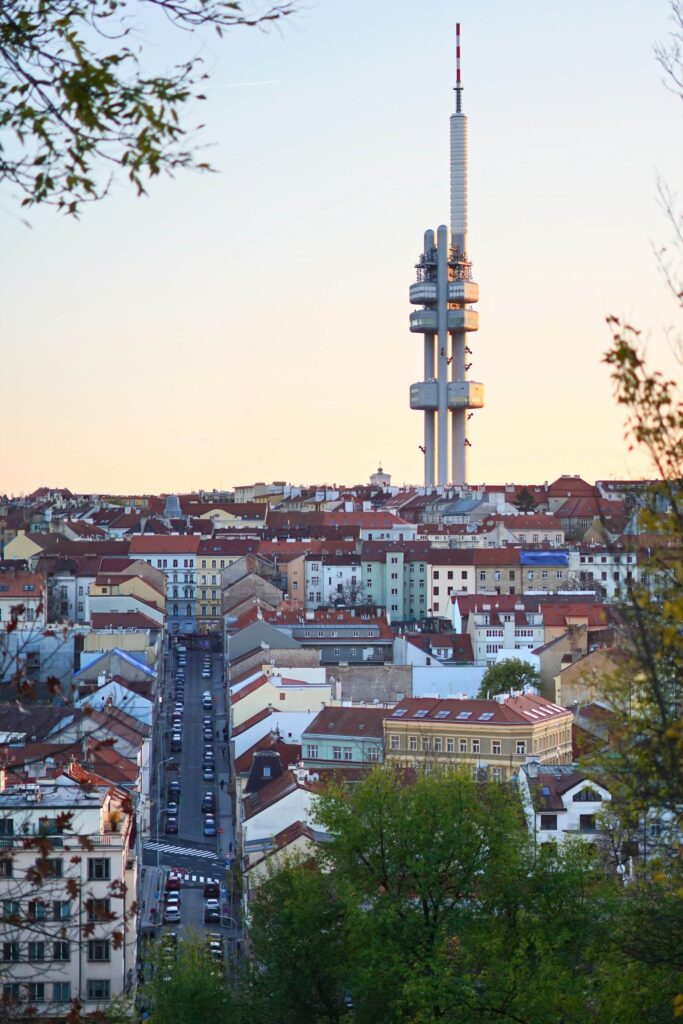
- The Tallest Landmark: If you look toward the horizon, you literally can’t miss the Žižkov Television Tower. It clocks in at 216 meters high, making it the highest thing in the city by far.
- The Best Walking Loop: Don’t overcomplicate your route. Just start up at Prague Castle, wander down through Lesser Town, cross over the Charles Bridge, and then hit the Old Town before wrapping things up in the New Town.
- How Long to Stay: Look, you can easily rush through the absolute highlights in a single 1-day sprint if you’re desperate. But if you actually want to explore without ruining your feet, plan for 2 or 3 days instead.
A Quick Breakdown of Prague Architecture Changing Styles
| Style & Era | When It Happened | The Ultimate Example to Visit |
|---|---|---|
| Romanesque | 10th to 12th Century | Basilica of St. George (The oldest vibe in town) |
| Gothic | 13th to 15th Century | St. Vitus Cathedral (Massive, dark, and spiky) |
| Renaissance | 16th Century | Belvedere Summer Palace (Super elegant and clean) |
| Baroque | 17th to 18th Century | St. Nicholas Church (Over-the-top dramatic art) |
| Art Nouveau | Late 19th Century | Municipal House (Incredibly detailed and flowery) |
| Cubism | Early 20th Century | House of the Black Madonna (Total geometric madness) |
| Functionalism | The 1920s | Villa Müller (Minimalist and sharply stripped down) |
| Communist Era | 1950 to 1989 | Hotel International (Heavy Soviet-style presence) |
| Contemporary | 1990 to Present Day | Dancing House (The wild, twisting modern icon) |
Why Prague Architecture Stands Out Across Europe
Honestly, I don’t think many places on the map can boast such an unbroken, seamless timeline of design.
You can walk just a mile or two and literally step through almost every significant design movement Europe ever went through. You might be looking at an old, rugged medieval church one second, and then right next door is a highly detailed Renaissance palace. You’ll catch Baroque domes popping up right behind delicate Art Nouveau storefronts, and then turn around to see sleek modern glass reflecting stone towers that have stood for centuries.
Instead of tearing down old neighborhoods to make room for the new, the city basically let every single generation build right alongside whatever was already there. This hands-off approach created a weirdly perfect harmony you just don’t stumble across in other major capitals.
Now that you know how the layout works, let’s look at the actual standout buildings you should check out.
25 Famous Prague Architecture Buildings You Shouldn’t Miss
1. St. Vitus Cathedral: Gothic Masterpiece of Prague Architecture
Architectural Style: Gothic
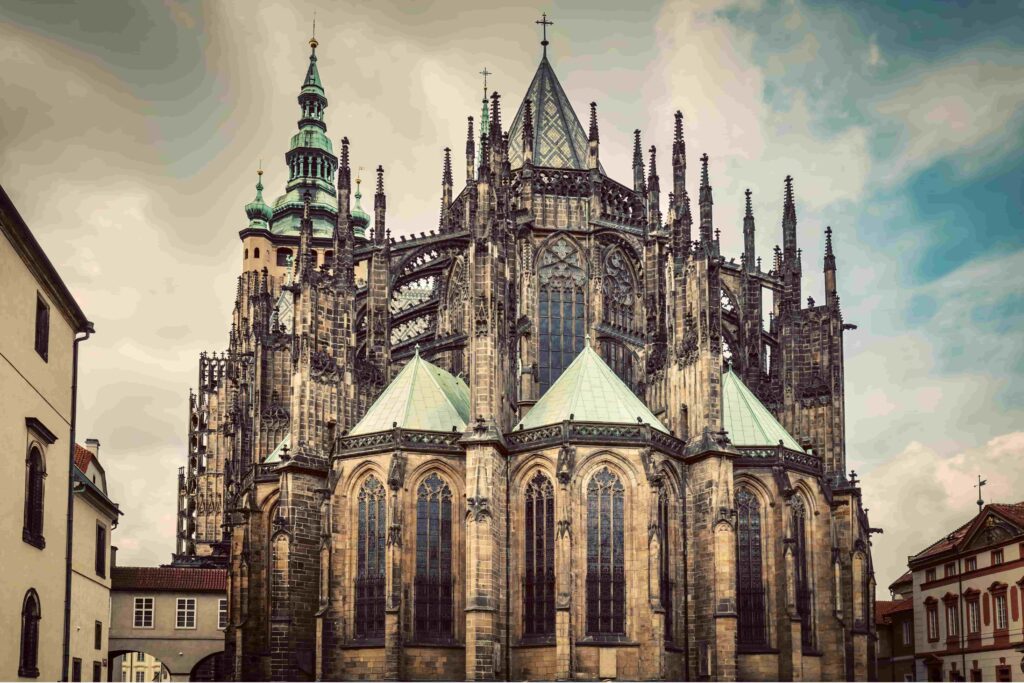
If you look up from almost anywhere inside the Prague Castle complex, St. Vitus Cathedral dominates the view. It is easily the most dramatic example of Gothic design you’ll find in the entire city.
The story of how this place actually got built is pretty wild. Construction kicked off way back in 1344 because of Emperor Charles IV, but the final blocks weren’t put into place until 1929. Wrapping up the project took almost 600 years. Even with that massive delay, the whole structure holds together beautifully as a prime piece of European Gothic history.
From the outside, the massive spires and dark stonework look incredibly imposing. But the whole atmosphere flips the second you walk through the doors. The interior opens up into this massive space lit by beautiful stained glass, and you can even spot a masterpiece in there designed by Alfons Mucha. You’ll also run into the St. Wenceslas Chapel and the old tombs where Bohemian kings were laid to rest.
If you have the energy, huffing it up the Great South Tower gives you some of the best panoramic views over the rooftops. Also, if you plan on checking out more than one church during your visit, we laid out all the ticket details, opening hours, and the smartest routes in our full Prague Cathedral Circuit guide.
What to look out for:
- The stunning St. Wenceslas Chapel
- The Royal Crypt down below
- The intricate Golden Gate Mosaic
- The climb up the Great South Tower
A Quick Photo Tip:
Try to get here before 9 a.m. Not only is the lighting way softer for pictures, but you will also beat the waves of tour groups that show up later in the morning.
2. Basilica of St. George: Romanesque Prague Architecture
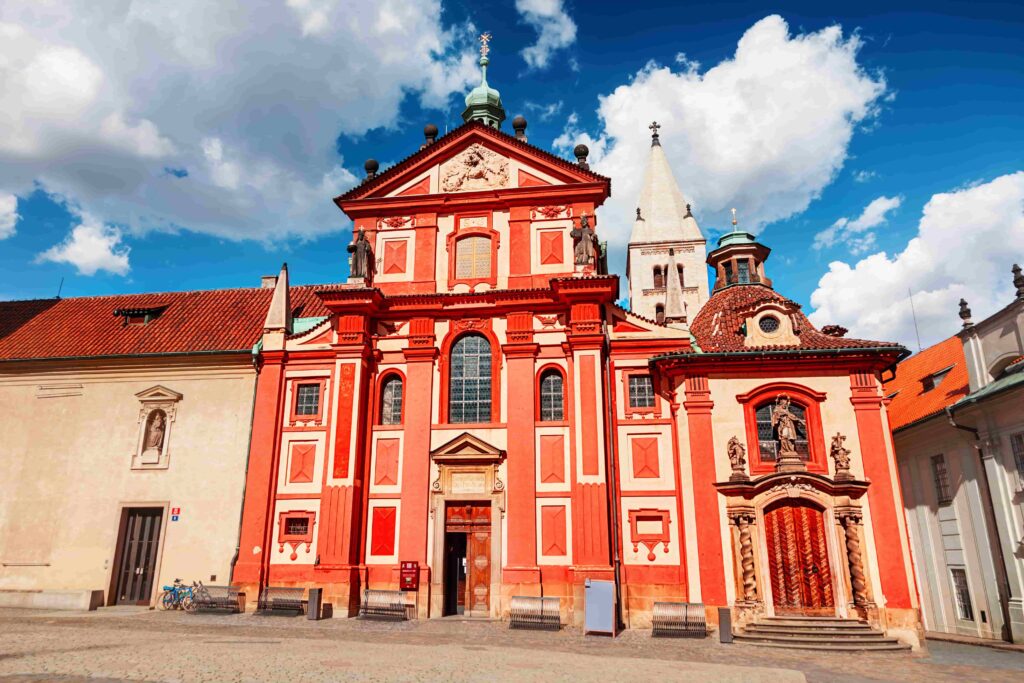
Architectural Style: Romanesque
Right around the corner from St. Vitus Cathedral, you’ll stumble onto the single oldest surviving church in the city.
The Basilica of St. George was set up somewhere around 920 AD, making it roughly a thousand years older than a lot of the neighboring structures you’ll see. It has these massive thick walls, heavy rounded arches, and a stripped-back layout that shows you exactly what early Romanesque design was all about.
You won’t find any of the over-the-top, fancy details that dominate the massive Gothic cathedrals here. Instead, the building relies on a very simple, calm atmosphere where the sheer age of the stone does all the talking.
If you look up from the outside, those iconic twin white towers rising from behind the red facade have easily become some of Prague Castle’s most recognizable features.
What to look out for:
- The striking, bright red Baroque front facade
- The final resting place of Saint Ludmila down in the crypt
- The beautiful, surviving fragments of 12th-century frescoes on the ceiling
- The stark contrast of the two white limestone towers outside
A Quick Photo Tip:
For the best photos, stand out in the square during the late afternoon when the sun hits the front of the building directly.
3. Old Royal Palace: Gothic and Renaissance Architecture in Prague
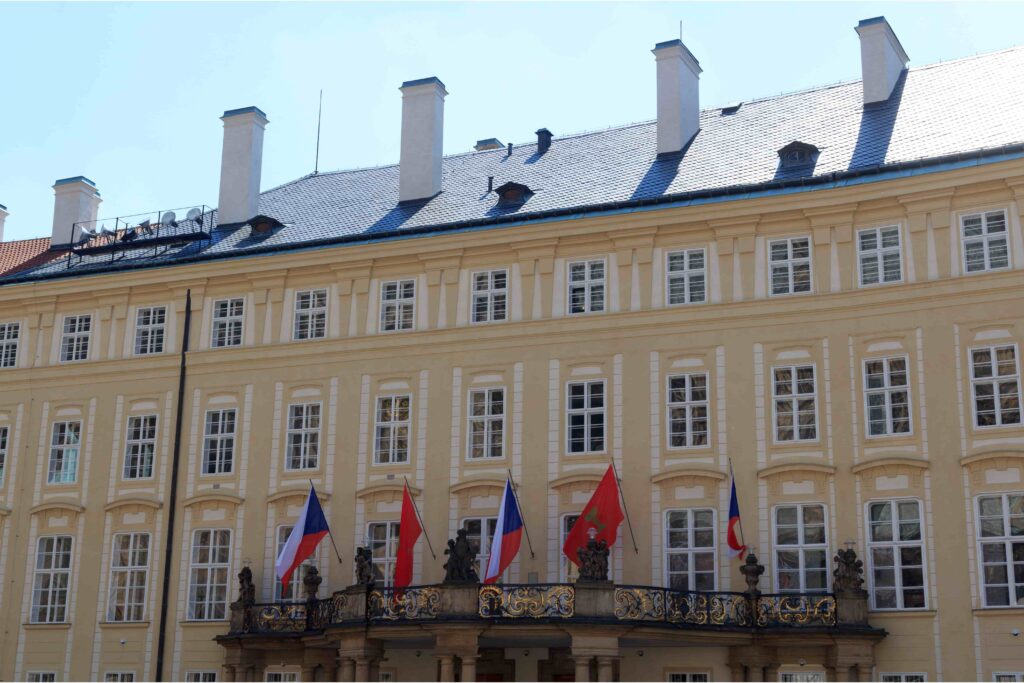
Architectural Style: Gothic & Renaissance
This massive building served as the actual home base for Bohemian kings for hundreds of years.
The real standout spot inside is Vladislav Hall, which completely broke all the engineering rules when it was built. The builders managed to span a massive space with a huge vaulted ceiling without putting a single supporting column in the middle of the room. It was an absolute engineering triumph for the late Gothic era.
It is also pretty wild to imagine, but knights actually used to ride their horses straight into this massive room to hold indoor jousting tournaments.
When you walk through the space today, you are stepping through the exact historic rooms where some of the biggest turning points in Czech history went down. If you’re interested in tracking down other royal residences while you’re in town, take a look at our guide to the best palaces in Prague for a full look at hours and tickets.
What to look out for:
- The massive, column-free expanse of Vladislav Hall
- The unique Riders’ Staircase built specifically for horses
- The old office rooms where the famous Defenestration of Prague happened
- The intricate stonework weaving across the vaulted ceilings
A Quick Photo Tip:
Since you are shooting indoors under massive vaulted ceilings, skip the flash completely. Instead, stand near the high windows in the main hall to let the natural side-light pull out the shadows in the stone architecture.
4. Belvedere Summer Palace: Renaissance Architecture in Prague
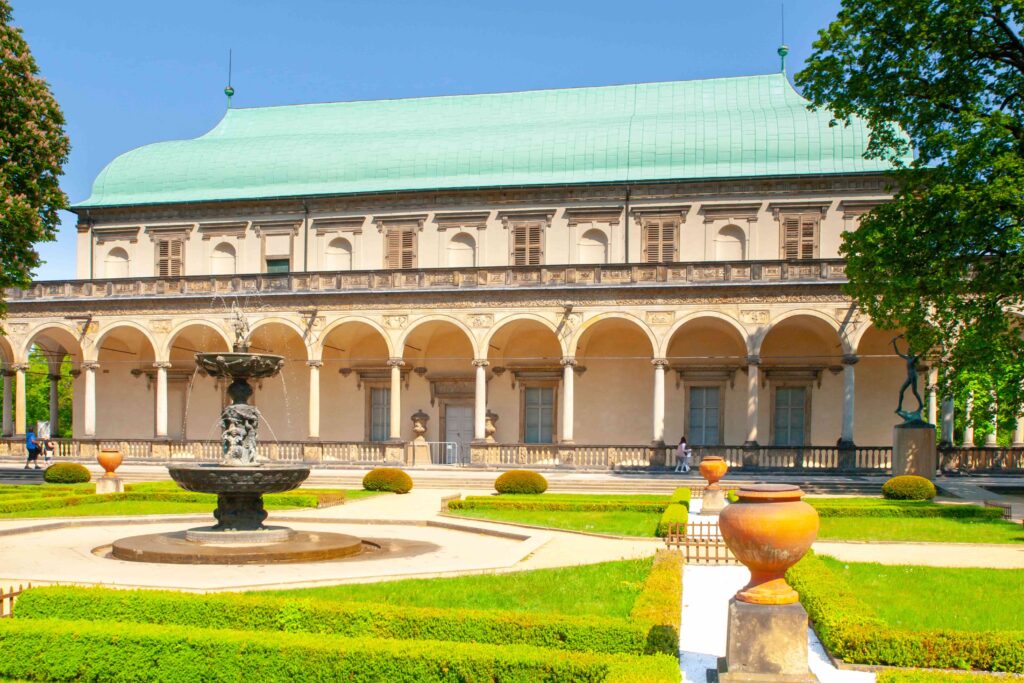
Architectural Style: Renaissance
People frequently talk about this palace as the absolute best example of Renaissance design you can find anywhere north of the Alps. Emperor Ferdinand I originally ordered it to be built back in the 16th century as a gift for his wife, Queen Anne.
It looks totally different from the city’s dark Gothic spots. They used simple, repeating pillars and archways here to give you some breathing room.
Because it sits completely enclosed by the Royal Gardens, the entire area has a remarkably quiet, relaxed vibe. It is easily one of the best spots to escape the heavy crowds in the center of the city.
What to look out for:
- The long row of delicate arches forming the ground-floor arcade
- The unique copper roof that looks exactly like an upside-down ship’s hull
- The famous Singing Fountain sitting right in the formal garden out front
- The detailed stone reliefs carved along the building’s exterior walls
A Quick Photo Tip:
For the best photos, stand out in the square during the late afternoon when the sun hits the front of the building directly.
5. Schwarzenberg Palace: Renaissance Architecture in Prague
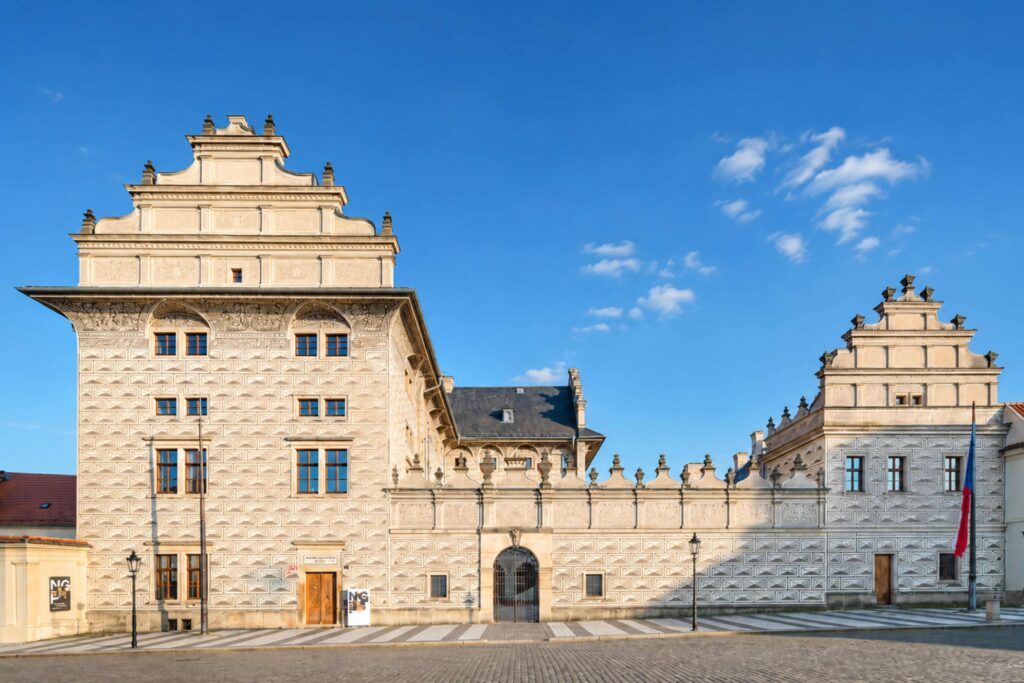
Architectural Style: Renaissance
Honestly, very few spots on the street grab your eye quite as fast as this palace does.
When you first look at the striking black-and-white facade, you’d swear it’s covered in heavy, three-dimensional carved stone blocks. But it’s actually an optical illusion. The entire pattern is painted flat onto the walls using an old Renaissance plaster technique called sgraffito. It is incredibly cool to see up close because your brain tells you it is textured, but your hands tell you it is smooth.
These days, the building holds a massive collection of artwork for the National Gallery. It easily stands out as one of Prague Castle’s absolute must-see design highlights.
What to look out for:
- The clever plaster designs painted on to look like pointing pyramids
- The richly decorated, steep gables lining the very top of the roofline
- The beautiful Renaissance ceiling paintings kept safe inside the main rooms
- The massive main gateway leading into the inner courtyard area
A Quick Photo Tip:
For the best photos, stand out in the square during the late afternoon when the sun hits the front of the building directly.
6. Church of Our Lady before Týn: Gothic Prague Architecture Landmark
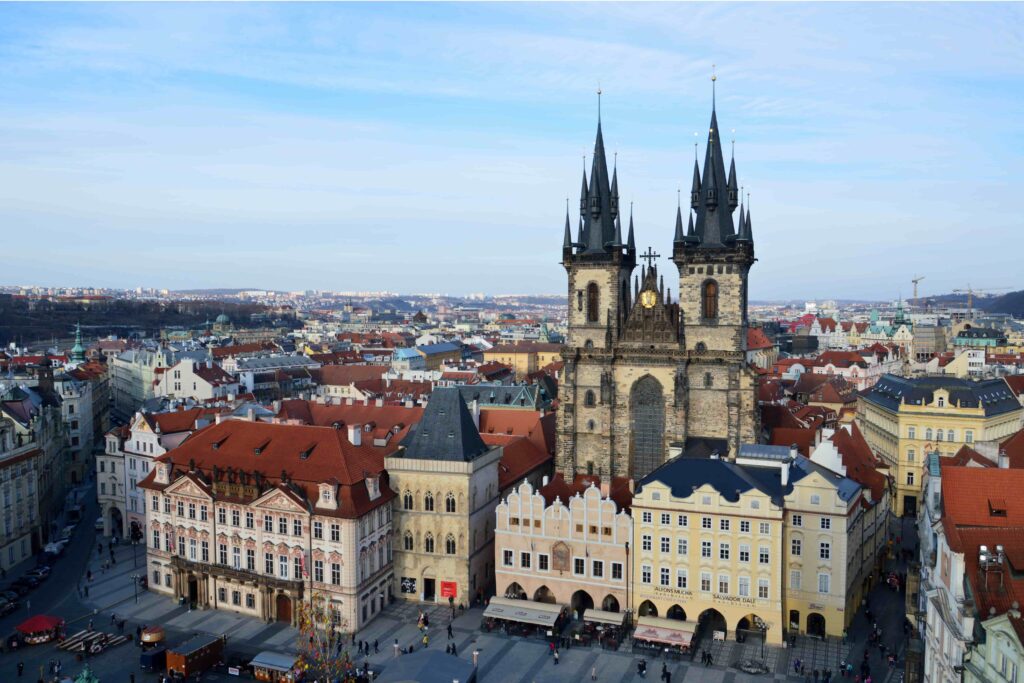
Architectural Style: Gothic
If you stand right in the middle of the Old Town Square and look up, this massive church completely dominates the horizon. It easily stands out as one of the most captured backdrops in the entire city.
Take a good look at those two massive towers and you’ll see they don’t actually match. According to local legend, the builders made them uneven on purpose to stand for man and woman. For hundreds of years, sailors making their way down the Vltava River actually relied on these dark spires as an early navigation point to find the city center.
When the sun starts to go down, the dark outline of the spires against the sky gives you an incredible view. If you want more inspiration on things to do when the sun goes down, check out our guide to Prague Night Activities.
What to look out for:
- The two asymmetric towers, Adam and Eve, topped with tiny spikes
- The hidden entrance way tucked right behind the houses on the square
- The old Gothic stone pulpit preserved inside the main hall
- The dramatic dark spires piercing the skyline at night
A Quick Photo Tip:
For the best photos, stand out in the square during the late afternoon when the sun hits the front of the building directly.
7. Powder Tower: Medieval Prague Architecture and Royal Route
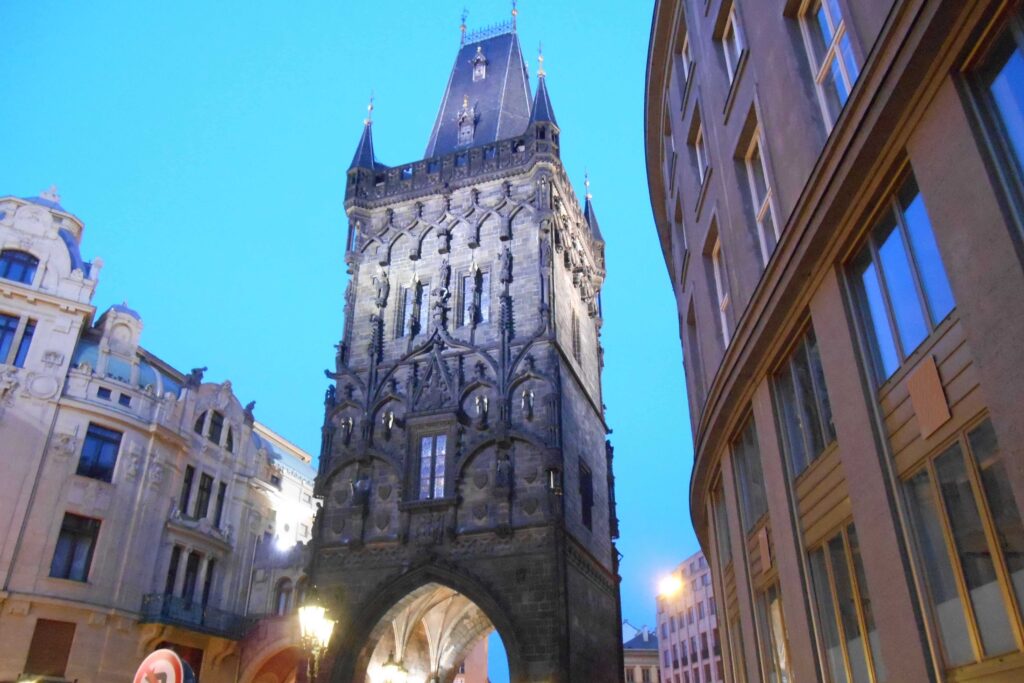
Architectural Style: Gothic
This dark, massive structure originally served as one of the main gates leading into the old medieval city. It also marked the very beginning of the famous Royal Route, which is the exact path kings would take during their coronation marches toward the castle.
Work on the stone started in the late 15th century, but down the line, people started using it to store actual gunpowder. That storage choice is exactly how the building ended up with the name it has today.
If you are up for a quick leg workout, you can head inside and climb close to 200 stone steps to get a great look over the surrounding rooftops. By the way, if you love getting above the crowds for a good view, check out our guide to the best towers in Prague to see current ticket costs and figure out which ones are actually worth the climb.
The highly detailed stone carvings on the outside walls show off the exact type of heavy craftsmanship that made the city a major artistic hub back in the Middle Ages.
What to look out for:
- The dark, weathered Gothic exterior carvings and statues
- The massive archway spanning directly across the roadway
- The steep stone staircase tucked inside leading to the top deck
- The historical exhibits explaining the old city defense network
A Quick Photo Tip:
For the best photos, stand out in the square during the late afternoon when the sun hits the front of the building directly.
8. Old Town Bridge Tower: Gothic Prague Architecture Gateway
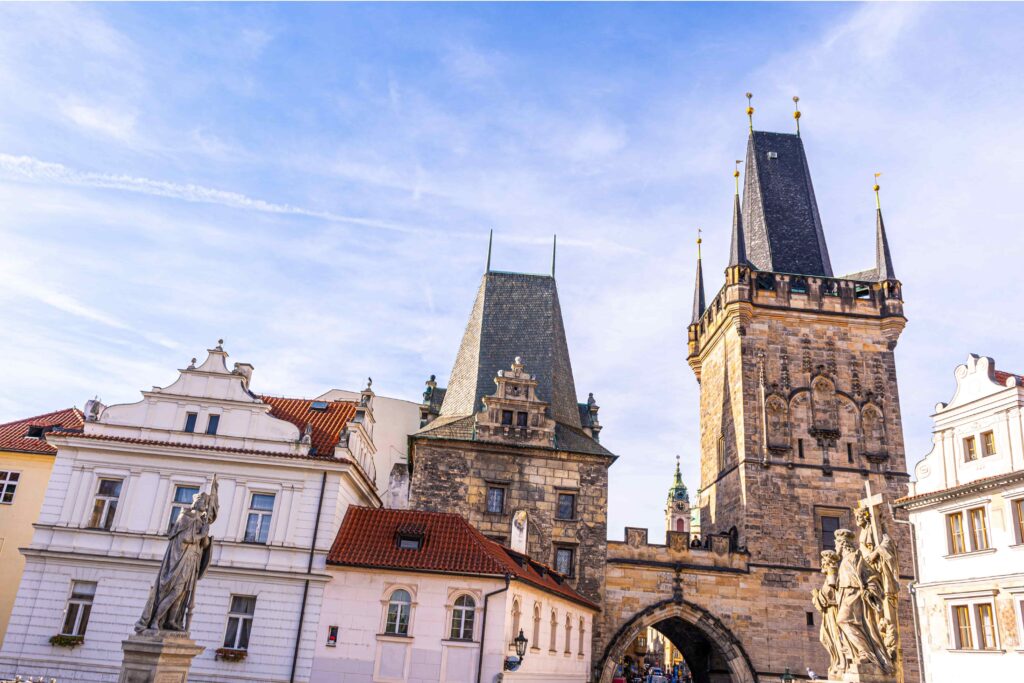
Architectural Style: Gothic
Guarding the eastern entrance to Charles Bridge, the Old Town Bridge Tower is widely regarded as one of the most beautiful Gothic gateway towers in the world. Designed by the celebrated architect Peter Parler in the late 14th century, it formed part of Prague’s Royal Route, welcoming Bohemian kings during their coronation processions.
The tower is richly decorated with statues of Charles IV, Saint Vitus, and Saint Wenceslas, along with intricate Gothic carvings that symbolize the power and prestige of medieval Prague. Inside, a winding staircase leads to a viewing gallery overlooking Charles Bridge, the Vltava River, and Prague Castle.
If you want to explore more river crossings, check out our guide to the most beautiful bridges in Prague with history, views, and photo spots.
Why Visit
- One of Europe’s finest examples of Gothic civic architecture.
- Spectacular panoramic views.
- Less crowded than many castle viewpoints.
Photography Tip
Visit just before sunset when the golden light illuminates Prague Castle across the river.
9. Municipal House (Obecní dům): Art Nouveau Prague Architecture Masterpiece
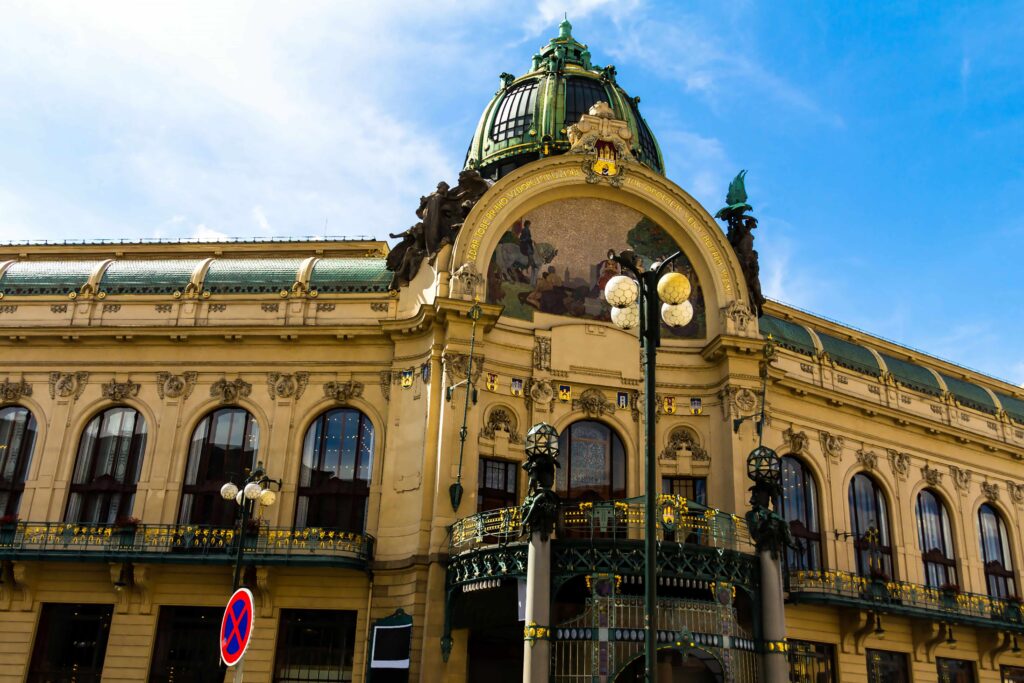
Architectural Style: Art Nouveau
If you wanted to point to just one building that acts as the ultimate palace for the Art Nouveau movement, this is absolutely it.
Finishing touches on the exterior wrapped up around 1912. The front facade is packed with detailed mosaic panels, stone figures, looping floral patterns, and highly stylized ironwork. Basically, every square inch of the building shows off the wild, creative energy flowing through the city during the early 20th century.
When you walk past the doors, you run into luxurious concert halls put together by some of the most famous local creators, including Alfons Mucha. The main auditorium, Smetana Hall, is one of the most important classical music spaces in the country, playing host to major concerts during the annual Prague Spring International Music Festival. Aside from the incredible design, the building is a huge deal for local history too. Back in 1918, the official declaration of independence for Czechoslovakia was read out right here.
What to look out for:
- The massive glass dome sitting right over the main entrance arch
- The huge mosaic titled Homage to Prague displayed on the front wall
- The highly detailed Art Nouveau cafe on the lower level
- The brilliant murals painted by Alfons Mucha in the Lord Mayor’s Hall
A Quick Photo Tip:
For the best photos, stand out in the square during the late afternoon when the sun hits the front of the building directly.
10. House of the Black Madonna
Architectural Style: Cubism
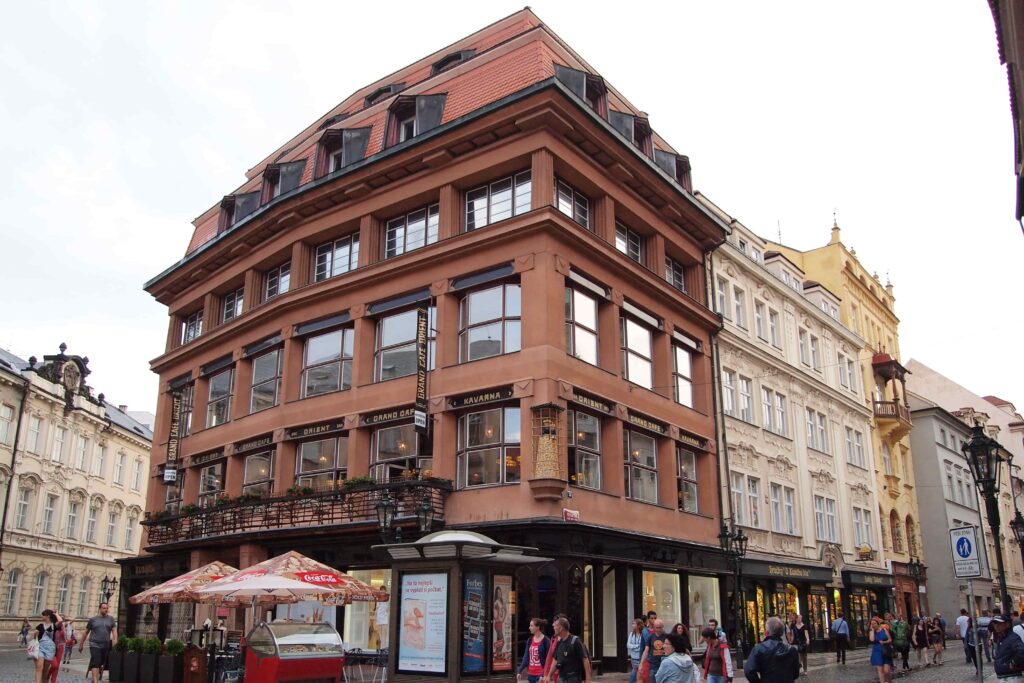
Prague happens to be the only place on the planet where Cubism jumped off the canvas and actually became a full-blown building movement instead of just a painting style. This building stands out as the ultimate masterpiece of that short-lived experiment.
An architect named Josef Gočár put the design together back in 1912. He completely ditched all the standard, smooth lines you see on regular buildings and replaced them with sharp angles, split-level surfaces, and blocky shapes inspired by avant-garde art.
The name itself comes from a tiny, dark Baroque statue of the Black Madonna tucked away behind a golden grille on one corner of the building. The builders actually saved it from the original old house that used to sit on this exact plot of land before they tore it down.
These days, the space inside is home to the Museum of Czech Cubism, where you can check out all kinds of wild geometric furniture, pottery, light fixtures, and interiors that you literally cannot find anywhere else in Europe.
What to look out for:
- The tiny Black Madonna statue mounted on the exterior corner structure
- The incredible, matching geometric grand staircase winding up inside the cafe
- The unique, deeply recessed angular windows that catch the light strangely
- The fully preserved Cubist-style Grand Cafe Orient on the first floor
A Quick Photo Tip:
For the best photos, stand out in the square during the late afternoon when the sun hits the front of the building directly.
11. Grand Café Orient
Architectural Style: Cubism
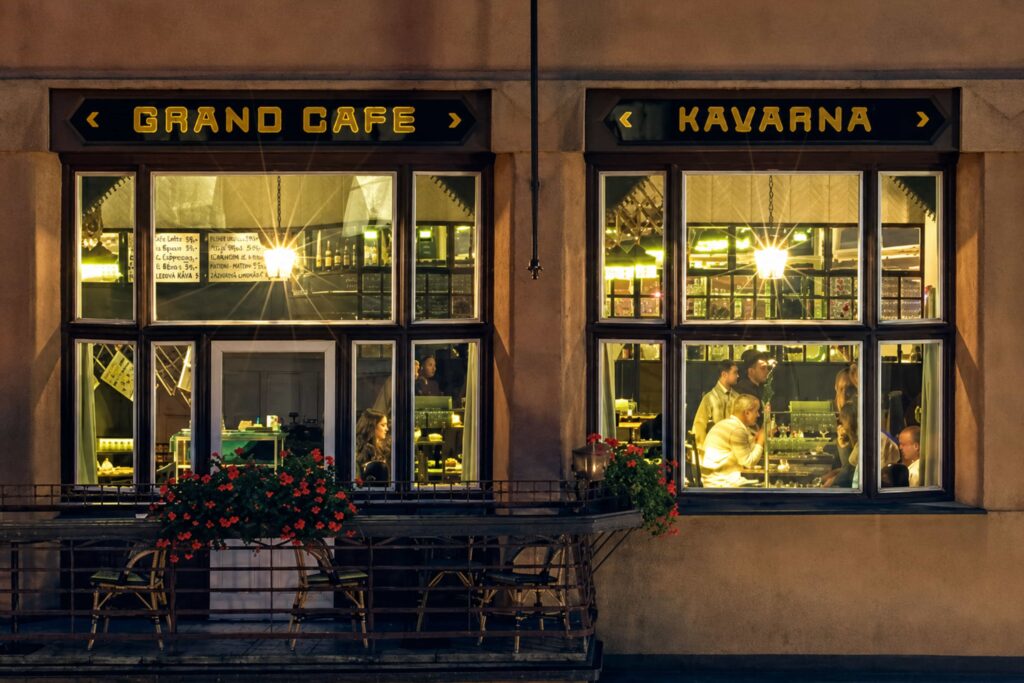
Tucked right inside the House of the Black Madonna, Grand Café Orient stands out as the only surviving Cubist cafe left on the planet.
The furniture, the wall patterns, and even the light fixtures all share the same blocky, sharp design. Even sitting down to order a basic cup of coffee ends up feeling like you are stepping directly into an interactive art piece.
The cafe originally opened its doors back in 1912, but it completely vanished for decades after fading out of style. Eventually, design teams tracked down the original old blueprints to rebuild the entire interior from scratch exactly how it used to look.
These days, it is a great spot to grab traditional Czech pastries while sitting inside one of the rarest interior designs ever built. By the way, if you love tracking down unique dining spots like this around town, take a look at our full list of the best restaurants in Prague.
What to look out for:
- The massive, custom-designed angular chandeliers hanging from the ceiling
- The geometric green lanterns lining the bar area
- The unique built-in coat hooks shaped like abstract diamond blocks
- The blocky, custom-made wooden chairs designed specifically for this room
A Quick Photo Tip:
Try to snag a table near the big front windows during the late afternoon. The natural daylight cuts right across the furniture, throwing really unique, sharp shadows across the room.
12. National Theatre
Architectural Style: Neo-Renaissance
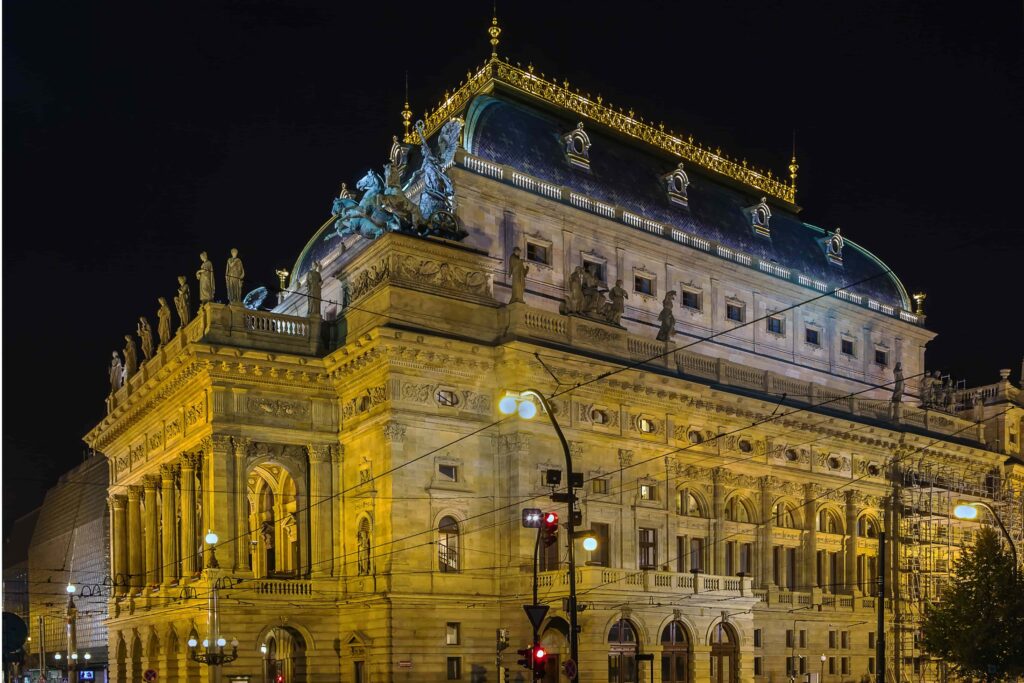
This place is a massive deal for local history. Back in the 19th century during the National Revival, it served as a huge focal point for Czech culture and identity.
The story of getting it built is pretty wild. Construction kicked off in 1868, funded almost entirely by small donations from thousands of regular Czech citizens. But just after they finally finished it in 1881, a massive fire broke out and absolutely gutted the building. Instead of throwing in the towel, the public immediately started raising cash all over again, pooling enough money to completely rebuild the whole theatre in under two years.
When you stand outside today, you’re looking at a highly detailed exterior topped with an incredible golden roof and lined with dramatic stone statues.
If you manage to catch a performance inside, look up above the main stage to spot the famous historic motto written across the proscenium arch:
“The Nation Unto Itself.”
Even now, it holds its ground as one of the most prominent cultural spots in the country.
What to look out for:
- The brilliant, gleaming golden crown roofing structure that glows at night
- The massive bronze statues of triga (three-horse chariots) riding the roof corners
- The lavishly painted ceilings and historical murals inside the main foyer
- The famous motto proudly painted right above the main performance stage
A Quick Photo Tip:
For the best photos, stand out in the square during the late afternoon when the sun hits the front of the building directly.
13. St. Nicholas Church
Architectural Style: Baroque
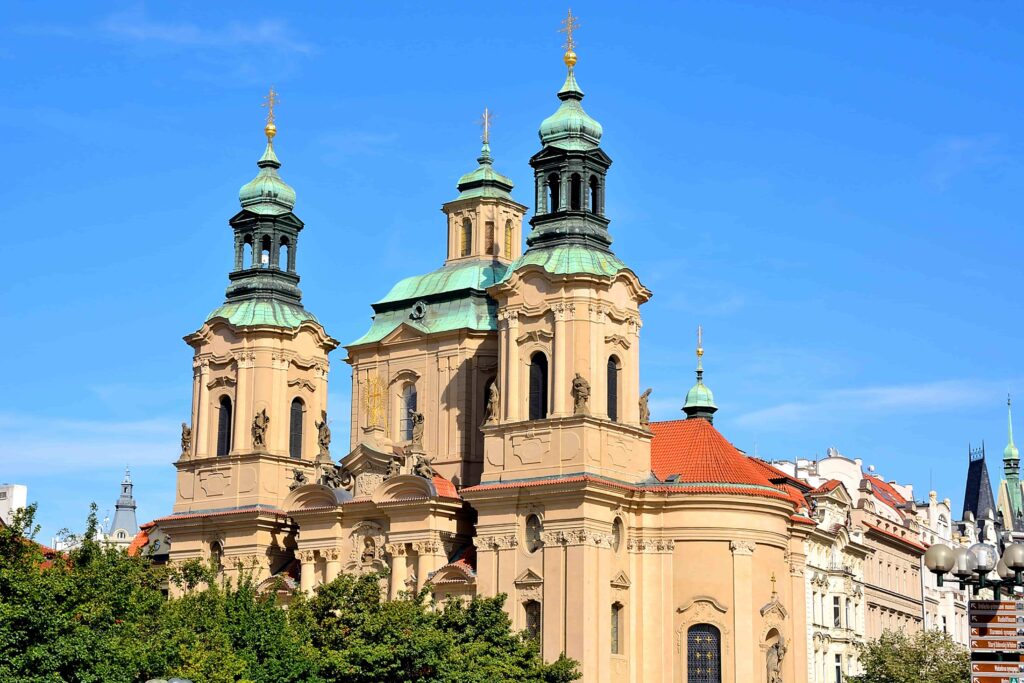
If you’re hanging out in Lesser Town Square, you really can’t miss this place. It stands as a massive landmark and a premier example of high Baroque style in the city.
A father-and-son team of architects, Christoph and Kilian Ignaz Dientzenhofer, put the plans together back in the 18th century. They went all-in on wavy exterior walls, massive columns, and a gigantic green copper dome that juts right up into the city skyline.
Once you walk inside, the whole place feels incredibly bright because of how the big windows let the light stream in. The ceiling art is painted to trick your eyes into thinking the roof is much taller.
It is also pretty cool for music history fans to note that Wolfgang Amadeus Mozart actually sat down and played the pipe organ here during his trips to the city.
What to look out for:
- The massive green copper dome dominating the skyline view
- The optical illusion paintings wrapping across the high ceiling
- The historic pipe organ that Mozart actually performed on
- The attached bell tower for a great vantage point over Lesser Town
A Quick Photo Tip:
For the best photos, stand out in the square during the late afternoon when the sun hits the front of the building directly.
14. Clementinum
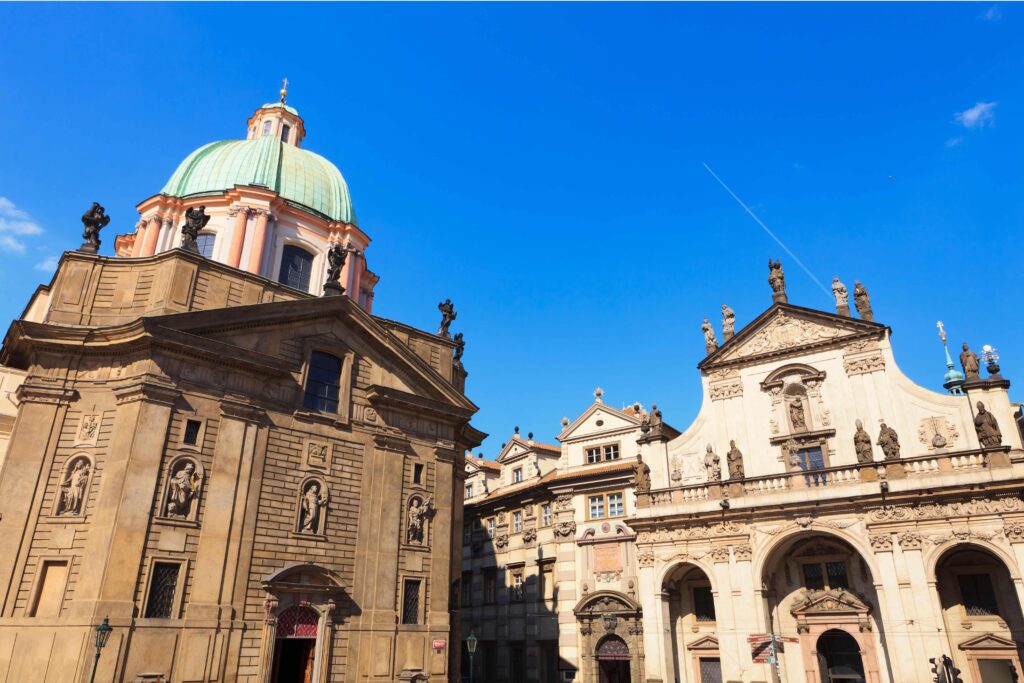
Architectural Style: Baroque
This whole site takes up about two hectares. In fact, only Prague Castle is bigger. Back in the 1500s, it was just a Jesuit college. Over time, they built more onto it until it became a giant Baroque layout with various courtyards, classrooms, and an observatory.
The most famous room inside is definitely the Baroque Library Hall. It features hand-painted ceilings, old historic globes, and carved wooden shelving that makes it a top spot for pictures.
You can also head up the Astronomical Tower if you want a great look across the city center. Besides the view, the complex holds a pretty cool link to scientific history. Albert Einstein actually worked and gave lectures right here back in 1911 during his time as a professor in the city.
What to look out for:
- The gorgeous Baroque Library Hall lined with old wooden shelves
- The high Astronomical Tower offering great city views
- The incredibly ornate Mirror Chapel inside the complex
- The old instruments kept inside the historic observatory room
A Quick Photo Tip:
For the best photos, stand out in the square during the late afternoon when the sun hits the front of the building directly.
15. Wallenstein Palace
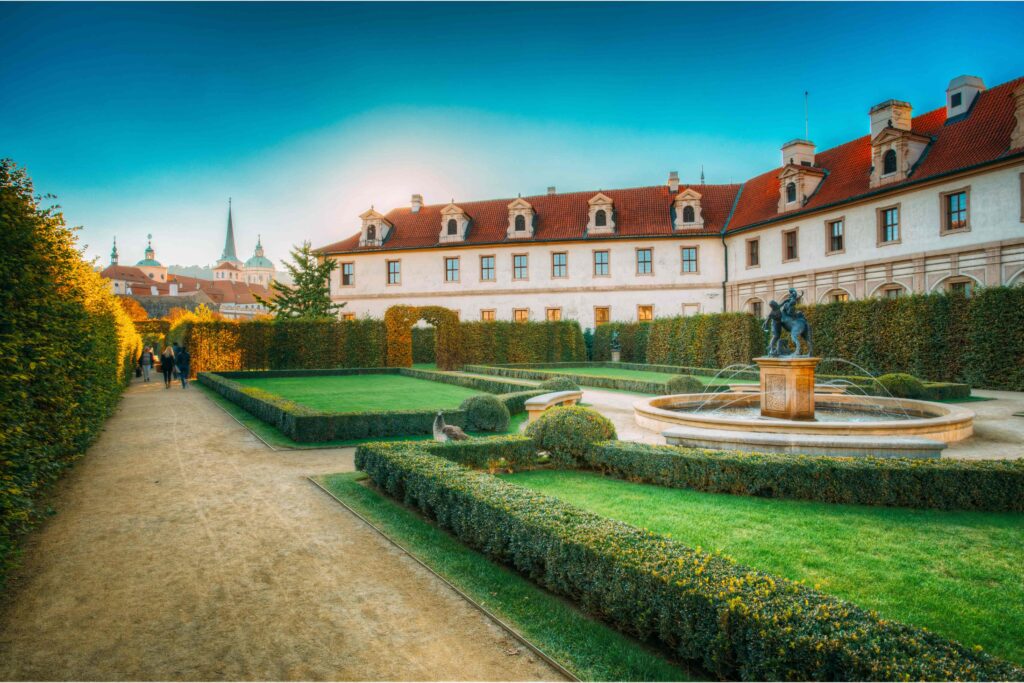
Architectural Style: Early Baroque
Finished back in the 1630s, this site stands out as the very first massive Baroque palace constructed in the city. A military leader named Albrecht von Wallenstein ordered it to be built because he wanted a residence grand enough to compete directly with Prague Castle.
You get several courtyards and large halls here. On top of that, there are massive landscaped gardens outside. Inside the Great Hall, you can look up to see an immense ceiling fresco showing Wallenstein dressed up like Mars, the Roman god of war.
Out in the gardens, you will come across hidden pathways, bronze statues, loose peacocks walking around, and a weird Dripstone Wall that looks like a spooky artificial cave.
There’s a pretty grim backstory here too. Wallenstein was murdered in 1634 on the Emperor’s orders, and people still repeat tales about ghost sightings and hidden alchemy labs under the property. You can read the whole legend in our guide to 16 strange dark stories in Prague locals don’t tell tourists.
Today, the Czech Senate uses the palace as their main headquarters, but a huge portion of the grounds stays completely open to the public.
What to look out for:
- The massive ceiling painting in the Great Hall showing Wallenstein as Mars
- The bizarre, artificial cave look of the Dripstone Wall outside
- The free-roaming peacocks hanging out by the fountains
- The symmetrical layout of the early Baroque garden paths
A Quick Photo Tip:
For the best photos, stand out in the square during the late afternoon when the sun hits the front of the building directly.
16. Loreto
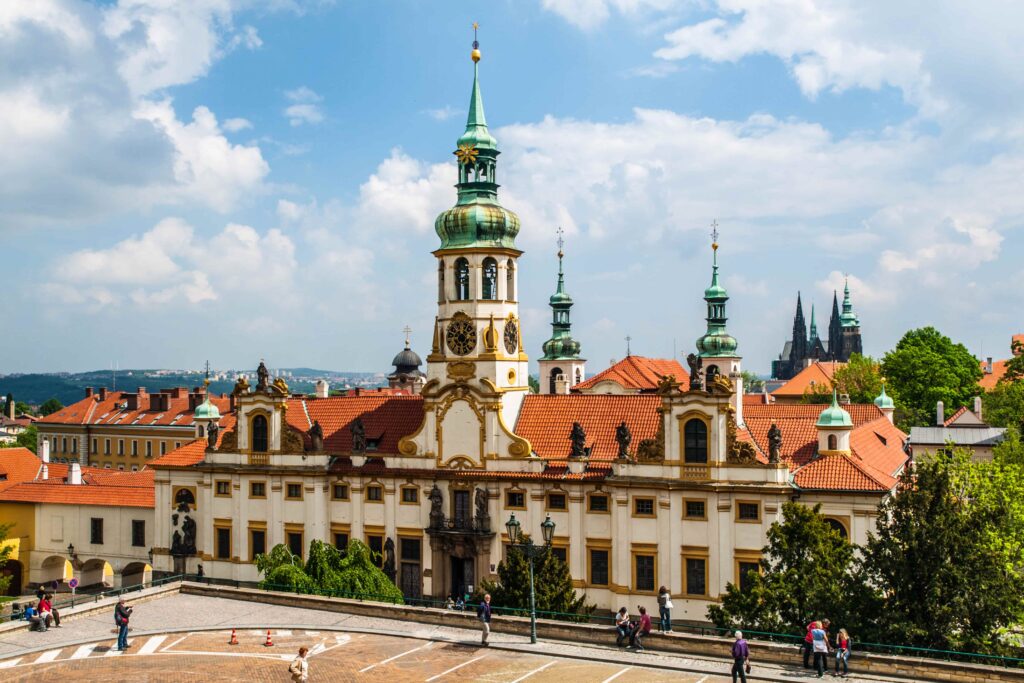
Architectural Style: Baroque
This site stands out as a massive destination for pilgrims and easily ranks as one of the most eye-catching Baroque landmarks around.
Work on the property kicked off during the 17th century. The designers modeled the main complex after the Holy House of Nazareth, which religious tradition marks as the original home of the Virgin Mary. A wealthy noblewoman named Kateřina Benigna commissioned the entire sanctuary to help support the Catholic Counter-Reformation.
When you walk in, you pass through a quiet courtyard surrounded by detailed cloister walkways before you reach the Santa Casa replica itself. The outside features a highly detailed Baroque front and a prominent bell tower that plays a famous historic carillon chime at the top of every hour.
If you head inside to check out the Loreto Treasury, you can see a massive collection of religious items. The absolute star of the show is the Diamond Monstrance, which is covered in over 6,000 actual diamonds.
What to look out for:
- The hourly bell concert ringing from the main tower
- The incredibly shiny, diamond-covered monstrance inside the treasury
- The quiet, covered cloister paths surrounding the courtyard
- The great panoramic views over the area from nearby Hradčany
A Quick Photo Tip:
For the best photos, stand out in the square during the late afternoon when the sun hits the front of the building directly.
17. Villa Müller
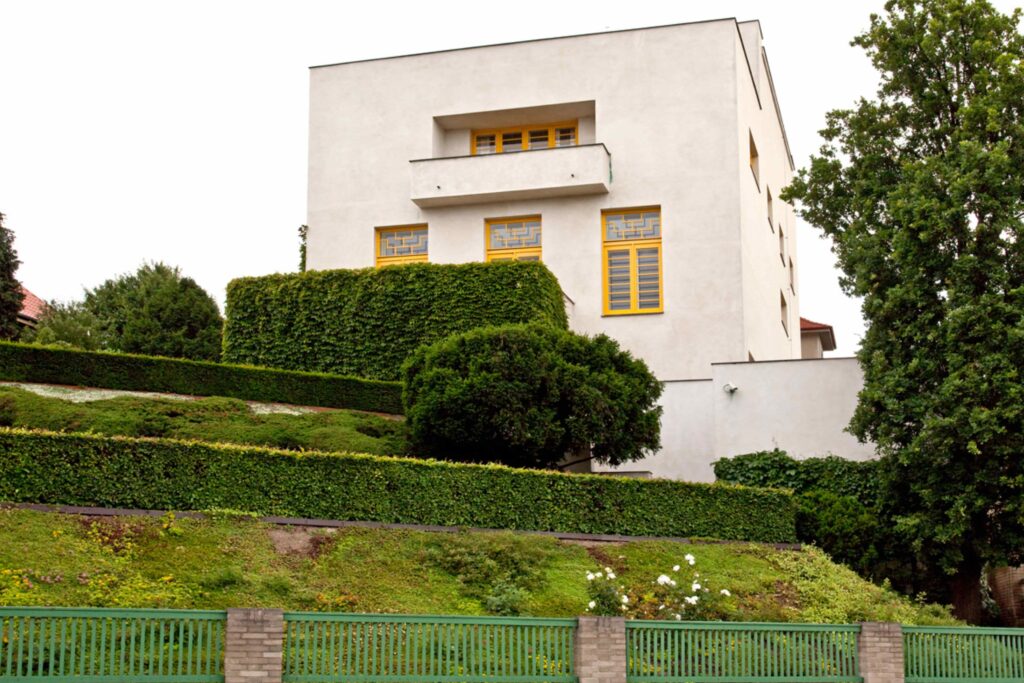
Architectural Style: Functionalism
Prague is famous for its old medieval stuff, but the city was also a huge deal for modern building design.
Take Villa Müller, for instance. This house was designed by an Austrian architect named Adolf Loos and finished up around 1930. If you look at it today, it’s pretty much the ultimate example of the Functionalist movement.
From the outside, it looks like a totally plain, white concrete box with zero decorations. It’s incredibly basic. But the second you walk inside, the layout completely changes the game.
Loos used this exact house to try out a wild idea he called the “Raumplan.” Instead of just stacking normal, identical floors on top of each other, he made every single room a different height and used split levels depending on what the room was for. Because he threw out the normal rules, the rooms still look shockingly modern.
This single house ended up changing how people designed homes all over Europe, so it’s a huge spot to visit if you care about twentieth-century design.
What to look out for:
- The plain, naked white cube shape facing the street
- The different room heights and steps inside from the Raumplan layout
- The high-end marble and wood surfaces used instead of wallpaper
- The built-in couches and shelves tailored right into the walls
A Quick Photo Tip:
For the best photos, stand out in the square during the late afternoon when the sun hits the front of the building directly.
18. Hotel International Prague
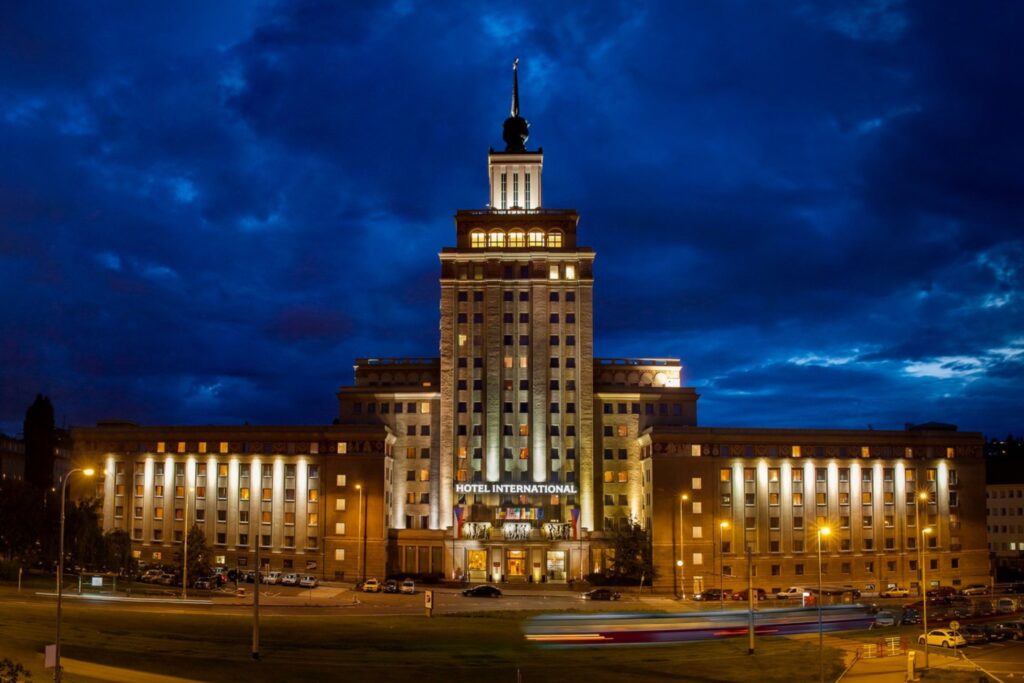
Architectural Style: Socialist Realism
If you head out to the Dejvice district, you’ll run straight into this massive building. It stands as a premier surviving example of Stalinist architecture left in the country.
They wrapped up the building work back in 1956. Originally, the whole point of the place was to give military officers and visiting foreign officials a place to stay. The designers took heavy cues from Moscow’s famous “Seven Sisters” skyscrapers. Because of that inspiration, it features a massive central tower, heavy decorative reliefs, and a perfectly symmetrical layout meant to show off the political presence of Communist Czechoslovakia.
Even with its heavy political backstory, a lot of people like checking it out today just to see the mid-century craftsmanship and the grand layout inside.
These days, the property still functions as a regular hotel, which has helped keep a lot of its original 1950s interior character completely intact.
What to look out for:
- The massive 88-meter central tower dominating the local skyline
- The large green star mounted at the very top of the spire
- The detailed reliefs and socialist art details carved onto the exterior
- The grand, symmetrical wings wrapping around the main entryway
A Quick Photo Tip:
For the best photos, stand out in the square during the late afternoon when the sun hits the front of the building directly.
19. Žižkov Television Tower
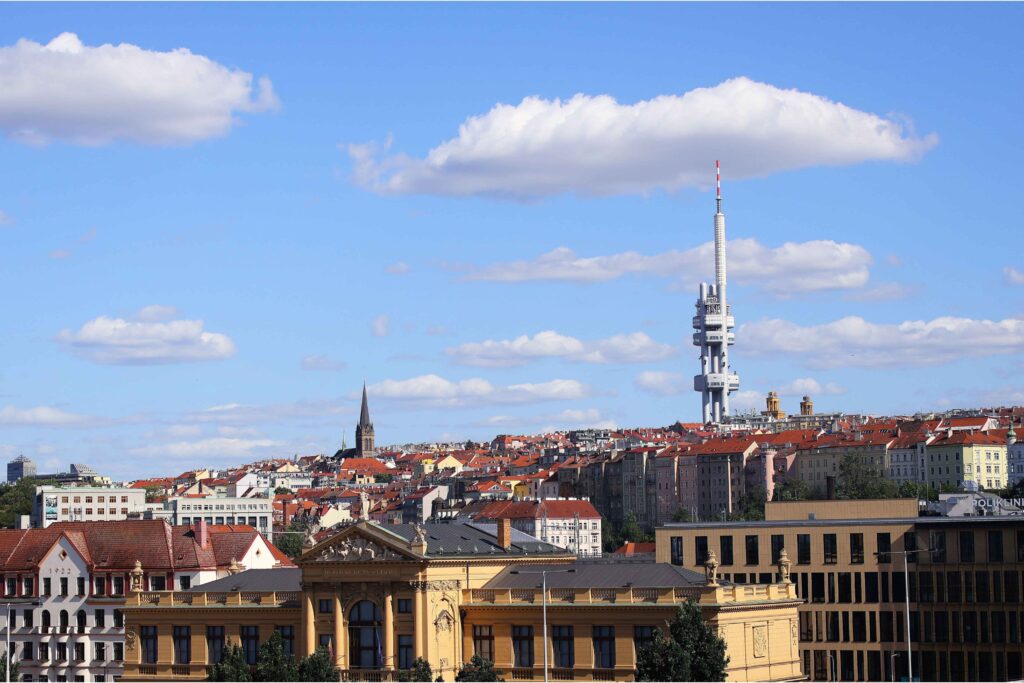
Architectural Style: Contemporary / High-Tech
Whether you think it looks cool or totally ugly, you really can’t miss this massive tower poking out of the horizon.
They wrapped up construction on the futuristic structure back in 1992. It reaches up 216 meters high, which officially makes it the tallest building structure you will see anywhere in the Czech Republic.
The look of the tower split opinion immediately upon completion. A lot of locals thought it was a complete eyesore that ruined the classic view of the city’s historic roofs. Eventually, though, it just became a normal part of the skyline that everyone knows.
Back in 2000, an artist named David Černý attached his famous giant crawling baby sculptures directly onto the structural pillars. That addition completely changed the vibe and made it a top spot for people to snap pictures.
If you head up inside, you can check out the panoramic observation decks, look at art exhibits, or even book a night inside a luxury hotel suite tucked way up near the clouds.
What to look out for:
- The creepy, giant baby sculptures crawling up the metal pillars
- The high observation deck offering a complete view over the city
- The futuristic pod layout that looks like a rocket launch pad
- The bright colorful lights illuminating the structure after dark
A Quick Photo Tip:
For the best photos, stand out in the square during the late afternoon when the sun hits the front of the building directly.
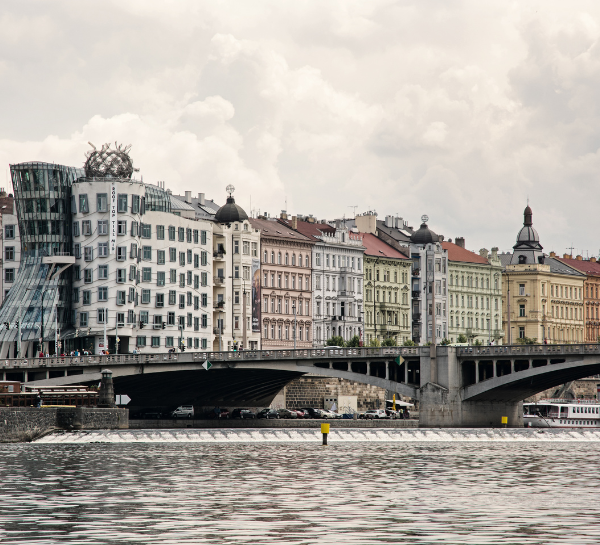
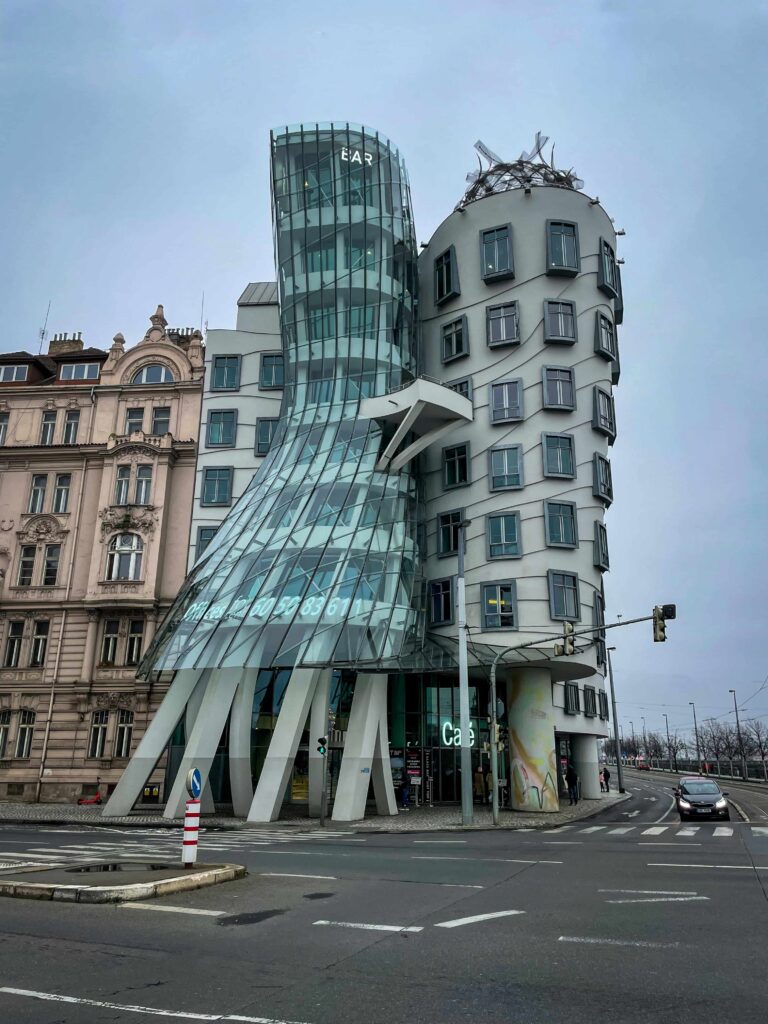
20. Dancing House
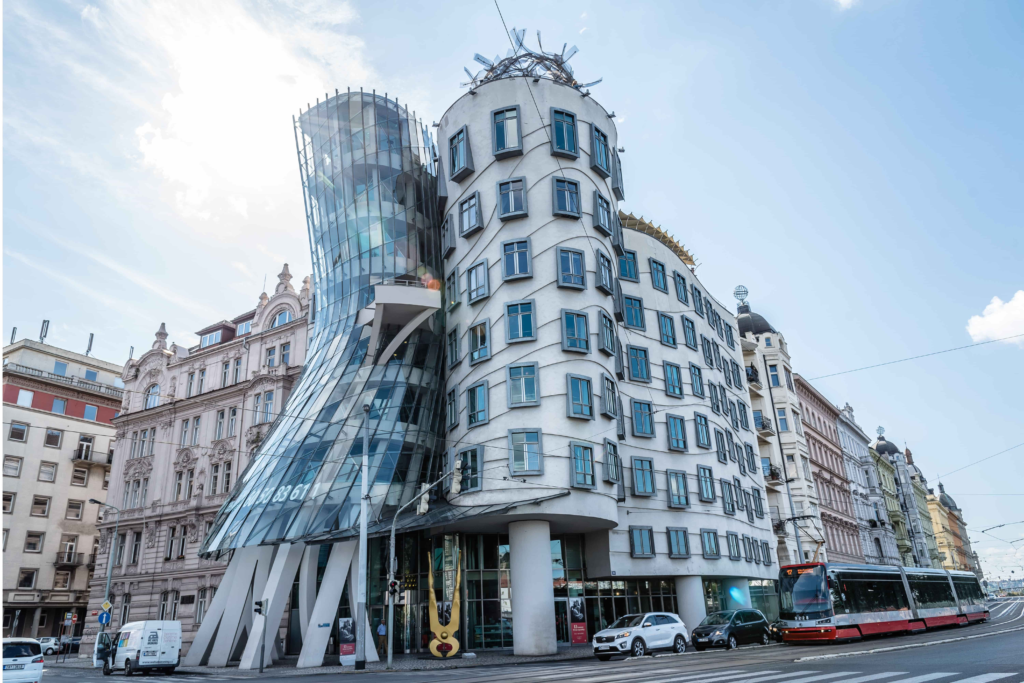
Architectural Style: Deconstructivism
When people think about modern design in the city, the Dancing House is usually the very first thing that comes to mind.
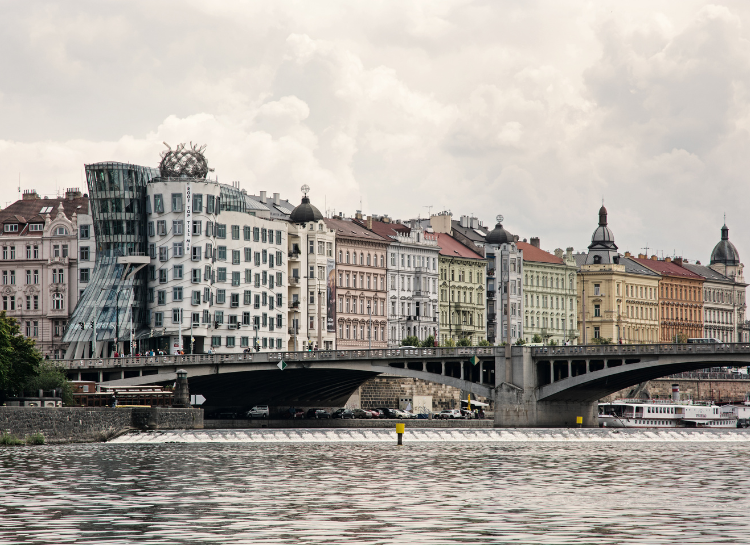
They wrapped up construction on the property back in 1996. The whole thing was designed by a pair of architects, Vlado Milunić and Frank Gehry, who wanted to build something that deliberately stood out from the historic neighborhoods around it.
The main glass tower twists inward and leans over the pavement, making it look like it’s actively moving next to the solid stone structure right beside it. Because of that twisting look, people started nicknaming the building “Fred and Ginger” after the famous Hollywood dance duo.
At first, the design started a ton of arguments among locals who didn’t want modern shapes messing up the riverfront. But over the years, the building completely won people over.
Most of the interior is actually used for office space today, but you can head inside to visit an art gallery, eat at a restaurant, or head out onto the rooftop deck to get a great look at the Vltava River and the castle.
What to look out for:
- The twisting, curved glass facade that mimics a dancer in motion
- The uneven window layouts lining the concrete tower beside the glass
- The massive, tangled metal mesh sculpture mounted right on the roof
- The heavy pillars at ground level supporting the leaning glass front
A Quick Photo Tip:
For the best photos, stand out in the square during the late afternoon when the sun hits the front of the building directly.
21. Masaryčka
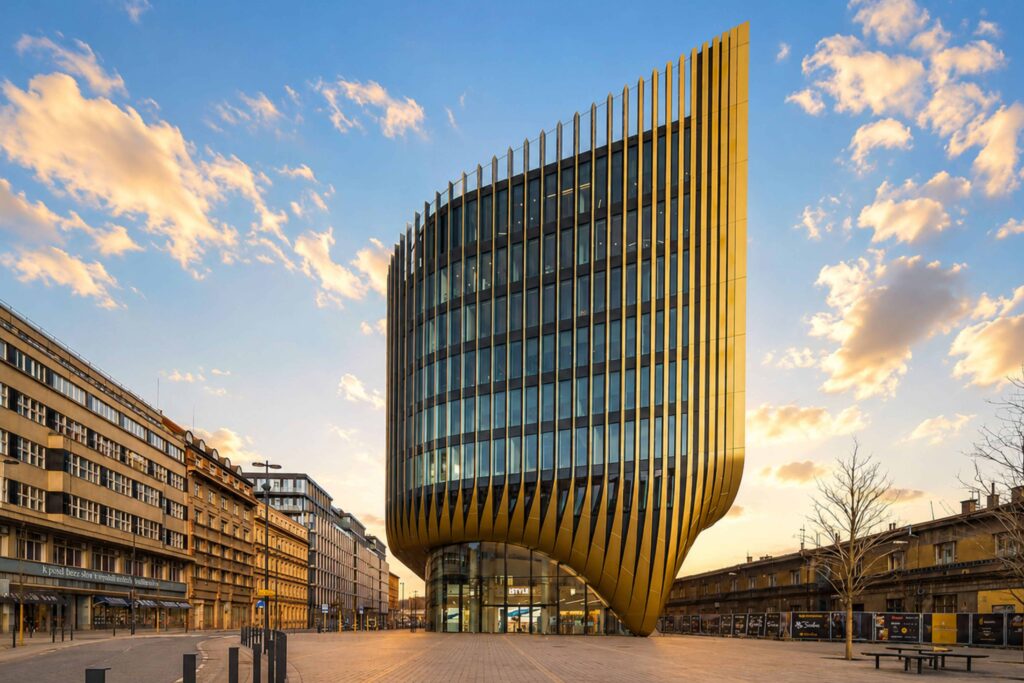
Architectural Style: Contemporary
This place just opened up in 2023, so it’s fresh on the city’s timeline.
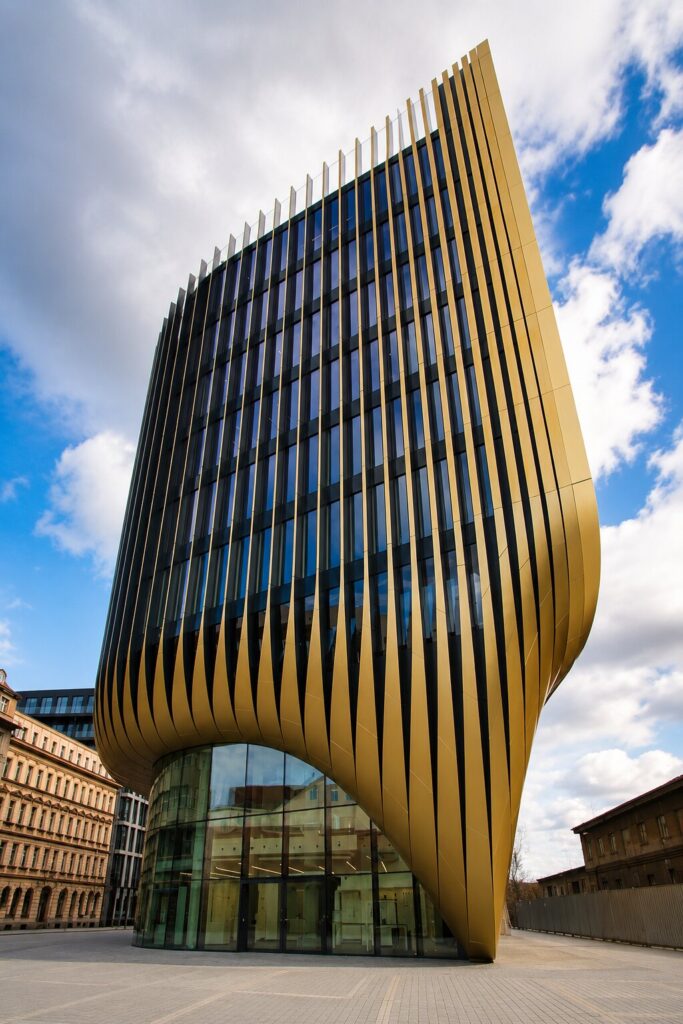
The famous design team over at Zaha Hadid Architects drew up the plans for Masaryčka. They took the rough, neglected area right around the old Masaryk Railway Station and completely flipped it into a highly modern business district.
Honestly, you can’t miss the massive golden front facade. They used thousands of custom aluminum fins that catch the daylight differently depending on what time you walk past. The whole curved, aerodynamic shape of the tower is actually meant to mimic the flow of the train tracks running right next to it.
It’s a great example of how the city is willing to embrace really futuristic, wild designs instead of just getting stuck in the past.
Inside the actual complex, they packed in standard offices alongside a bunch of shops, cafés, and new pedestrian walkways that finally make it easy to walk straight between Old Town, Florenc, and Karlín.
What to look out for:
- The massive golden aluminum fins sweeping up the front facade
- The curving, aerodynamic building shape modeled after train tracks
- The new pedestrian plazas connecting the surrounding neighborhoods
- The sharp contrast between the futuristic glass and the old railway hub
A Quick Photo Tip:
For the best photos, stand out in the square during the late afternoon when the sun hits the front of the building directly.
22. DRN Building
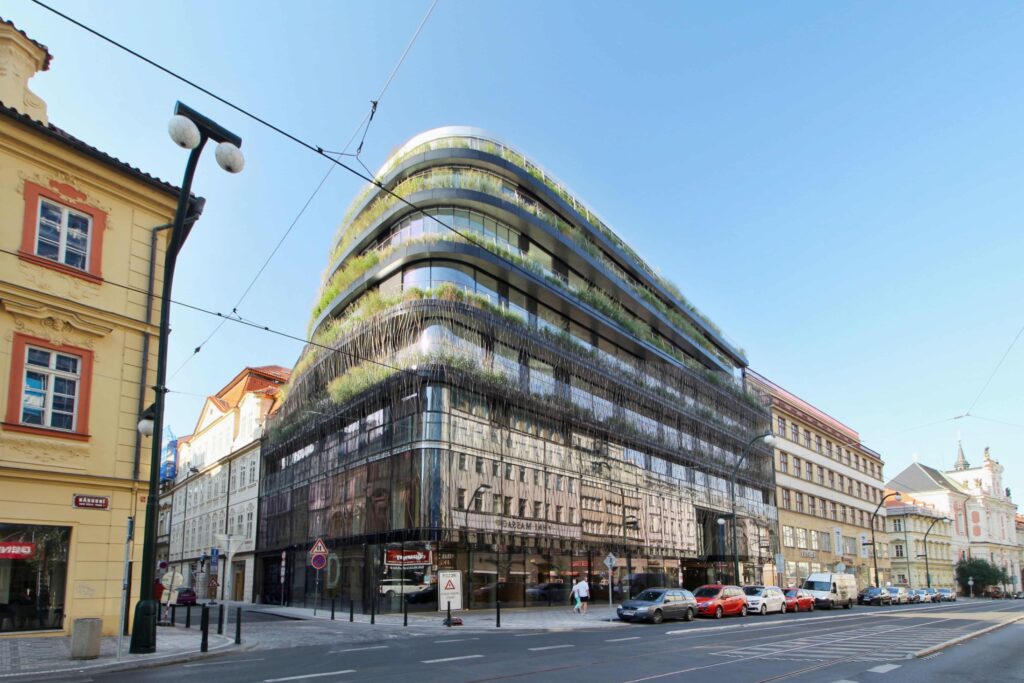
Architectural Style: Contemporary
You can find the DRN Building on Národní Street, and it’s a great example of a modern design that doesn’t clash with the older neighborhood.
Construction wrapped up fairly recently in 2018. The project basically took an old, ignored empty lot and built a completely eco-friendly retail and office hub while safely keeping the historic Baroque palace next door fully intact.
A local architect named Stanislav Fiala drew up the blueprints. The architect didn’t just stick to basic concrete. He used big curved glass panels, open metal beams, and tons of actual living plants across the exterior walls. It sits right alongside properties that are hundreds of years old without looking like a total mismatch.
The word “DRN” literally translates to “turf” or “grass” in Czech. That name is pretty accurate since the builders covered the outer terraces and balconies in tons of trees and climbing shrubs.
Inside, the property handles standard office spaces alongside multiple public spots, which has done a lot to bring some fresh energy back to one of the busiest streets in town.
What to look out for:
- The living green walls and trees growing right out of the upper balconies
- The massive, sweeping curved glass windows wrapping around the street corner
- The exposed steel framing used across the outer structure
- The way the modern roofline blends smoothly with the old palace next door
A Quick Photo Tip:
For the best photos, stand out in the square during the late afternoon when the sun hits the front of the building directly.
23. DOX Centre for Contemporary Art
Architectural Style: Contemporary
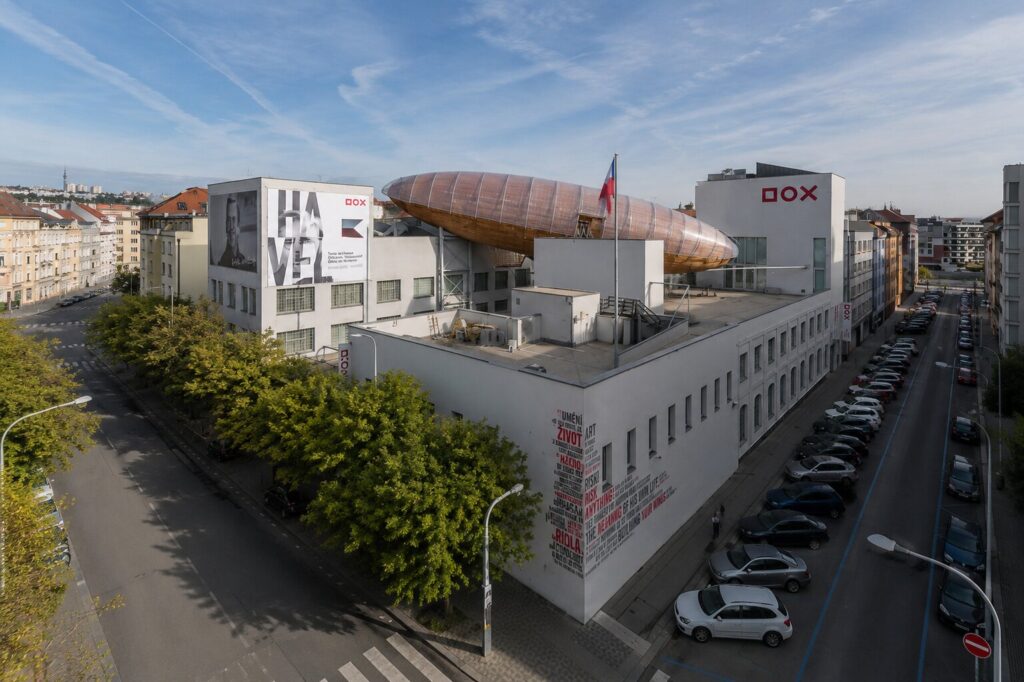
If you head out to the old industrial neighborhood of Holešovice, you will find the DOX Centre for Contemporary Art. This place is a prime example of how the city takes old, historic factory walls and completely flips them for the modern era.
They opened the doors back in 2008 inside an old factory complex that was completely converted. Instead of just knocking down the old industrial buildings, the design teams decided to leave them standing and stitch them together with fresh additions made from raw concrete, heavy steel, and massive glass sheets.
The real showstopper here, and what most people know it for, is Gulliver. It is a massive wooden airship structure that looks like it is floating directly over the rooftops. An architect named Martin Rajniš designed the giant ship, and it has easily become one of the most unusual sights in the local skyline.
You’ll find something completely different every time you visit since they change up the art and photography shows all the time. If you like mixing history with some of the more interactive experiences around town, take a look at our full list of fun things to do in Prague for some great ideas.
What to look out for:
- The massive Gulliver wooden airship suspended right above the roofline
- The raw industrial textures of the old factory brickwork mixed with concrete
- The open-air rooftop terraces that connect the different gallery sections
- The experimental design layouts inside the main exhibition halls
A Quick Photo Tip:
For the best photos, stand out in the square during the late afternoon when the sun hits the front of the building directly.
24. Emmaus Monastery
Architectural Style: Gothic & Modern
If you are looking for a spot that completely sums up the unique timeline of Prague Architecture, this is absolutely it.
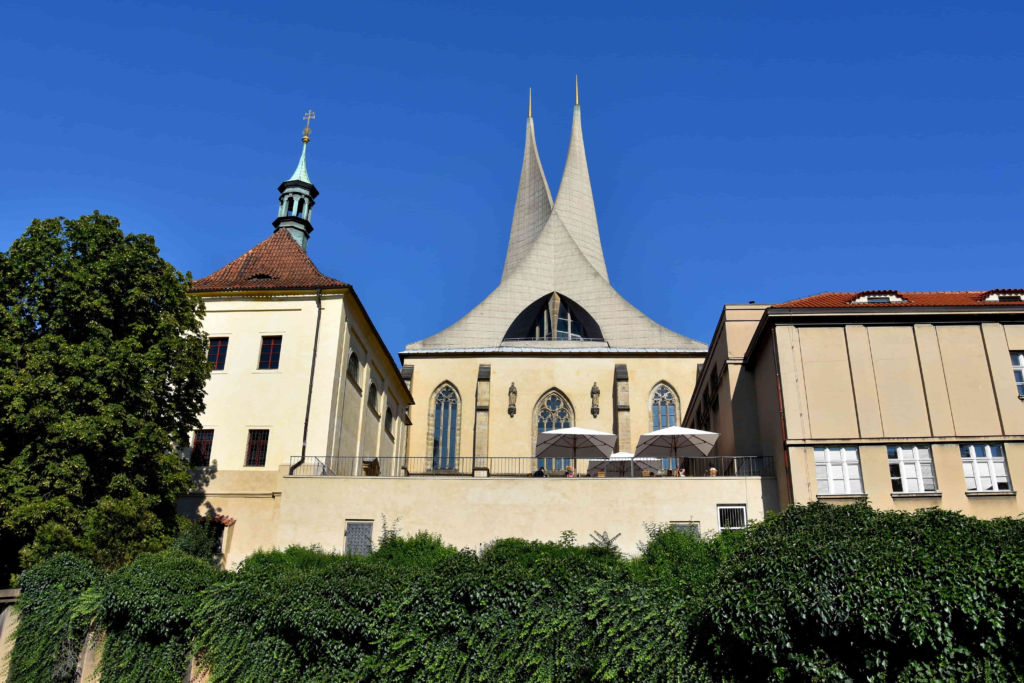
The history of the Emmaus Monastery stretches all the way back to 1347, when Emperor Charles IV first set it up as a classic Gothic site. But during World War II, a massive Allied bombing raid heavily damaged the main church building and completely knocked down the original twin stone towers.
When it came time to fix the damage in the 1960s, the design teams did something totally unexpected. Instead of copying the old medieval blueprint, they slapped two futuristic white concrete spires right on top of the ancient stone walls.
Because of their sweeping, curved look, locals quickly nicknamed them the “angel wings.” It’s a great example of how the city isn’t afraid to let completely different centuries live right on top of each other in the exact same building.
A lot of tourists walk up to the property thinking they are looking at a purely modern 20th-century church, only to walk through the doors and find out that the actual Gothic monastery underneath is nearly 700 years old.
What to look out for:
- The futuristic concrete “angel wings” spires mounted on the roofline
- The beautiful 14th-century Gothic frescoes preserved inside the cloister walkways
- The contrast between the raw modern concrete and the ancient stonework
- The quiet, peaceful terrace gardens looking down toward the riverfront
A Quick Photo Tip:
For the best photos, stand out in the square during the late afternoon when the sun hits the front of the building directly.
25. Jubilee Synagogue
Architectural Style: Moorish Revival & Art Nouveau
While most people look for historic houses of worship inside Prague’s Jewish Quarter, the biggest synagogue in the city sits just outside that historic core.
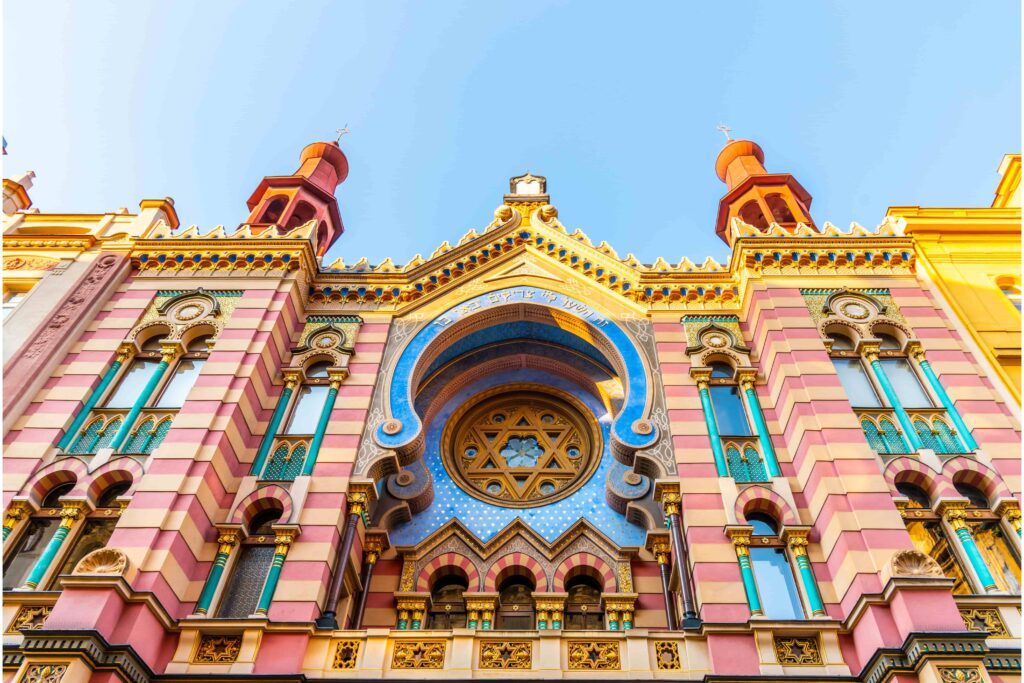
They finished building the Jubilee Synagogue back in 1906. The architects mixed intense, colorful Moorish Revival layouts with highly detailed Art Nouveau decorations, making it easily one of the most vibrant pieces of design you’ll run across in the entire city.
The exterior immediately jumps out at you with its bright red-and-white striped walls, huge decorative arches, and intricate stained-glass panels. It looks entirely different from any other religious building around here.
Unlike the older synagogues tucked away in Josefov, this place still operates as a regular, active house of worship today, though they are completely happy to welcome tourists inside to explore the local history.
Once you step through the doors, you’ll find incredibly deep wall paintings, rich ornamental layouts, and a handful of permanent historical exhibits tracking the life of the local community over the years.
What to look out for:
- The intense red-and-white striped patterns running across the front walls
- The huge central Islamic-style horseshoe arch framing the main rose window
- The brilliantly colorful, geometric stained glass filling the window frames
- The gold-leaf decorations and blue star patterns covering the interior ceiling
A Quick Photo Tip:
If you go early, you can catch the morning daylight coming right through the glass to see the colors light up the floor.
How David Černý Changed Prague’s Cityscape
The city’s design scene isn’t just about static historic buildings. A contemporary artist named David Černý has completely flipped multiple public plazas on their head with wild public sculptures that completely shake up the traditional Prague Architecture backdrop.
His sculptures became famous landmarks on their own and really alter the look of regular street corners.
Kafka Head
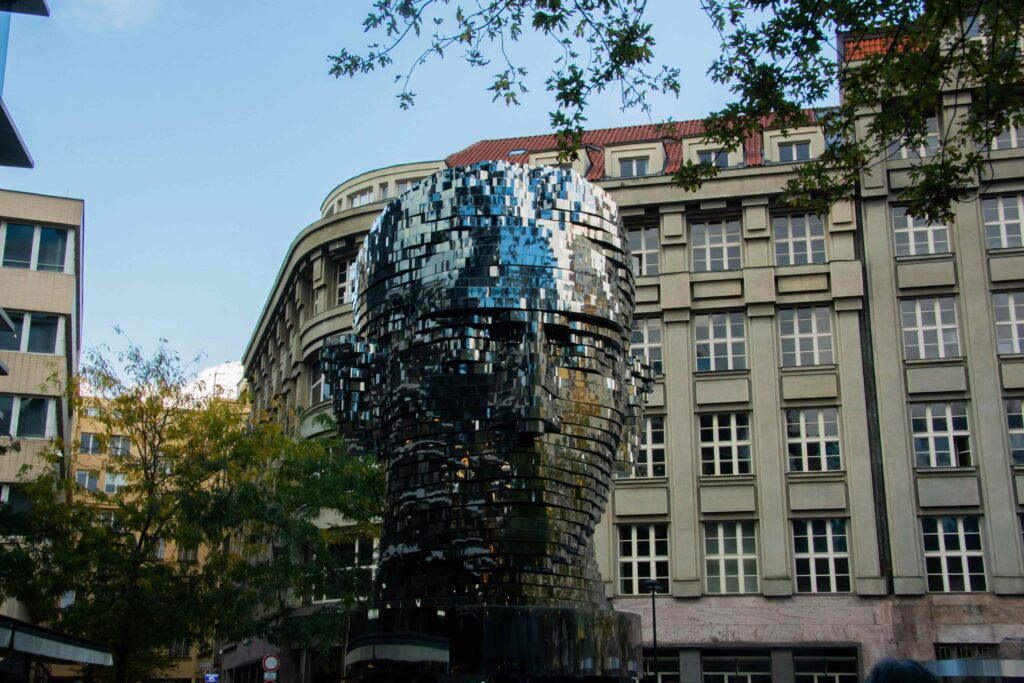
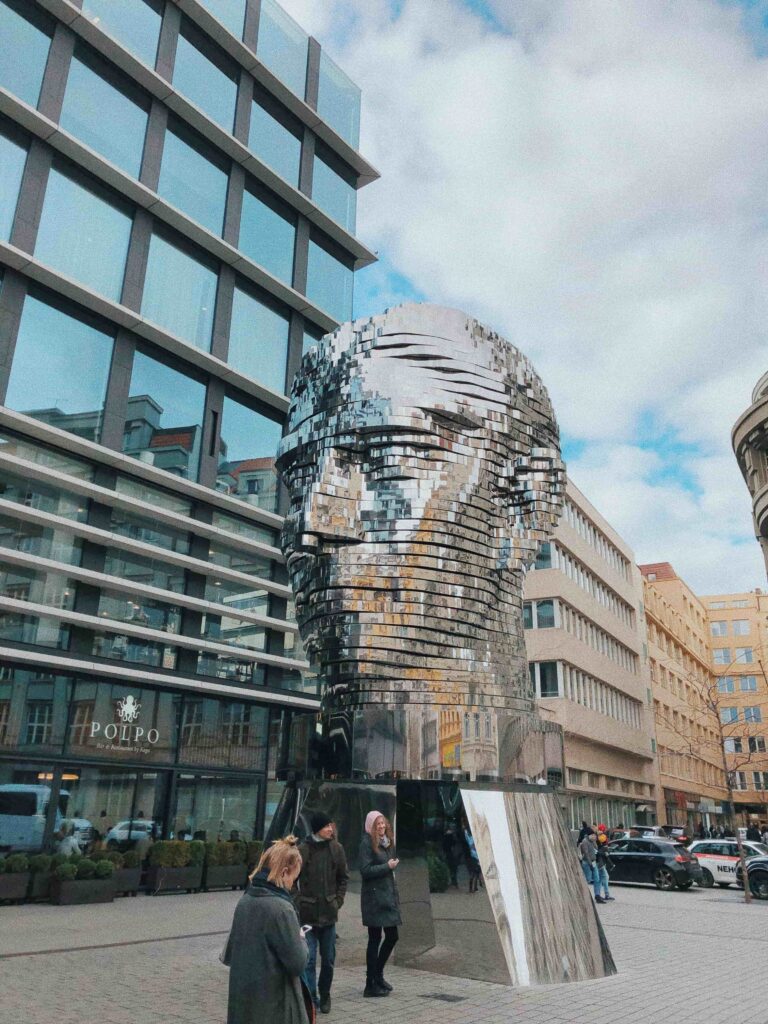
If you pull up right outside the Quadrio shopping center, you’ll run straight into this massive, 11-meter kinetic installation. The whole thing is made out of 42 separate layers of shiny stainless steel stacked right on top of each other.
The steel slices twist around separately on a timer. They scramble the image for a bit, then come together to make Franz Kafka’s face.
Because it’s constantly moving and shifting, it has easily become a major hotspot for people looking to capture unique video clips and photos.
Best time to visit:
Head over here right after the sun goes down, because they turn on a bright lighting layout that makes the metal layers stand out completely against the dark buildings.
Žižkov Babies
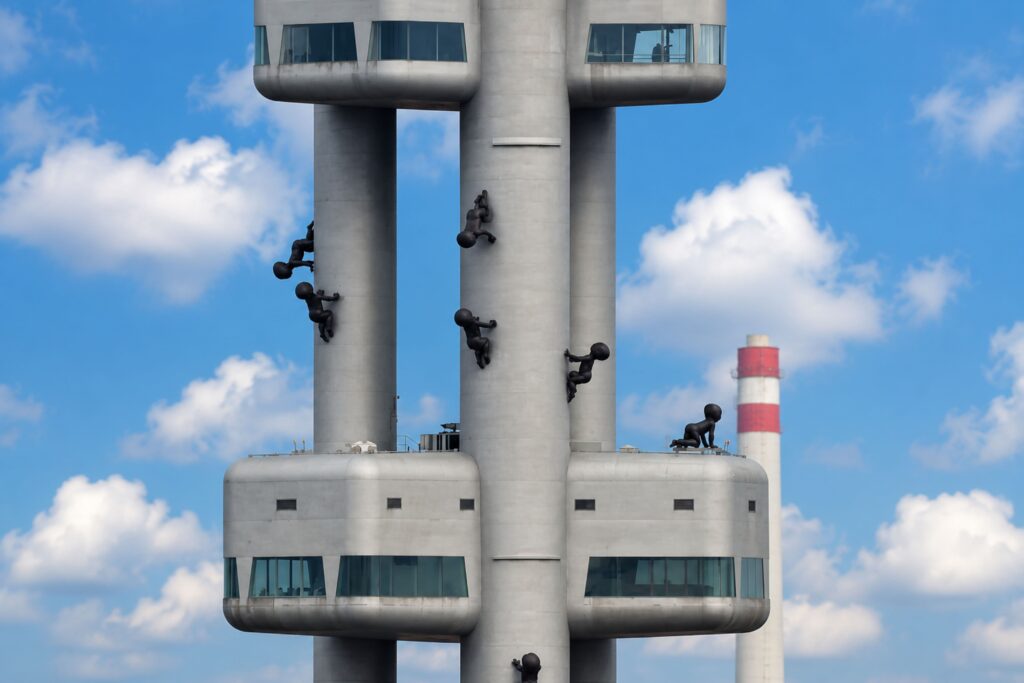
These giant crawling babies first showed up on the side of the Žižkov Television Tower back in 2000.
Instead of having normal faces, every single baby sculpture has a strange barcode-like slot smashed into its head. It stands out as a completely bizarre piece of Prague architecture history and easily ranks among the most unusual art displays in town.
Best time to visit:
Walk by the tower at night when they turn on the colorful spotlights. The lighting casts huge, dramatic shadows from the babies across the concrete structure.
Hanging Man
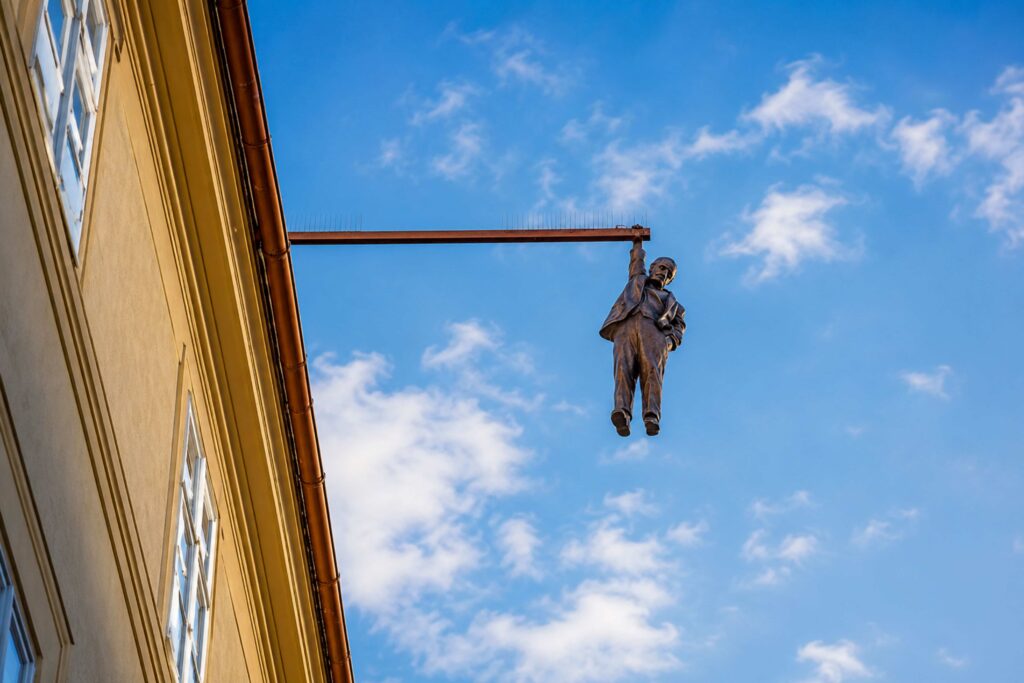
If you find yourself walking down Husova Street, make sure you don’t forget to look straight up.
Officially titled Man Hanging Out, this famous sculpture shows Sigmund Freud dangling casually from one hand way above the roadway. It is easily one of the strangest pieces of Prague architecture you will stumble across while wandering around the Old Town.
The installation is so realistic that tons of people walking by for the first time look up, completely panic, and think they are seeing a real person in trouble before they actually figure out it’s just an art piece.
Best time to visit:
Try to pass by during the middle of the day when the clear blue sky sits right behind the figure. That way, you get a clean shot against the sky, which makes the fake guy look completely real.
St. Wenceslas Ridding Upside Down Horse
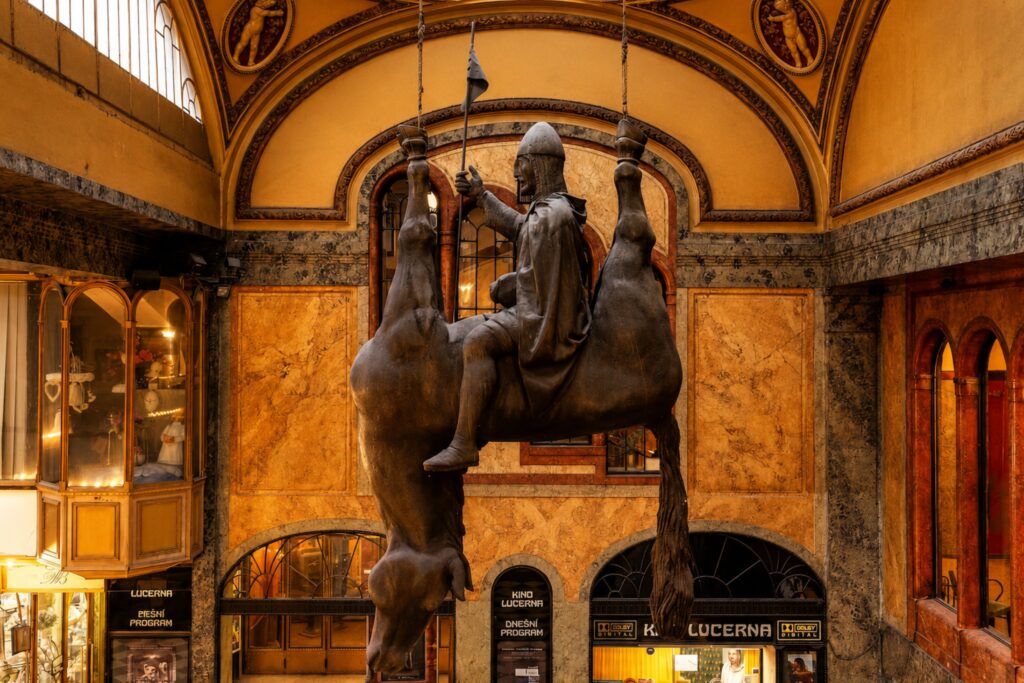
If you wander inside the beautiful art nouveau passage of Lucerna Palace, you’ll run straight into one of the most bizarre art pieces in the city center.
Suspended directly from the ceiling dome, this huge installation shows Saint Wenceslas sitting casually on top of an upside-down, dead horse. It serves as David Černý’s sharp, satirical take on the famous historic equestrian monument standing just a short walk away in Wenceslas Square. It’s easily one of the most memorable pieces of modern Prague architecture you can track down indoors.
Best time to visit:
You can stop by anytime during the arcade’s opening hours. Try to grab a spot at the ground-floor cafe right underneath the sculpture to get a great angle looking directly up at the horse.
Butterfly Effect RAF planes
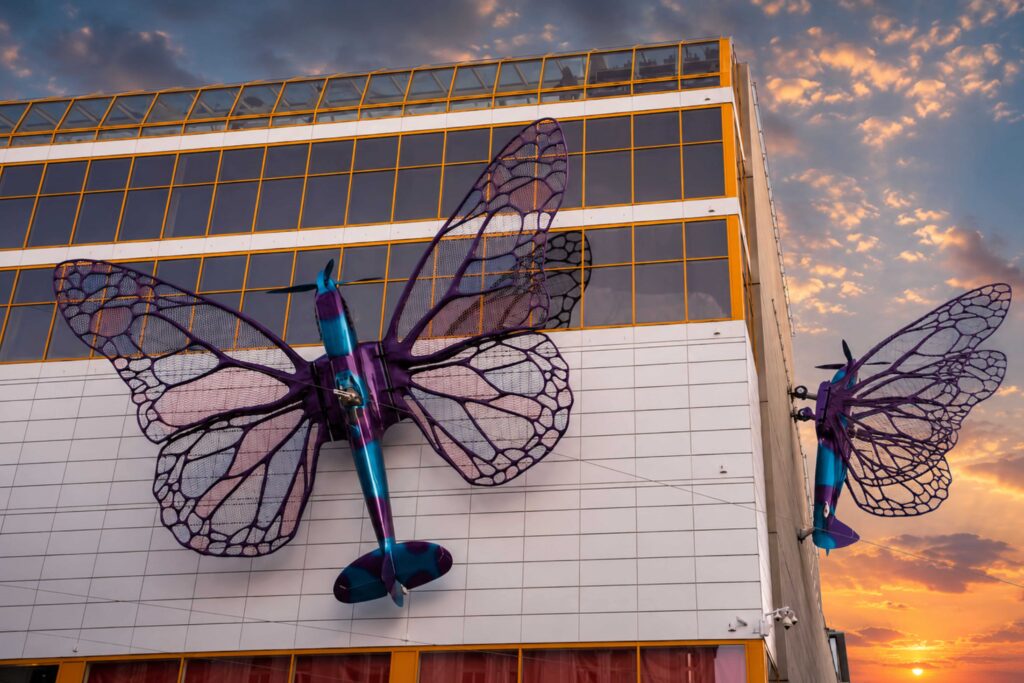
If you look up at the facade of the newly renovated Máj department store, you’ll see one of the newest and most talked-about art pieces in the city center.
Officially named Butterfly Effect, this massive installation features two huge Spitfire fighter aircraft mounted directly onto the side of the building. The bodies of the planes are painted in vibrant, iridescent purple and blue shades, and their wings are split open to look exactly like giant butterfly wings. It adds a completely wild, modern twist to the surrounding Prague architecture landscape.
It actually remembers the Czech pilots from the Royal Air Force in WWII, turning old war history into a giant art piece.
Best time to visit:
Try to pass by just before sunset. The changing evening light hits the metallic paint on the planes perfectly, making the shifting purple and blue colors pop way more than they do during the middle of the day.
Lilith Statue
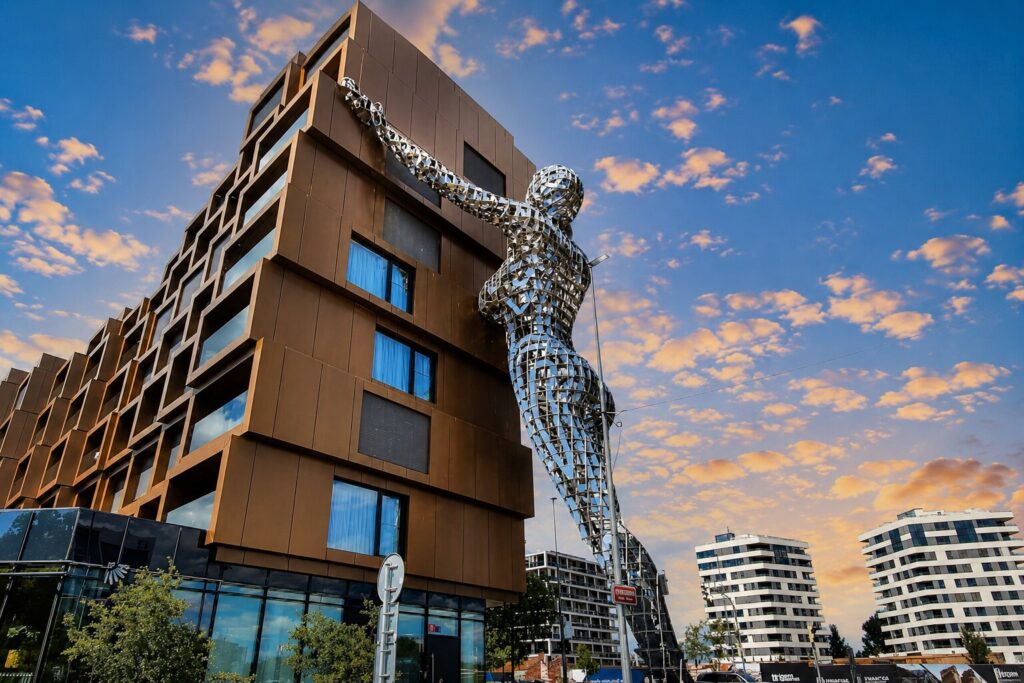
If you check out the Fragment residential complex over in Karlín, you will run straight into this massive sculpture.
Known as Lilith, this giant installation shows a massive female figure made out of polished steel mesh that looks like she is leaning directly against the corner of the building.
Because of where they put it, the sculpture stands out immediately from the street and has quickly become a major hotspot for anyone looking to track down modern landmarks in the area.
Best time to visit:
Try to pass by in the late afternoon when the sun hits the metal mesh directly. The polished steel reflects the changing light, which gives you a great look for pictures before it gets dark.
Prague Architecture Styles Explained
Honestly, the main reason the historic center feels so unique is that almost every major European design movement is packed into its streets. Instead of tearing down old buildings to clear space for the next trend, each generation just built right alongside what was already there. This hands-off habit left behind a city where close to a thousand years of design history coexist perfectly.
Romanesque (10th–12th Century)
This style takes you straight back to the city’s earliest days as a fortified medieval outpost. The look relies entirely on heavy, functional construction. The structures use thick stone and basic circular archways across the design. On top of that, the windows are tiny and narrow, looking a lot like regular castle slots.
Best examples:
- Basilica of St. George
- Rotunda of St. Martin
- Rotunda of the Holy Cross
Gothic (13th–15th Century)
Prague’s Gothic era boomed during the rule of Emperor Charles IV, which is exactly when the city transformed into the capital of the Holy Roman Empire. The design style completely ditched the basic Romanesque look and went all-in on high-drama shapes.
The standouts of this movement are the sharp, pointed arches, massive spires reaching into the sky, crisscrossed stone vaults, and dark, detailed stone carvings that give the buildings an incredibly intense look.
Best examples:
- St. Vitus Cathedral
- Church of Our Lady before Týn
- Powder Tower
- Old Town Bridge Tower
Renaissance (16th Century)
This era was all about copying what was popular in Italy at the time. Builders completely dropped the dark, spooky look of the Middle Ages. Instead, they switched to straight lines, matching side layouts, basic pillars, and tidy open courtyards that give the properties a very clean, spacious look.
Best examples:
- Belvedere Summer Palace
- Schwarzenberg Palace
Baroque (17th–18th Century)
Once the Battle of White Mountain ended, a completely new wave of building design took over the city. It was the ultimate era of showing off. Designs from this time focused entirely on huge scales, giant roof domes, and lots of gold decoration.
Best examples:
- St. Nicholas Church
- Wallenstein Palace
- Clementinum
- Loreto
Art Nouveau
Right at the start of the 1900s, a totally new look took over the streets. Designers walked away from stiff, old-fashioned layouts and started using smooth wavy lines, plant-like shapes, detailed mosaic walls, and very colorful stained glass windows instead.
Best example:
- Municipal House
Cubism
This is a pretty unique chapter because Prague is literally the only spot on Earth where Cubism left the canvas and turned into a real, physical building movement. Everything here uses sharp points and boxy shapes that jump right out at you.
Best examples:
- House of the Black Madonna
- Grand Café Orient
Functionalism
This trend was basically the exact opposite of fancy. Designers completely threw out all the pointless decorations, extra trim, and colorful details. For them, it was all about using raw, simple materials to build something flat and highly practical that just did its job.
Best example:
- Villa Müller
Communist Architecture
Buildings from this era were all about making a huge statement. The Soviet-era planners didn’t do subtle. They just built things on a giant scale with matching sides to make the structures look as powerful as possible.
Best examples:
- Hotel International
- Žižkov Television Tower
Contemporary Architecture
These days, the city keeps pushing things forward with eco-friendly setups, massive glass layouts, and some really daring geometric shapes.
Best examples:
- Dancing House
- Masaryčka
- DRN Building
- DOX Centre for Contemporary Art
Prague Architecture by District
A great way to get a handle on the local design scene is to just wander through the city neighborhood by neighborhood. Every separate district gives you a clear window into a completely different era of the city’s past.
Prague Castle (Hradčany)
This massive hilltop site packs close to a full millennium of building history right inside a single compound.
Don’t miss:
- St. Vitus Cathedral
- Basilica of St. George
- Old Royal Palace
- Schwarzenberg Palace
- Belvedere Summer Palace
Main styles:
- Romanesque
- Gothic
- Renaissance
Lesser Town (Malá Strana)
Lesser Town is Prague’s Baroque masterpiece. Elegant palaces, churches, and gardens fill its quiet streets beneath Prague Castle.
Don’t miss
- St. Nicholas Church
- Wallenstein Palace
- Loreto
Main styles
- Baroque
- Renaissance
Old Town (Staré Město)
Old Town combines medieval Prague with the city’s early twentieth-century artistic revolution.
Don’t miss
- Church of Our Lady before Týn
- Powder Tower
- Municipal House
- House of the Black Madonna
- Grand Café Orient
Main styles
- Gothic
- Art Nouveau
- Cubism
New Town (Nové Město)
Founded by Charles IV in the fourteenth century, New Town now showcases Prague’s architectural evolution from the nineteenth century to today.
Don’t miss
- Dancing House
- DRN Building
- National Theatre
Main styles
- Neo-Renaissance
- Contemporary
Holešovice
Once an industrial suburb, Holešovice has transformed into Prague’s creative district.
Don’t miss
- DOX Centre for Contemporary Art
Nearby you’ll also find modern galleries, cafés, and innovative architecture.
Karlín
Karlín is one of Prague’s fastest-changing neighborhoods and a showcase for modern urban regeneration.
Don’t miss
- Masaryčka
- Contemporary office buildings
- Restored industrial architecture
Can You Go Inside These Prague Architecture Landmarks?
| Building | Interior Open? | Worth Going Inside? |
|---|---|---|
| St. Vitus Cathedral | Yes | Extraordinary |
| Basilica of St. George | Yes | Excellent |
| Old Royal Palace | Yes | Excellent |
| Belvedere Summer Palace | Seasonal | Excellent |
| Schwarzenberg Palace | Yes | Excellent |
| Church of Our Lady before Týn | Limited | Excellent |
| Powder Tower | Yes | Extraordinary |
| Old Town Bridge Tower | Yes | Extraordinary |
| Municipal House | Guided Tours | Extraordinary |
| House of the Black Madonna | Yes | Extraordinary |
| Grand Café Orient | Yes | Excellent |
| National Theatre | Guided Tours | Excellent |
| St. Nicholas Church | Yes | Extraordinary |
| Clementinum | Guided Tours | Extraordinary |
| Wallenstein Palace | Gardens Only | Excellent |
| Loreto | Yes | Excellent |
| Villa Müller | Reservation Required | Extraordinary |
| Hotel International Prague | Yes | Good |
| Žižkov Television Tower | Yes | Extraordinary |
| Dancing House | Yes1 | Extraordinary |
| Masaryčka | No | Good (Exterior Only) |
| DRN Building | No | Good (Exterior Only) |
| DOX Centre for Contemporary Art | Yes | Extraordinary |
| Emmaus Monastery | Yes | Excellent |
| Jubilee Synagogue | Yes | Excellent |
Hidden Gems of Prague Architecture
While Prague’s famous landmarks deserve their reputation, several lesser-known sites are equally rewarding.
- Rotunda of St. Martin
- Rotunda of the Holy Cross
- Cubist Lamp Post
- Church of the Most Sacred Heart of Our Lord
- Invalidovna
- New Stage of the National Theatre
- Klementinum Mirror Chapel
- Karlín Negrelli Viaduct
These hidden gems reveal another side of Prague that many visitors never discover.
Best Self-Guided Prague Architecture Walk
If you only have one day in Prague, this self-guided walking route covers the city’s most iconic architectural landmarks while following a logical path through the historic center. You’ll experience nearly every major architectural style, from Romanesque and Gothic to Art Nouveau, Cubism, and contemporary design.
Getting Around Tip: Most of this route is walkable, but if you want to skip sections or start at Prague Castle, the Prague metro and trams make it easy. Check which Prague attractions you can reach by metro, and don’t forget to validate your tram tickets or bus tickets to avoid fines.
Suggested Walking Route
- Start at Prague Castle
- St. Vitus Cathedral
- Basilica of St. George
- Old Royal Palace
- Schwarzenberg Palace
- Belvedere Summer Palace
- Walk to Loreto
- Admire one of Prague’s finest Baroque pilgrimage sites.
- Continue to Wallenstein Palace
- Explore its magnificent gardens and Early Baroque architecture.
- Cross Charles Bridge
- Enjoy panoramic views of the Vltava River and Prague Castle.
- Climb the Old Town Bridge Tower
- One of Europe’s finest Gothic gateway towers.
- Visit the Church of Our Lady before Týn
- The iconic twin-spired church overlooking Old Town Square.
- Explore the House of the Black Madonna
- The world’s most famous Cubist building.
- Admire Municipal House
- Prague’s greatest Art Nouveau masterpiece.
- Walk to the National Theatre
- A symbol of Czech culture and Neo-Renaissance architecture.
- Finish at the Dancing House
- Prague’s world-famous modern architectural icon.
- Optional Extension
- Continue to Kafka Head at Quadrio Shopping Center and Masaryčka to experience Prague’s newest contemporary architecture.
Walking Information
- Distance: Approximately 8 km (5 miles)
- Walking Time: Around 3–4 hours (excluding interior visits)
- Recommended Duration: Allow a full day if you plan to visit several interiors, museums, or enjoy breaks at cafés along the way.
Prague Architecture Frequently Asked Questions
St. Vitus Cathedral is the most famous building in Prague. Located within Prague Castle, this Gothic masterpiece is known for its soaring towers, stained-glass windows, royal tombs, and panoramic views from the Great South Tower.
Prague features Romanesque, Gothic, Renaissance, Baroque, Art Nouveau, Cubism, Functionalism, Communist-era, and Contemporary architecture. Few European cities preserve such a wide variety of architectural styles within a compact historic center.
Yes. Prague’s Historic Centre has been a UNESCO World Heritage Site since 1992 thanks to its exceptional collection of medieval, Renaissance, Baroque, and modern architecture that has remained remarkably well preserved.
Prague is the only city in the world where Cubism became a true architectural style. Buildings like the House of the Black Madonna and Grand Café Orient showcase distinctive geometric façades and angular designs found nowhere else.
Yes. Prague combines historic landmarks with contemporary architecture, including the Dancing House, Masaryčka, DRN Building, DOX Centre for Contemporary Art, and the Žižkov Television Tower.
One day is enough to see Prague’s architectural highlights on a self-guided walk. To explore interiors, museums, and hidden gems at a relaxed pace, plan two to three days.
Why Prague Architecture Is Unlike Anywhere Else
Few cities in the world preserve such an extraordinary architectural journey. In just one day, you can stand inside a thousand-year-old Romanesque church, admire the soaring Gothic towers of Prague Castle, wander through elegant Baroque palaces, sip coffee inside a Cubist masterpiece, and finish the evening watching the sunset from the Dancing House.
This remarkable blend of history and innovation is what makes Prague far more than a beautiful city, it is one of Europe’s greatest open-air architectural museums. Whether you’re a first-time visitor, a history enthusiast, or an architecture lover, exploring Prague’s buildings offers a deeper understanding of the city’s past, present, and future.
The next time you walk through Prague’s streets, look beyond the famous landmarks. Notice the carved façades, hidden courtyards, decorative balconies, colorful mosaics, and modern additions that quietly tell the story of a city that has spent nearly a thousand years reinventing itself without ever forgetting its roots. That’s what makes Prague architecture one of the world’s most unforgettable urban experiences.